

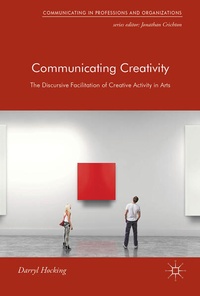
Communicating Creativity
The Discursive Facilitation of Creative Activity in Arts
Published on 24. October 2017
Book
Hardback
XII, 307 pages
978-1-137-55803-9 (ISBN)
Description
This book provides an extensive and original analysis of the way that written and spoken communication facilitates creative practice in the university art and design studio. Challenging the established view of creativity as a personal attribute which can be objectively measured, the author demonstrates instead that creativity and creative practice are constructed through a complex array of intersecting discourses, each shaped by wider socio-historical contexts, beliefs and values. The author draws upon a range of methods and resources to capture this dynamic complexity from corpus linguistics to ethnography and multimodal analysis. This innovative volume will appeal to students and scholars of discourse analysis, creativity, and applied linguistics. It will also appeal to art and design educators.
Reviews / Votes
"This is a welcome addition for novices to discourse analyses in art and design fields." (Gavin Melles, Discourse & Communication, Vol. 13 (1), 2019)
More details
Series
Edition
2018 ed.
Language
English
Place of publication
London
United Kingdom
Target group
Professional and scholarly
Illustrations
11 s/w Abbildungen, 1 farbige Abbildung
XII, 307 p. 12 illus., 1 illus. in color.
Dimensions
Height: 216 mm
Width: 153 mm
Thickness: 22 mm
Weight
528 gr
ISBN-13
978-1-137-55803-9 (9781137558039)
DOI
10.1057/978-1-137-55804-6
Schweitzer Classification
Other editions
Additional editions
E-Book
10/2017
1st Edition
Palgrave Macmillan
€96.29
Available for download
Person
Darryl Hocking
is Senior Lecturer at Auckland University of Technology, New Zealand. His research focuses on the interactional genres and communicative practices in art and design settings and how these impact on creative activity. He received his PhD in Linguistics from Macquarie University and a Bachelor of Fine Arts from Auckland University.
Content
Chapter 1. Introduction.- Chapter 2. Investigating Communication in Creative Practice.- Chapter 3. Work.- Chapter 4. Agency.- Chapter 5. Motivation.- Chapter 6. Exploration.- Chapter 7. Ideas.- Chapter 8. Identity.- Chapter 9. Professional Practice.- Chapter 10. Conclusion.