

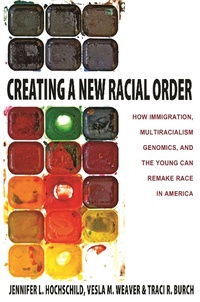
Creating a New Racial Order
How Immigration, Multiracialism, Genomics, and the Young Can Remake Race in America
Published on 23. February 2014
Book
Paperback/Softback
280 pages
978-0-691-16093-1 (ISBN)
Description
The American racial order--the beliefs, institutions, and practices that organize relationships among the nation's races and ethnicities--is undergoing its greatest transformation since the 1960s. Creating a New Racial Order takes a groundbreaking look at the reasons behind this dramatic change, and considers how different groups of Americans are being affected. Through revealing narrative and striking research, the authors show that the personal and political choices of Americans will be critical to how, and how much, racial hierarchy is redefined in decades to come. The authors outline the components that make up a racial order and examine the specific mechanisms influencing group dynamics in the United States: immigration, multiracialism, genomic science, and generational change. Cumulatively, these mechanisms increase heterogeneity within each racial or ethnic group, and decrease the distance separating groups from each other. The authors show that individuals are moving across group boundaries, that genomic science is challenging the whole concept of race, and that economic variation within groups is increasing.
Above all, young adults understand and practice race differently from their elders: their formative memories are 9/11, Hurricane Katrina, and Obama's election--not civil rights marches, riots, or the early stages of immigration. Blockages could stymie or distort these changes, however, so the authors point to essential policy and political choices. Portraying a vision, not of a postracial America, but of a different racial America, Creating a New Racial Order examines how the structures of race and ethnicity are altering a nation.
Above all, young adults understand and practice race differently from their elders: their formative memories are 9/11, Hurricane Katrina, and Obama's election--not civil rights marches, riots, or the early stages of immigration. Blockages could stymie or distort these changes, however, so the authors point to essential policy and political choices. Portraying a vision, not of a postracial America, but of a different racial America, Creating a New Racial Order examines how the structures of race and ethnicity are altering a nation.
Reviews / Votes
One of Choice's Outstanding Academic Titles for 2012 "Hochschild, Weaver, and Burch deliver a rich, novel account of the transformation of the new racial order in the U.S. They examine the beliefs, institutions, and history of the practices of race and ethnicity to show that events like September 11, Hurricane Katrina, and the election of Barack Obama reshaped a new generation's concept of race and ethnicity... This well-written book is a refreshingly welcome contribution that lays the foundation for a new generation of scholars and policy makers to study the political and social implications of an increasingly heterogeneous population. The book is essential reading."--Choice "Creating a New Racial Order is necessary reading that will easily find a place on syllabi for this and the next generation, to whom they dedicate the book, and on whom they are counting to work for a better racial future."--Jennifer Lee, American Journal of Sociology "One of the most appealing things about the book is its earnest call to action, which is really of the best kind: an appeal that simultaneously stresses the need for improvement while nurturing the optimism that change for the better is within reach... Creating a New Racial Order also deserves high marks for taking up such an important and timely matter, one with the most far-reaching of implications, and doing so in an unusually well-organized and -argued manner."--Ann Morning, Contemporary Sociology "Creating a New Racial Order does not reveal the outlines of any new racial order or any major new political movements, it helps us understand why a racially transformative politics might become possible, and the problems and prospects it faces. Those understandings are likely to be valuable for years to come."--Rogers M. Smith, Political Science Quarterly "Future historians may find that Hochschild, Weaver, and Burch got many things wrong, but I doubt they will fault them for lacking bold vision and intellectual courage. This important and timely book belongs not on the shelf but on the desk of every serious scholar of race, regardless of the discipline."--Matt Wray, Journal of American HistoryMore details
Language
English
Place of publication
New Jersey
United States
Target group
College/higher education
Professional and scholarly
Product notice
Paperback (trade)
Illustrations
19 halftones. 14 line illus. 10 tables.
Dimensions
Height: 224 mm
Width: 145 mm
Thickness: 20 mm
Weight
363 gr
ISBN-13
978-0-691-16093-1 (9780691160931)
Copyright in bibliographic data and cover images is held by Nielsen Book Services Limited or by the publishers or by their respective licensors: all rights reserved.
Schweitzer Classification
Other editions
Additional editions
Jennifer L. Hochschild | Vesla M. Weaver | Traci R. Burch
Creating a New Racial Order
How Immigration, Multiracialism, Genomics, and the Young Can Remake Race in America
E-Book
05/2019
1st Edition
Princeton University Press
€20.99
Available for download
Persons
Jennifer L. Hochschild is the Henry LaBarre Jayne Professor of Government, professor of African and African American studies, and Harvard College Professor at Harvard University. Vesla M. Weaver is an assistant professor in the Woodrow Wilson Department of Politics at the University of Virginia. Traci R. Burch is assistant professor of political science at Northwestern University and research professor at the American Bar Foundation.
Content
List of Figures and Tables xi Introduction xiii Part I: The Argument 1 Chapter 1. Destabilizing the American Racial Order 3 Part II : Creating a New Order 19 Chapter 2. Immigration 21 Chapter 3. Multiracialism 56 Chapter 4. Genomics 83 Chapter 5. Cohort Change 113 Chapter 6. Blockages to Racial Transformation 139 Part III : Possibilities 165 Chapter 7. The Future of the American Racial Order 167 Notes 183 References 213 Index 255