

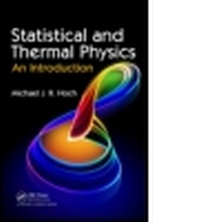
Statistical and Thermal Physics
An Introduction
1st Edition
Published on 25. May 2011
Book
Hardback
450 pages
978-1-4398-5053-4 (ISBN)
Description
Concepts and relationships in thermal and statistical physics form the foundation for describing systems consisting of macroscopically large numbers of particles. Developing microscopic statistical physics and macroscopic classical thermodynamic descriptions in tandem, Statistical and Thermal Physics: An Introduction provides insight into basic concepts at an advanced undergraduate level. Highly detailed and profoundly thorough, this comprehensive introduction includes exercises within the text as well as end-of-chapter problems.
The first section of the book covers the basics of equilibrium thermodynamics and introduces the concepts of temperature, internal energy, and entropy using ideal gases and ideal paramagnets as models. The chemical potential is defined and the three thermodynamic potentials are discussed with use of Legendre transforms. The second section presents a complementary microscopic approach to entropy and temperature, with the general expression for entropy given in terms of the number of accessible microstates in the fixed energy, microcanonical ensemble. The third section emphasizes the power of thermodynamics in the description of processes in gases and condensed matter. Phase transitions and critical phenomena are discussed phenomenologically.
In the second half of the text, the fourth section briefly introduces probability theory and mean values and compares three statistical ensembles. With a focus on quantum statistics, the fifth section reviews the quantum distribution functions. Ideal Fermi and Bose gases are considered in separate chapters, followed by a discussion of the "Planck" gas for photons and phonons. The sixth section deals with ideal classical gases and explores nonideal gases and spin systems using various approximations. The final section covers special topics, specifically the density matrix, chemical reactions, and irreversible thermodynamics.
The first section of the book covers the basics of equilibrium thermodynamics and introduces the concepts of temperature, internal energy, and entropy using ideal gases and ideal paramagnets as models. The chemical potential is defined and the three thermodynamic potentials are discussed with use of Legendre transforms. The second section presents a complementary microscopic approach to entropy and temperature, with the general expression for entropy given in terms of the number of accessible microstates in the fixed energy, microcanonical ensemble. The third section emphasizes the power of thermodynamics in the description of processes in gases and condensed matter. Phase transitions and critical phenomena are discussed phenomenologically.
In the second half of the text, the fourth section briefly introduces probability theory and mean values and compares three statistical ensembles. With a focus on quantum statistics, the fifth section reviews the quantum distribution functions. Ideal Fermi and Bose gases are considered in separate chapters, followed by a discussion of the "Planck" gas for photons and phonons. The sixth section deals with ideal classical gases and explores nonideal gases and spin systems using various approximations. The final section covers special topics, specifically the density matrix, chemical reactions, and irreversible thermodynamics.
Reviews / Votes
"When I started reading Michael J.R. Hoch's book Statistical and Thermal Physics: An Introduction I thought to myself that this is another book the same as a large group of others with similar content. ... But during my reading this unjustified belief changed. ... The main reason for this change was the way of information presentation: ... the way of presentation is designed so that the reader receives only the information that is necessary to give the essence of the problem. ... this book will provide an introduction to the subject especially for those who are interested in basic or applied physics. ... very well-written." -Dominik Strzalka, Zentralblatt MATH 1230More details
Language
English
Place of publication
Washington
United States
Target group
College/higher education
Advanced undergraduate students and early postgraduate students in statistical physics, mechanics, and thermodynamics; engineering, chemistry, and materials students.
Illustrations
137 b/w images and 4 tables
Dimensions
Height: 234 mm
Width: 156 mm
Weight
771 gr
ISBN-13
978-1-4398-5053-4 (9781439850534)
Copyright in bibliographic data and cover images is held by Nielsen Book Services Limited or by the publishers or by their respective licensors: all rights reserved.
Schweitzer Classification
Other editions
New editions
Book
05/2021
2nd Edition
CRC Press
€272.61
Shipment within 15-20 days
Additional editions
Book
09/2019
1st Edition
CRC Press
€70.55
Withdrawn from sale
Person
Michael J.R. Hoch is a visiting scientist in the National High Magnetic Field Laboratory at Florida State University and an emeritus professor and honorary professorial research fellow at the University of the Witwatersrand.
Content
CLASSICAL THERMAL PHYSICS: THE MICROCANONICAL ENSEMBLE: Introduction to Classical Thermal Physics Concepts: The First and Second Laws of Thermodynamics. Microstates and the Statistical Interpretation of Entropy. Applications of Thermodynamics to Gases and Condensed Matter, Phase Transitions, and Critical Phenomena. QUANTUM STATISTICAL PHYSICS AND THERMAL PHYSICS APPLICATIONS: The Canonical and Grand Canonical Ensembles and Distributions. Quantum Distribution Functions, Fermi-Dirac and Bose-Einstein Statistics, Photons, and Phonons. The Classical Ideal Gas, Maxwell-Boltzmann Statistics, Nonideal Systems. The Density Matrix, Reactions and Related Processes, and Introduction to Irreversible Thermodynamics. Appendices. Index.