

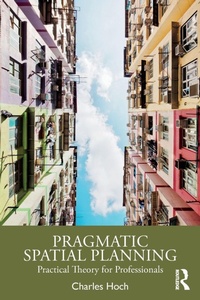
Pragmatic Spatial Planning
Practial Theory for Professionals
1st Edition
Published on 11. July 2019
Book
Paperback/Softback
196 pages
978-0-367-07539-2 (ISBN)
Description
Instead of seeking theory to justify practical professional judgments this book describes how professionals can and should use theory to guide these judgments.
Professional spatial planning in the US, and globally, continues to suffer from a weak conceptual grasp of its own practice. Practitioners routinely recognize the value and wisdom of practical judgment finely attuned to context, nuance and complexity; but later offer banal testimony and glib stories of 'just so' best-practice discrediting the ambiguity of their own experience. The chapters in this book provide a vocabulary tailored to the conventions of practical judgment, challenging students and practitioners to treat professional expertise as work in progress rather than 'best' practice. Instead of seeking theory to justify practical professional judgments, Hoch describes how professionals can and should use theory to guide these judgments. The pragmatist plan helps cope with complexity rather than control it, making it invaluable in the anyone's pursuit of a planning career.
This book will appeal to a wide cross section of students and scholars, especially those working in urban planning, public policy, and government.
Professional spatial planning in the US, and globally, continues to suffer from a weak conceptual grasp of its own practice. Practitioners routinely recognize the value and wisdom of practical judgment finely attuned to context, nuance and complexity; but later offer banal testimony and glib stories of 'just so' best-practice discrediting the ambiguity of their own experience. The chapters in this book provide a vocabulary tailored to the conventions of practical judgment, challenging students and practitioners to treat professional expertise as work in progress rather than 'best' practice. Instead of seeking theory to justify practical professional judgments, Hoch describes how professionals can and should use theory to guide these judgments. The pragmatist plan helps cope with complexity rather than control it, making it invaluable in the anyone's pursuit of a planning career.
This book will appeal to a wide cross section of students and scholars, especially those working in urban planning, public policy, and government.
More details
Language
English
Place of publication
London
United Kingdom
Publishing group
Taylor & Francis Ltd
Target group
College/higher education
Illustrations
15 s/w Abbildungen, 10 s/w Photographien bzw. Rasterbilder, 2 s/w Zeichnungen, 3 s/w Tabellen
3 Tables, black and white; 2 Line drawings, black and white; 10 Halftones, black and white; 15 Illustrations, black and white
Dimensions
Height: 229 mm
Width: 152 mm
Thickness: 11 mm
Weight
307 gr
ISBN-13
978-0-367-07539-2 (9780367075392)
Copyright in bibliographic data and cover images is held by Nielsen Book Services Limited or by the publishers or by their respective licensors: all rights reserved.
Schweitzer Classification
Other editions
Additional editions
Book
07/2019
1st Edition
Routledge
€206.10
Shipment within 15-20 days
E-Book
07/2019
1st Edition
Routledge
€52.49
Available for download
E-Book
07/2019
1st Edition
Routledge
€52.49
Available for download
Person
Professor Charles Hoch studies planning activity across scale and discipline. He has spent four decades studying and proposing that we treat planning as an inherently pragmatic enterprise. Hoch received his doctorate in Urban Planning from UCLA in 1981. After a short stint at Iowa State he settled in Chicago teaching urban planning in the College of Urban Planning and Public Affairs at the University of Illinois, USA.
Content
Introduction Part I 1. Practical Judgment & Planning 2. Emotional Intelligence in Planning Judgment Part II 3. Integrating the Planning Field, Movement and Discipline 4. Anticipating Complex Spatial Change 5. Planning Imagination: Utopia, Scenario & Plan Part III 6. Crafting Plans 7. Evaluating Plans 8. How Planning Theory Informs Planning Practice Part IV 9. Planning Spatial Community in a Complex Society 10. Ethical Planning Judgment