

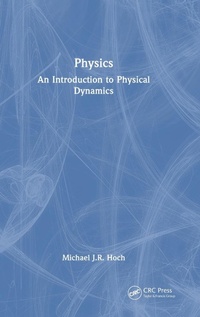
Physics
An Introduction to Physical Dynamics
1st Edition
Published on 25. February 2025
Book
Hardback
212 pages
978-1-032-77947-8 (ISBN)
Description
Physics: An Introduction to Physical Dynamics provides an accessible introduction to the fundamentals of physics for science and engineering undergraduates who are studying elementary physics.
This textbook contains 12 chapters with accompanying problem sets and explains the dynamical properties of a variety of physical systems. The first six chapters intro- duce Newton's laws of motion, followed by the concepts of mechanical work and mechanical energy, with illustrative applications to the translational and/or rotational motion of inflexible objects such as particles and 3D objects of fixed shape. The next four chapters generalize the application of Newton's laws and mechanical energy to flexible systems, including flowing fluids, waves on strings, and oscillating springs. The last two chapters elucidate the laws of thermodynamics, especially heat energy transfer between systems at different temperatures.
Some familiarity with topics in elementary mathematics, including calculus, is assumed. A wide variety of situations are explored, by means of which a student should acquire an enhanced understanding of the properties of physical systems from the astronomic scale to the microscopic.
Key Features
Covers the classical mechanics of both single particles and assemblies of particles subject to forces
Contains wide-ranging sets of examples and worked problems
Covers much of the material that a student might expect to encounter during the first year of a university physics course
This textbook contains 12 chapters with accompanying problem sets and explains the dynamical properties of a variety of physical systems. The first six chapters intro- duce Newton's laws of motion, followed by the concepts of mechanical work and mechanical energy, with illustrative applications to the translational and/or rotational motion of inflexible objects such as particles and 3D objects of fixed shape. The next four chapters generalize the application of Newton's laws and mechanical energy to flexible systems, including flowing fluids, waves on strings, and oscillating springs. The last two chapters elucidate the laws of thermodynamics, especially heat energy transfer between systems at different temperatures.
Some familiarity with topics in elementary mathematics, including calculus, is assumed. A wide variety of situations are explored, by means of which a student should acquire an enhanced understanding of the properties of physical systems from the astronomic scale to the microscopic.
Key Features
Covers the classical mechanics of both single particles and assemblies of particles subject to forces
Contains wide-ranging sets of examples and worked problems
Covers much of the material that a student might expect to encounter during the first year of a university physics course
More details
Language
English
Place of publication
London
United Kingdom
Publishing group
Taylor & Francis Ltd
Target group
College/higher education
Undergraduate Advanced and Undergraduate Core
Illustrations
110 s/w Zeichnungen, 3 s/w Tabellen, 110 s/w Abbildungen
3 Tables, black and white; 110 Line drawings, black and white; 110 Illustrations, black and white
Dimensions
Height: 240 mm
Width: 161 mm
Thickness: 17 mm
Weight
505 gr
ISBN-13
978-1-032-77947-8 (9781032779478)
Copyright in bibliographic data and cover images is held by Nielsen Book Services Limited or by the publishers or by their respective licensors: all rights reserved.
Schweitzer Classification
Other editions
Additional editions
E-Book
02/2025
1st Edition
CRC Press
€69.99
Available for download
E-Book
02/2025
1st Edition
CRC Press
€69.99
Available for download
Book
02/2025
1st Edition
CRC Press
€76.80
Shipment within 10-20 days
Person
Michael J.R. Hoch spent many years as a visiting scientist at the National High Magnetic Field Laboratory at Florida State University, USA. Prior to this, he was a professor of physics and the director of the Condensed Matter Physics Research Unit at the University of the Witwatersrand, Johannesburg, where he is currently professor emeritus in the School of Physics.
Content
Chapter 1: The Physical World. Chapter 2: Motion in Space and Time. Chapter 3: Momentum and the Laws of Motion. Chapter 4: Work and Mechanical Energy. Chapter 5: Circular Motion. Chapter 6: Rigid Body Motion. Chapter 7: Fluids and Solids. Chapter 8: Oscillations. Chapter 9: Waves in Low Dimensions. Chapter 10: Waves in Higher Dimensions. Chapter 11: Basics of Thermal Physics. Chapter 12: Entropy and the Second Law. Appendices. Index.