

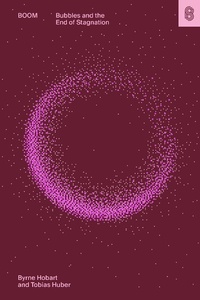
Boom
Bubbles and the End of Stagnation
Published on 19. November 2024
Book
Hardback
304 pages
978-1-953953-47-6 (ISBN)
Description
A timely investigation of the causes of technological and scientific stagnation, and a radical blueprint for accelerating innovation.
"Read this book for the alternative history of our age."
-Peter Thiel, investor and author of Zero to One
"A must-read for those who seek to build the future."
-Marc Andreessen, cofounder of Netscape and Andreessen Horowitz
From the Moon landing to the dawning of the atomic age, the decades prior to the 1970s were characterized by the routine invention of transformative technologies at breakneck speed. By comparison, ours is an age of stagnation. Median wage growth has slowed, inequality and income concentration are on the rise, and scientific research has become increasingly expensive and incremental.
Why are we unable to replicate the rate of progress of past decades? What can we do to reinvigorate innovation?
In Boom, Byrne Hobart and Tobias Huber take an inductive approach to the problem. In a series of case studies tracking some of the most significant breakthroughs of the past 100 years-from the Manhattan Project and the Apollo program to fracking and Bitcoin-they reverse-engineer how transformative progress arises from small groups with a unified vision, vast funding, and surprisingly poor accountability. They conclude that financial bubbles, while often maligned as destructive and destabilizing forces, have in fact been the engine of past breakthroughs and will drive future advances. In other words: Bubbles aren't all bad.
Integrating insights from economics, philosophy, and history, Boom identifies the root causes of the Great Stagnation and provides a blueprint for accelerating innovation. By decreasing collective risk aversion, overfunding experimental processes, and organizing high-agency individuals around a transcendent mission, bubbles are the key to realizing a future that is radically different from the present. Boom offers a definite and optimistic vision of our future-and a path to unleash a new era of global prosperity.
"Read this book for the alternative history of our age."
-Peter Thiel, investor and author of Zero to One
"A must-read for those who seek to build the future."
-Marc Andreessen, cofounder of Netscape and Andreessen Horowitz
From the Moon landing to the dawning of the atomic age, the decades prior to the 1970s were characterized by the routine invention of transformative technologies at breakneck speed. By comparison, ours is an age of stagnation. Median wage growth has slowed, inequality and income concentration are on the rise, and scientific research has become increasingly expensive and incremental.
Why are we unable to replicate the rate of progress of past decades? What can we do to reinvigorate innovation?
In Boom, Byrne Hobart and Tobias Huber take an inductive approach to the problem. In a series of case studies tracking some of the most significant breakthroughs of the past 100 years-from the Manhattan Project and the Apollo program to fracking and Bitcoin-they reverse-engineer how transformative progress arises from small groups with a unified vision, vast funding, and surprisingly poor accountability. They conclude that financial bubbles, while often maligned as destructive and destabilizing forces, have in fact been the engine of past breakthroughs and will drive future advances. In other words: Bubbles aren't all bad.
Integrating insights from economics, philosophy, and history, Boom identifies the root causes of the Great Stagnation and provides a blueprint for accelerating innovation. By decreasing collective risk aversion, overfunding experimental processes, and organizing high-agency individuals around a transcendent mission, bubbles are the key to realizing a future that is radically different from the present. Boom offers a definite and optimistic vision of our future-and a path to unleash a new era of global prosperity.
Reviews / Votes
"The dot-com bubble looked like the peak of delusion, but the truly deluded were those who wanted to indefinitely defer the future. Everyone knows bubbles can disguise madness as wisdom; read this book for the alternative history of our age."-Peter Thiel, investor and author of Zero to One"Boom makes the case that humanity's greatest risk is not climate change or misaligned superintelligent Al but not making enough progress. A must-read for those who seek to build the future."-Marc Andreessen, cofounder of Netscape and Andreessen Horowitz
"When is it that temporary bubbles can help drive forward progress? This happened with the railroads, with the internet, and it is likely to happen with AI. Byrne Hobart and Tobias Huber have produced some essential reading on a very important and also understudied topic."-Tyler Cowen, author of The Great Stagnation and professor of economics at George Mason University
More details
Language
English
Place of publication
United States
Publishing group
Stripe Matter Inc
Product notice
Cloth over boards
Illustrations
Illustrations
Dimensions
Height: 235 mm
Width: 159 mm
Thickness: 28 mm
Weight
740 gr
ISBN-13
978-1-953953-47-6 (9781953953476)
Copyright in bibliographic data and cover images is held by Nielsen Book Services Limited or by the publishers or by their respective licensors: all rights reserved.
Schweitzer Classification
Persons
Byrne Hobart is an investor, consultant, and writer. He is the author of The Diff, a daily newsletter covering inflection points in finance and technology. He is also a partner at Anomaly, a frontier tech investment firm.
Tobias Huber is a writer and investor. He is a partner at Anomaly, a frontier tech investment firm. He has a background in philosophy and holds a doctor of science degree from ETH Zurich.
Tobias Huber is a writer and investor. He is a partner at Anomaly, a frontier tech investment firm. He has a background in philosophy and holds a doctor of science degree from ETH Zurich.
Content
Introduction: Doom and Boom
Part I: Stagnation
Chapter 1: The Ideology of Stasis
Chapter 2: From Bust to Boom: Bubbles as Innovation Accelerators
Part II: Acceleration
Chapter 3: The Manhattan Project
Chapter 4: The Apollo Program
Chapter 5: Moore's law
Chapter 6: The Golden Age of Corporate R?&?D
Chapter 7: Fracking
Chapter 8: Bitcoin
Part III: Escape
Chapter 9: Unleashing Prometheus? Technology as Salvation
Acknowledgments
About the Authors
Bibliography
Index
Part I: Stagnation
Chapter 1: The Ideology of Stasis
Chapter 2: From Bust to Boom: Bubbles as Innovation Accelerators
Part II: Acceleration
Chapter 3: The Manhattan Project
Chapter 4: The Apollo Program
Chapter 5: Moore's law
Chapter 6: The Golden Age of Corporate R?&?D
Chapter 7: Fracking
Chapter 8: Bitcoin
Part III: Escape
Chapter 9: Unleashing Prometheus? Technology as Salvation
Acknowledgments
About the Authors
Bibliography
Index