

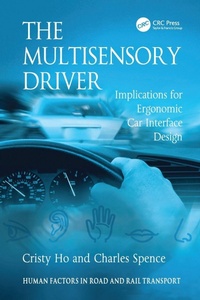
The Multisensory Driver
Implications for Ergonomic Car Interface Design
1st Edition
Published on 31. March 2017
Book
Paperback/Softback
158 pages
978-1-138-07584-9 (ISBN)
Description
Driver inattention has been identified as one of the leading causes for car accidents. The problem of distraction while driving is likely to worsen, partly due to increasingly complex in-car technologies. However, intelligent transport systems are being developed to assist drivers and to ensure a safe road environment. One approach to the design of ergonomic automobile systems is to integrate our understanding of the human information processing systems into the design process. This book aims to further the design of ergonomic multisensory interfaces using research from the fast-growing field of cognitive neuroscience. It focuses on two aspects of driver information-processing in particular: multisensory interactions and the spatial distribution of attention in driving. The Multisensory Driver provides interface design guidelines together with a detailed review of current cognitive neuroscience and behavioural research in multisensory human perception, which will help the development of ergonomic interfaces. The discussion on spatial attention is particularly relevant for car interface designers, but it will also appeal to cognitive psychologists interested in spatial attention and the applications of these theoretical research findings. Giving a detailed description of a cohesive series of psychophysical experiments on multisensory warning signals, conducted in both laboratory and simulator settings, this book provides an approach for those in the engineering discipline who wish to test their systems with human observers.
Reviews / Votes
'The knowledge and insight required in order to fully integrate research from a wide range of inter-related disciplines in this area is formidable, yet this book manages to achieve it. The attention to detail in the authors' own research questions and designs, and the expertise that they show in interpreting their own findings and placing them within the wider context of research, is exemplary. Anyone wishing to do research in this area would be well advised to read this book. The authors are also fully aware of the applied context in which their research is placed, so this book will be of great interest to practitioners and designers, who can rely on the intellectual skill of the authors to intepret for them the meaning, significance and appropriate application of research findings. You will not find a more detailed, insightful book on this topic' Judy Edworthy, University of Plymouth. UK 'Cristy Ho and Charles Spence bridge the theoretical and applied divide in The Multisensory Driver: Implications for Ergonomic Car Interface Design. An understanding of the multisensory processing of drivers is key to designing the next generation of information-rich passenger vehicles. The Multisensory Driver taps into core issues of what works and what doesn't in designing warnings to keep drivers alert, aware and driving more safely.' Daniel V. McGehee, The University of Iowa, USAMore details
Series
Language
English
Place of publication
London
United Kingdom
Publishing group
Taylor & Francis Ltd
Target group
College/higher education
Dimensions
Height: 234 mm
Width: 156 mm
Thickness: 9 mm
Weight
254 gr
ISBN-13
978-1-138-07584-9 (9781138075849)
Copyright in bibliographic data and cover images is held by Nielsen Book Services Limited or by the publishers or by their respective licensors: all rights reserved.
Schweitzer Classification
Other editions
Additional editions
E-Book
05/2017
CRC Press
€80.49
Available for download
E-Book
05/2017
CRC Press
€80.49
Available for download
Book
09/2008
1st Edition
Ashgate Publishing Limited
€241.20
Shipment within 10-20 days
Persons
Cristy Ho, is a Daiwa Scholar, at the Daiwa-Anglo Japanese Foundation, Japan and Charles Spence is Professor of Experimental Psychology, at the Oxford University, UK.
Content
Contents: Introduction; Driven to distraction; Driven to listen; The auditory spatial cuing of driver attention; The vibrotactile spatial cuing of driver attention; The multisensory perceptual versus decisional facilitation of driving; The multisensory spatial cuing of driver attention; Conclusions; References; Index.