

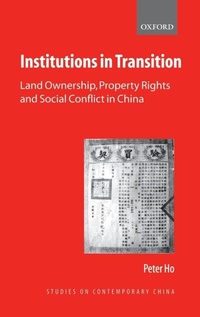
Institutions in Transition
Land Ownership, Property Rights, and Social Conflict in China
Published on 21. July 2005
Book
Hardback
296 pages
978-0-19-928069-8 (ISBN)
Description
China's urban sprawl has led to serious social cleavages. Unclear land and property rights have resulted in an uneasy alliance between real estate companies and local authorities, with most willing to strike illegal deals over land. The results have been devastating. Farmers live in fear that the land they till today will be gone tomorrow, while urban citizens are regularly evicted from their homes to make way for new skyscrapers and highways.
These shocking incidents underscore the urgency of the land question in China. The recent conviction of the Chinese Minister for Land Resources and the forced evictions that have led to the injury and death of ordinary Chinese citizens highlight the case for land reform. Against this backdrop, many scholars criticize China's lack of privatization and titling of property. This monograph, however, demonstrates that these critically depend on timing and place. Land titling is imperative for the wealthier regions, yet, may prove detrimental in areas with high poverty. The book argues that China's land reform can only succeed if the clarification of property rights is done with caution and ample regard for regional variations.
These shocking incidents underscore the urgency of the land question in China. The recent conviction of the Chinese Minister for Land Resources and the forced evictions that have led to the injury and death of ordinary Chinese citizens highlight the case for land reform. Against this backdrop, many scholars criticize China's lack of privatization and titling of property. This monograph, however, demonstrates that these critically depend on timing and place. Land titling is imperative for the wealthier regions, yet, may prove detrimental in areas with high poverty. The book argues that China's land reform can only succeed if the clarification of property rights is done with caution and ample regard for regional variations.
More details
Series
Language
English
Place of publication
Oxford
United Kingdom
Target group
Professional and scholarly
Illustrations
Numerous halftones and tables
Dimensions
Height: 240 mm
Width: 161 mm
Thickness: 20 mm
Weight
602 gr
ISBN-13
978-0-19-928069-8 (9780199280698)
Copyright in bibliographic data and cover images is held by Nielsen Book Services Limited or by the publishers or by their respective licensors: all rights reserved.
Schweitzer Classification
Person
Peter Ho is Professor of International Development Studies and concurrent Director of the Centre for Development Studies at the University of Groningen. He is member of the Academic Committee of the International Institute for Asian Studies (IIAS) in Leiden and member of the Steering Committee of the European Conference on Agriculture and Rural Development in China (ECARDC). From 1997 until 2002, he served as the personal Chinese interpreter for the Dutch Minister of Foreign Affairs.
Content
Preface ; Introduction ; 1. The credibility of agricultural land tenure or why delibrate institutional ambiguity might work ; 2. Why the village has no power: land ownership disputes and customary tenure ; 3. Governing China's grasslands: the clash over state and collective property ; 4. Contested spaces: forest rights, registration and social conflict ; 5. Going, going, gone! A case-study of the wasteland auction policy ; 6. Between nationalization and privatization: common property as the third way? ; Summary and concluding observations: the national debate on property law