

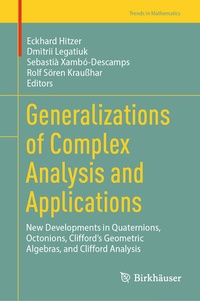
Generalizations of Complex Analysis and Applications
Description
This volume provides comprehensive coverage of new developments in hypercomplex analysis and Clifford analysis. Contributions are based on talks given at the 9th European Congress of Mathematics minisymposium "Generalizations of Complex Analysis and Applications," held in Spain in July 2024. Specific topics covered include:
- Hypercomplex integral transformations
- Spinors, Lie algebras, Clifford (geometric) algebras and group theory
- Generalizations of the standard model of particle physics
- Function theoretical aspects and technological applications
More details
Other editions
Additional editions
Persons
Eckhard Hitzer is a theoretical physicist teaching at the International Christian University in Tokyo.
Dr. Dmitrii Legatiuk is a mathematician working at the University of Erfurt, Germany.
Sebastià Xambó-Descamps is an Emeritus Full Professor of Mathematics at the Universitat Politècnica de Catalunya/Facultat de Matemàtiques i Estadística (UPC/FME).
Rolf Sören Kraußhar is Professor at the University of Erfurt (Germany) and is the Head of the Chair of Mathematics at the Faculty of Education since 2014.
Content
Overview of Hypercomplex Algebra and Analysis.- 8-Dimensional Composition Algebras and the Cayley Plane.- Embedding the Okubo algebra in Clifford's geometric algebras and vice versa.- On Born Reciprocal Relativity Theory, The Relativistic Oscillator and the Fulling-Davies-Unruh Effect.- Discrete octonionic analysis: a unified approach to the split-octonionic and classical settings.- Octonion quadratic-phase Fourier transform: theory and uncertainty principles.- Conjugate (1/q, q)-harmonic Polynomials in q-Clifford Analysis.- Poisson problem on multivector fields in hyperbolic upper-half space H3.- From Line Transformations to Two-Qubit Quantum Gates.- Quaternion Principal Component Analysis: Mathematical Foundations and NMR Spectroscopic Applications.- Singular Value Decomposition for Geometric Algebra modeled AC Electrical Systems.- Expression Classification Using Slepian-based Rotation Invariants Moments.