

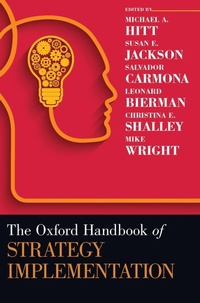
The Oxford Handbook of Strategy Implementation
Published on 30. March 2017
Book
Hardback
552 pages
978-0-19-065023-0 (ISBN)
Description
Good strategies can fail because they are poorly implemented. Behind this straightforward statement is a complex reality. This innovative volume explores various aspects of strategy implementation, a process that is as challenging as it is important.
For strategies to be implemented effectively, firms must have the right resources and capabilities available. Available resources must be integrated in ways that create the capabilities needed and then those capabilities must be leveraged to effectively implement the strategy in order to create and sustain a competitive advantage.
This handbook focuses on how strategy implementation is influenced by resources and governance, human capital and management of it, and accounting-based control systems. It examines how the dynamic, competitive, and international environment increases the importance of knowledge and its acquisition, effective governance as a signal of proper incentives, the interaction of legality and legitimacy, and the connections between compliance and enforcement.
Because people implement the strategies through the completion of their job tasks and achievement of their job-related goals, the second section explores how changes in workforce demographics have influenced and may influence strategy. Major factors include the greater proportion of older workers and the increasing role women play in leadership. Acquiring, developing, and having a motivated work force is critical to implementation, whether and how best practices spread is explored, as is the effectiveness of setting goals.
Controlling managerial behavior plays a critical role in the implementation of strategies, and is the focus of the third section on accounting-based control systems. These can be helpful both in identifying inappropriate behaviors and in promoting positive managerial actions to achieve desired financial outcomes. They can also encourage experimentation and creativity. The effectiveness of accounting and accountability systems is influenced by four dimensions, including the intended users, standards of compliance, enforcement criteria, and the assurance process.
For strategies to be implemented effectively, firms must have the right resources and capabilities available. Available resources must be integrated in ways that create the capabilities needed and then those capabilities must be leveraged to effectively implement the strategy in order to create and sustain a competitive advantage.
This handbook focuses on how strategy implementation is influenced by resources and governance, human capital and management of it, and accounting-based control systems. It examines how the dynamic, competitive, and international environment increases the importance of knowledge and its acquisition, effective governance as a signal of proper incentives, the interaction of legality and legitimacy, and the connections between compliance and enforcement.
Because people implement the strategies through the completion of their job tasks and achievement of their job-related goals, the second section explores how changes in workforce demographics have influenced and may influence strategy. Major factors include the greater proportion of older workers and the increasing role women play in leadership. Acquiring, developing, and having a motivated work force is critical to implementation, whether and how best practices spread is explored, as is the effectiveness of setting goals.
Controlling managerial behavior plays a critical role in the implementation of strategies, and is the focus of the third section on accounting-based control systems. These can be helpful both in identifying inappropriate behaviors and in promoting positive managerial actions to achieve desired financial outcomes. They can also encourage experimentation and creativity. The effectiveness of accounting and accountability systems is influenced by four dimensions, including the intended users, standards of compliance, enforcement criteria, and the assurance process.
More details
Series
Language
English
Place of publication
New York
United States
Target group
College/higher education
Dimensions
Height: 250 mm
Width: 175 mm
Thickness: 34 mm
Weight
1117 gr
ISBN-13
978-0-19-065023-0 (9780190650230)
Copyright in bibliographic data and cover images is held by Nielsen Book Services Limited or by the publishers or by their respective licensors: all rights reserved.
Schweitzer Classification
Other editions
Additional editions
Michael A. Hitt | Susan E. Jackson | Salvador Carmona
The Oxford Handbook of Strategy Implementation
E-Book
02/2017
1st Edition
OUP eBook
€101.99
Available for download
Michael A. Hitt | Susan E. Jackson | Salvador Carmona
The Oxford Handbook of Strategy Implementation
E-Book
02/2017
1st Edition
OUP eBook
€101.99
Available for download
Persons
Michael A. Hitt received his Ph.D. from the University of Colorado. He is a University Distinguished Professor Emeritus, at Texas A&M University and a Distinguished Research Fellow at Texas Christian University. He is a Fellow of the Academy of Management and of the Strategic Management Society and former President of both organizations. His research focuses on international strategy, orchestration of resources to create value and strategic entrepreneurship.
Susan E. Jackson, PhD, is Distinguished Professor of Human Resource Management at the School of Management and Labor Relations. Her primary areas of expertise for teaching and scholarship include managing for environmental sustainability, work team diversity, and strategic human resource management systems. She has published more than 150 scholarly articles and chapters on these and related topics, and is the author or editor of several books, including her most recent book (with D. Ones and S. Dilchert), Managing Human Resources in Environmentally Sustainable Organizations, which examines how HRM practices are being shaped by business strategies aimed at improving their environmental performance records in response to increasing pressures from employees, customers, and investors.
Salvador Carmona is a professor of Accounting and Management Control at IE University, where he currently serves as Rector. Salvador is the President of the European Accounting Association(2015-2017) and a former editor of European Accounting Review. He has conducted empirical research on the implementation of management accounting systems in high-tech firms as well as on the organizational and social aspects of management control systems.
Leonard Bierman is a Professor of Management, Mays Business School, Texas A&M University. He teaches courses on the topics of negotiation/conflict resolution, business and government, labour relations/labour law, and employment regulation. His current research emphasis is in the areas of business and government and corporate governance. He is particularly interested in topics where these subject areas overlap, e.g., political activities/contributions by CEO's and other top executives and government regulation of corporate annual meetings/proxy voting.
Christina E. Shalley is Thomas R. Williams-Wells Fargo Professor of Organizational Behavior at the Scheller College of Business, Georgia Institute of Technology. Her Ph.D. in Business Administration is from the University of Illinois, Urbana-Champaign. Her current research examines effects of social and contextual factors for individual and team creativity.
Mike Wright is Professor of Entrepreneurship and Director of the Center for Management Buyout Research at Imperial College Business School and visiting professor at the University of Ghent. He is a co-editor of Strategic Entrepreneurship Journal, Academy of Management Perspectives and Foundations and Trends in Entrepreneurship. He is Chair of the Society for the Advancement of Management Studies and a Fellow of the British Academy.
Susan E. Jackson, PhD, is Distinguished Professor of Human Resource Management at the School of Management and Labor Relations. Her primary areas of expertise for teaching and scholarship include managing for environmental sustainability, work team diversity, and strategic human resource management systems. She has published more than 150 scholarly articles and chapters on these and related topics, and is the author or editor of several books, including her most recent book (with D. Ones and S. Dilchert), Managing Human Resources in Environmentally Sustainable Organizations, which examines how HRM practices are being shaped by business strategies aimed at improving their environmental performance records in response to increasing pressures from employees, customers, and investors.
Salvador Carmona is a professor of Accounting and Management Control at IE University, where he currently serves as Rector. Salvador is the President of the European Accounting Association(2015-2017) and a former editor of European Accounting Review. He has conducted empirical research on the implementation of management accounting systems in high-tech firms as well as on the organizational and social aspects of management control systems.
Leonard Bierman is a Professor of Management, Mays Business School, Texas A&M University. He teaches courses on the topics of negotiation/conflict resolution, business and government, labour relations/labour law, and employment regulation. His current research emphasis is in the areas of business and government and corporate governance. He is particularly interested in topics where these subject areas overlap, e.g., political activities/contributions by CEO's and other top executives and government regulation of corporate annual meetings/proxy voting.
Christina E. Shalley is Thomas R. Williams-Wells Fargo Professor of Organizational Behavior at the Scheller College of Business, Georgia Institute of Technology. Her Ph.D. in Business Administration is from the University of Illinois, Urbana-Champaign. Her current research examines effects of social and contextual factors for individual and team creativity.
Mike Wright is Professor of Entrepreneurship and Director of the Center for Management Buyout Research at Imperial College Business School and visiting professor at the University of Ghent. He is a co-editor of Strategic Entrepreneurship Journal, Academy of Management Perspectives and Foundations and Trends in Entrepreneurship. He is Chair of the Society for the Advancement of Management Studies and a Fellow of the British Academy.
Author
University Distinguished Professor Emeritus, Distinguished Research FellowUniversity Distinguished Professor Emeritus, Distinguished Research Fellow, Texas A&M University and Texas Christian University
Distinguished ProfessorDistinguished Professor, Rutgers University
Professor of Accounting and Management ControlProfessor of Accounting and Management Control, Instituto de Empresa
Professor of ManagementProfessor of Management, Texas A&M University
Thomas R. Williams-Wells Fargo Professor of Organizational BehaviorThomas R. Williams-Wells Fargo Professor of Organizational Behavior, Georgia Institute of Technology
Professor of Entrepreneurship and Director of the Center for Management Buyout ResearchProfessor of Entrepreneurship and Director of the Center for Management Buyout Research, Imperial College
Content
Chapter 1: The Imperative for Strategy Implementation
Michael A. Hitt, Susan E. Jackson, Salvador Carmona, Leonard Bierman, Christina E. Shalley and Mike Wright
PART 1: RESOURCES AND GOVERNANCE
Chapter 2: Sourcing External Knowledge: Clusters, Alliances, and Acquisitions
Stephen Tallman and Anupama Phene
Chapter 3: A Study of the Long-term Value of Capabilities-based Resources, Intangible Strategic Assets, and Firm Performance
Brian R. Chabowski and G. Tomas M. Hult
Chapter 4: IPOs and Corporate Governance
Igor Filatotchev, Mike Wright and Garry D. Bruton
Chapter 5: Epistemics at Work: The Theory of Mind in Principal-Agent Relations
Stefan Linder, Nicolai Foss and Diago Stea
Chapter 6: Social Construction of Boundaries in the Context of the Official and Unofficial Economies
Katalin Takacs-Haynes and R. Duane Ireland
Chapter 7: Antitrust Compliance
D. Daniel Sokol
PART 2: MANAGING HUMAN CAPITAL
Chapter 8: The Aging Workforce: Implications for Human Resource Management Research and Practice
Donald M. Truxillo, David M. Cadiz, and Jennifer R. Rineer
Chapter 9: Women at the Top: Will More Women in Senior Roles Impact Organizational Performance?
Carol T. Kulik and Isabel Metz
Chapter 10: Managing Human Capital: Meta-analysis of Links among Human Resource Management Practices and Systems, Human Capital and Performance
David J. Ketchen Jr., T. Russell Crook, Samuel Y. Todd, James G. Combs, and David J. Woehr
Chapter 11: Exploring the Relationship between Human Resource Management and Organizational Performance in the Healthcare Sector
Ian Kessler
Chapter 12: Evidence-Based Management at the Bottom of the Pyramid: Why Human Resources Standards and Research Must Connect More Closely
Wayne F. Cascio and John W. Boudreau
Chapter 13: Theory Development by Induction: Goal-Setting Theory, 1990 to 2013
Edwin A. Locke and Gary P. Latham
PART 3: ACCOUNTING-BASED CONTROL SYSTEMS
Chapter 14: Management Control Systems and Creativity
Antonio Davila and Angelo Ditillo
Chapter 15: Exploring the Challenges of Broadening Accounting Reports: Insights from Research
Brad Potter and Naomi Soderstrom
Chapter 16: Organizational Design and Control Choices
Christian Hofmann and Laurence van Lent
Chapter 17: Estimation of Discretionary Accruals and the Detection of Earnings Management
Paul Zarowin
Chapter 18: The Future of Strategy Implementation
Michael A. Hitt, Susan E. Jackson, Salvador Carmona, Leonard Bierman, Christina E. Shalley and Mike Wright
Michael A. Hitt, Susan E. Jackson, Salvador Carmona, Leonard Bierman, Christina E. Shalley and Mike Wright
PART 1: RESOURCES AND GOVERNANCE
Chapter 2: Sourcing External Knowledge: Clusters, Alliances, and Acquisitions
Stephen Tallman and Anupama Phene
Chapter 3: A Study of the Long-term Value of Capabilities-based Resources, Intangible Strategic Assets, and Firm Performance
Brian R. Chabowski and G. Tomas M. Hult
Chapter 4: IPOs and Corporate Governance
Igor Filatotchev, Mike Wright and Garry D. Bruton
Chapter 5: Epistemics at Work: The Theory of Mind in Principal-Agent Relations
Stefan Linder, Nicolai Foss and Diago Stea
Chapter 6: Social Construction of Boundaries in the Context of the Official and Unofficial Economies
Katalin Takacs-Haynes and R. Duane Ireland
Chapter 7: Antitrust Compliance
D. Daniel Sokol
PART 2: MANAGING HUMAN CAPITAL
Chapter 8: The Aging Workforce: Implications for Human Resource Management Research and Practice
Donald M. Truxillo, David M. Cadiz, and Jennifer R. Rineer
Chapter 9: Women at the Top: Will More Women in Senior Roles Impact Organizational Performance?
Carol T. Kulik and Isabel Metz
Chapter 10: Managing Human Capital: Meta-analysis of Links among Human Resource Management Practices and Systems, Human Capital and Performance
David J. Ketchen Jr., T. Russell Crook, Samuel Y. Todd, James G. Combs, and David J. Woehr
Chapter 11: Exploring the Relationship between Human Resource Management and Organizational Performance in the Healthcare Sector
Ian Kessler
Chapter 12: Evidence-Based Management at the Bottom of the Pyramid: Why Human Resources Standards and Research Must Connect More Closely
Wayne F. Cascio and John W. Boudreau
Chapter 13: Theory Development by Induction: Goal-Setting Theory, 1990 to 2013
Edwin A. Locke and Gary P. Latham
PART 3: ACCOUNTING-BASED CONTROL SYSTEMS
Chapter 14: Management Control Systems and Creativity
Antonio Davila and Angelo Ditillo
Chapter 15: Exploring the Challenges of Broadening Accounting Reports: Insights from Research
Brad Potter and Naomi Soderstrom
Chapter 16: Organizational Design and Control Choices
Christian Hofmann and Laurence van Lent
Chapter 17: Estimation of Discretionary Accruals and the Detection of Earnings Management
Paul Zarowin
Chapter 18: The Future of Strategy Implementation
Michael A. Hitt, Susan E. Jackson, Salvador Carmona, Leonard Bierman, Christina E. Shalley and Mike Wright