

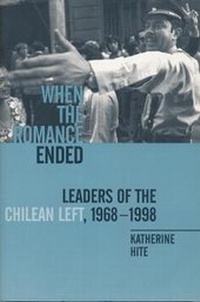
When the Romance Ended
Leaders of the Chilean Left, 1968-1998
Published on 10. December 1999
Book
Hardback
256 pages
978-0-231-11016-7 (ISBN)
Description
-- International Politics
Reviews / Votes
"This is an important, caring and respectful book documenting the evolution of ideological perspectives and political attitudes within the Chilean left during the period 1968-1998...Without a doubt, this is an important book for scholars of identity politics and for general readers interested in Chilean politics." -- Canadian Journal of Latin American & Caribbean Studies "Highly suggestive for understanding political leadership... and the leaders' personal stories, which Hite allows her interviewees to narrate in long, direct excerpts, make for gripping reading" -- Choice "The author effectively addresses questions of political identtity, leadership, and change through the lens of interviews with Chilean leaders of the Left. She contributes to our understanding of the transformation of the Left universally and the evolution of political culture in the Chilean national setting. Her conceptualization of individual political trajectories provides a powerful explanatory framework to comprehend the formulation of political thought and action." -- Jadwiga E. Pieper, The HistorianMore details
Language
English
Place of publication
New York
United States
Target group
Professional and scholarly
Illustrations
Illustrationsports.
Dimensions
Height: 234 mm
Width: 158 mm
Weight
480 gr
ISBN-13
978-0-231-11016-7 (9780231110167)
Copyright in bibliographic data and cover images is held by Nielsen Book Services Limited or by the publishers or by their respective licensors: all rights reserved.
Schweitzer Classification
Other editions
Additional editions
Book
12/1999
Columbia University Press
€37.20
Article not available at the moment
Person
Katherine Hite is an assistant professor of political science at Vassar College and is a coeditor of The New Politics of Inequality in Latin America: Rethinking Participation and Representation.
Content
1. Interpreting Political Identity 2. Chile's Revolutionary Generation 3. The Binds and Bonds of Party Loyalty 4. Personal Loyalists and the Meaning of Allendismo 5. Exile and the Thinkers 6. The Return: Political Entrepreneurs and the Chilean Transition Conclusion: Political Identity, Post-Authoritarianism of the 1990s, and the Politics of the Possible