

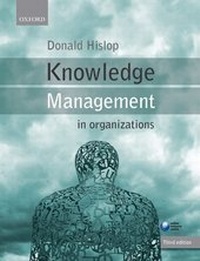
Knowledge Management in Organizations
A Critical Introduction
3rd Edition
Published on 31. January 2013
Book
Paperback/Softback
304 pages
978-0-19-969193-7 (ISBN)
Description
Building on the success of the second edition, the third edition of Knowledge Management in Organizations presents a critical introduction to the subject. Adopting a multidisciplinary perspective, encompassing issues of strategy, structure, systems and human resource management, the text introduces the reader to the concept of knowledge before examining how, and whether, knowledge can be managed within the organizations in which we work. The third edition
features a new section on intellectual capital accounting, increased discussion on the use of social networking technologies and significant updates to chapters on Knowledge Creation, Facilitating Knowledge Management via Culture Management, and Leadership, HRM and Knowledge Management.
This accessible and engaging text provides a comprehensive introduction to the subject, and incorporates a wealth of in-text learning features and examples in every chapter. International case studies throughout the text, which have been fully updated to reflect changes in the economic and political landscape since the previous edition, as well as new and emerging trends in the field, further illustrate knowledge management theory in a real-world business context.
The text is supported by a fully integrated Online Resource Centre, offering additional resources for students and registered lecturers:
For students:
Additional case studies
Web links
For registered lecturers:
Diagrams from the textbook
Examples of exam questions
Examples of essay/coursework questions
Suggestions for classroom activities to facilitate discussion around the themes addressed in the book
features a new section on intellectual capital accounting, increased discussion on the use of social networking technologies and significant updates to chapters on Knowledge Creation, Facilitating Knowledge Management via Culture Management, and Leadership, HRM and Knowledge Management.
This accessible and engaging text provides a comprehensive introduction to the subject, and incorporates a wealth of in-text learning features and examples in every chapter. International case studies throughout the text, which have been fully updated to reflect changes in the economic and political landscape since the previous edition, as well as new and emerging trends in the field, further illustrate knowledge management theory in a real-world business context.
The text is supported by a fully integrated Online Resource Centre, offering additional resources for students and registered lecturers:
For students:
Additional case studies
Web links
For registered lecturers:
Diagrams from the textbook
Examples of exam questions
Examples of essay/coursework questions
Suggestions for classroom activities to facilitate discussion around the themes addressed in the book
More details
Edition
3rd Revised edition
Language
English
Place of publication
Oxford
United Kingdom
Target group
College/higher education
Edition type
Revised edition
Dimensions
Height: 245 mm
Width: 190 mm
Thickness: 14 mm
Weight
584 gr
ISBN-13
978-0-19-969193-7 (9780199691937)
Copyright in bibliographic data and cover images is held by Nielsen Book Services Limited or by the publishers or by their respective licensors: all rights reserved.
Schweitzer Classification
Other editions
New editions
Donald Hislop | Rachelle Bosua | Remko Helms
Knowledge Management in Organizations
A critical introduction
Book
03/2018
4th Edition
Oxford University Press
€87.00
Shipment within 15-20 days
Previous edition

Book
05/2009
2nd Edition
Oxford University Press
€48.27
Article exhausted; check for reprint
Person
Content
SECTION 1: EPISTEMOLOGIES OF KNOWLEDGE IN THE KNOWLEDGE MANAGEMENT LITERATURE; SECTION 2: AN INTRODUCTION TO KEY CONCEPTS; SECTION 3: KNOWLEDGE CREATION AND ORGANIZATIONAL LOSS; SECTION 4: SOCIO-CULTURAL ISSUES RELATED TO MANAGING AND SHARING KNOWLEDGE