

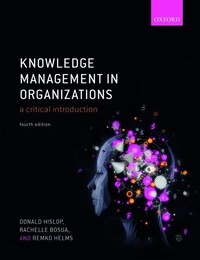
Knowledge Management in Organizations
A critical introduction
4th Edition
Published on 29. March 2018
Book
Paperback/Softback
344 pages
978-0-19-872401-8 (ISBN)
Description
Knowledge Management in Organizations is the most comprehensive and critical textbook on the subject. Encompassing a number of perspectives - including organizational behaviour, HRM, systems, and sociocultural factors - the text introduces the concept of knowledge before examining how it can be effectively managed within the organizations in which we work.
The international author team ensure the broad theoretical coverage is brought to life with practical illustrations and case studies exploring topics such as knowledge sharing via social media, knowledge transfer in different cultural contexts, and the interaction of leadership, culture, and knowledge management in Australian SMEs. Examples are diverse, international, and highly relevant to each chapter, showcasing the significance of knowledge management in all types of organizational settings.
'Time to Reflect' boxes, review and discussion questions, and a question or activity to accompany every illustration and case study ensure students are challenged to engage with the subject critically and reflectively. Despite the critical approach and depth of coverage, the text remains accessible through its widely praised writing style, coherent structure, in-chapter definition boxes, and manageable size.
This book is accompanied by a selection of online resources:
For students:
Extra online cases
Web links to additional resources and relevant websites
Extension questions
For lecturers:
Suggested exam questions
Suggested essay/coursework questions
Suggestions for classroom activities
Figures and tables from the book
The international author team ensure the broad theoretical coverage is brought to life with practical illustrations and case studies exploring topics such as knowledge sharing via social media, knowledge transfer in different cultural contexts, and the interaction of leadership, culture, and knowledge management in Australian SMEs. Examples are diverse, international, and highly relevant to each chapter, showcasing the significance of knowledge management in all types of organizational settings.
'Time to Reflect' boxes, review and discussion questions, and a question or activity to accompany every illustration and case study ensure students are challenged to engage with the subject critically and reflectively. Despite the critical approach and depth of coverage, the text remains accessible through its widely praised writing style, coherent structure, in-chapter definition boxes, and manageable size.
This book is accompanied by a selection of online resources:
For students:
Extra online cases
Web links to additional resources and relevant websites
Extension questions
For lecturers:
Suggested exam questions
Suggested essay/coursework questions
Suggestions for classroom activities
Figures and tables from the book
Reviews / Votes
Finally a text book that provides a refreshing and global insight into knowledge management and is a rich learning resource to both academic tutors and students. * Dr Derek Watson, The University of Sunderland * Hislop et al.'s book provides students with a perfect introduction to knowledge management that develops critical and scholarly understanding of the key concepts and issues concerning how KM is developed and managed in organizations. Packed with learning materials such as case studies, self-reflection and discussion topics, together with access to online resources that provide further materials, this book is core reading for all students and academics engaged in KM study. * Virginia Power, The University of the West of England, Bristol * The main strength of Hislop et al.'s book is that it helps the reader to think beyond differences in perspective and to explore the assumptions that may underlie these differences. I think, in addition, the book scores well in terms of clarity of reading and spread of examples. * Dr Ana Cristina Vasconcelos, The University of Sheffield * Far better than most in its overview, detail and critical points. * Christian T. Lystbaek, Aarhus University *More details
Edition
4th Revised edition
Language
English
Place of publication
Oxford
United Kingdom
Target group
College/higher education
Edition type
Revised edition
Dimensions
Height: 243 mm
Width: 186 mm
Thickness: 20 mm
Weight
672 gr
ISBN-13
978-0-19-872401-8 (9780198724018)
Copyright in bibliographic data and cover images is held by Nielsen Book Services Limited or by the publishers or by their respective licensors: all rights reserved.
Schweitzer Classification
Other editions
Previous edition
Book
01/2013
3rd Edition
Oxford University Press
€53.22
Article exhausted; check for reprint
Persons
Donald Hislop, Loughborough University Rachelle Bosua, The University of Melbourne, Remko Helms, Open University of The Netherlands
Content
1: The Contemporary Importance of Knowledge and Knowledge Management Part 1: Epistemologies of Knowledge in the Knowledge Management Literature 2: The Objectivist Perspective on Knowledge 3: The Practice-Based Perspective on Knowledge Part 2: An Introduction to Key Concepts 4: What is Knowledge Management? 5: Knowledge Intensive Firms and Knowledge Workers 6: Learning and Knowledge Management Part 3: Innovation, Knowledge Creation and Unlearning 7: Innovation and Knowledge Processes 8: Unlearning, Knowledge Loss, of the Protection of Knowledge Part 4: Introduction to ICTs and Knowledge Management 9: Objectivist Perspectives on ICTs and Knowledge Management 10: Practice-based Perspectives on ICTs and Knowledge Management Part 5: Socio-Cultural Issues Related To Managing and Sharing Knowledge 11: The Influence of Socio-Cultural Factors in Motivating Workers to Participate in Knowledge Management Initiatives 12: Communities of Practice 13: Boundary-Spanning Knowledge Processes in Heterogeneous Collaborations 14: Power, Politics, Conflict, and Knowledge Processes Part 6: The Management of Knowledge Work (and Workers) 15: Facilitating Knowledge Management via the Use of Human Resource Management Practices 16: Leadership, Organizational Culture Management, and Knowledge Management