

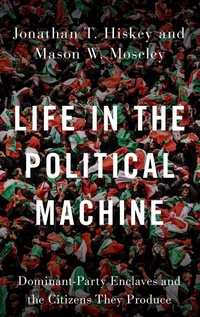
Life in the Political Machine
Dominant-Party Enclaves and the Citizens They Produce
Published on 8. September 2020
Book
Hardback
282 pages
978-0-19-750040-8 (ISBN)
Description
Whether in the northern provinces of Argentina, the central states of Mexico, or the southern states of the United States, less-than-democratic subnational regimes are often found within democratic national political systems. However, little is known about how or if these subnational pockets foster political attitudes and behavior that threaten the democratic norms that exist at the national level.
Life in the Political Machine offers one of the first systematic explorations of the ways in which subnational "dominant-party enclaves" influence citizens' political attitudes and behaviors through a focus on the provinces and states of Argentina and Mexico. Specifically, the authors find starkly divergent patterns of political attitudes and behaviors among citizens in dominant-party enclaves as opposed to those living in competitive multiparty systems. In the latter, the authors find a political culture that approximates what scholars have long documented in established democracies. In the former, they uncover three factors--the politicization of the rule of law, an uneven electoral playing field, and the partisan cooptation of state resources--that strongly shape citizens' understanding of democratic principles, accountability, and political participation. The authors argue that this environment erodes public support for democracy at the national level and that these local strongholds of illiberalism thus provide added fuel to the recent drift from democracy globally. Ultimately, this book calls for greater attention to subnational variations in citizens' political attitudes and behaviors in order to more fully understand the process through which a national democratic political culture can emerge.
Life in the Political Machine offers one of the first systematic explorations of the ways in which subnational "dominant-party enclaves" influence citizens' political attitudes and behaviors through a focus on the provinces and states of Argentina and Mexico. Specifically, the authors find starkly divergent patterns of political attitudes and behaviors among citizens in dominant-party enclaves as opposed to those living in competitive multiparty systems. In the latter, the authors find a political culture that approximates what scholars have long documented in established democracies. In the former, they uncover three factors--the politicization of the rule of law, an uneven electoral playing field, and the partisan cooptation of state resources--that strongly shape citizens' understanding of democratic principles, accountability, and political participation. The authors argue that this environment erodes public support for democracy at the national level and that these local strongholds of illiberalism thus provide added fuel to the recent drift from democracy globally. Ultimately, this book calls for greater attention to subnational variations in citizens' political attitudes and behaviors in order to more fully understand the process through which a national democratic political culture can emerge.
Reviews / Votes
This impressive, precise work offers lessons for many other countries. * A. Siaroff, CHOICE * Life in the Political Machine is an engaging, comparative exploration of the impact of pre-democratic parties in transitional democratic countries, specifically Mexico and Argentina. The authors combine original qualitative analysis based on extensive field research with broad statistical assessments from the Latin American Public Opinion Project datasets. This imaginative, original work clearly demonstrates the degree to which widely differing levels of support for democracies exist within and among countries, challenging the notion of national political cultures. Anyone interested in the process of democratic transitions should read this book. * Roderic Ai Camp, Claremont McKenna College * This book successfully brings together two important but largely separate literatures: those on subnational regimes and on political behavior. Moving the focus from elites to citizens, the book explores how undemocratic regions within democratic countries shape the minds and actions of their voters. Through statistical analyses of survey data and case studies, Hiskey and Moseley demonstrate that subnational dominant-party enclaves undermine democratic mass attitudes and behaviors. This important book provides a model of how to integrate political institutions and political culture in a single piece of research. * Carlos Gervasoni, Universidad Torcuato Di Tella * Hiskey and Moseley make an original and important contribution to our understanding of subnational dominant party enclaves by examining these enclaves through a new lens: the beliefs and behaviors of the citizens who reside in them. Using varied data from Argentina and Mexico, the authors demonstrate that undemocratic local political regimes affect how citizens engage with both subnational and national politics. This lucid book is highly recommended reading for anyone seeking to understand how subnational undemocratic regimes affect the quality of national democracy. * Rebecca Weitz-Shapiro, Brown University *More details
Language
English
Place of publication
New York
United States
Target group
Professional and scholarly
Dimensions
Height: 240 mm
Width: 161 mm
Thickness: 20 mm
Weight
590 gr
ISBN-13
978-0-19-750040-8 (9780197500408)
Copyright in bibliographic data and cover images is held by Nielsen Book Services Limited or by the publishers or by their respective licensors: all rights reserved.
Schweitzer Classification
Other editions
Additional editions
Jonathan T. Hiskey | Mason W. Moseley
Life in the Political Machine
Dominant-Party Enclaves and the Citizens They Produce
E-Book
06/2020
OUP eBook
€46.99
Available for download
Jonathan T. Hiskey | Mason W. Moseley
Life in the Political Machine
Dominant-Party Enclaves and the Citizens They Produce
E-Book
06/2020
OUP eBook
€36.99
Available for download
Persons
Jonathan T. Hiskey is Associate Professor of Political Science at Vanderbilt University. His work focuses on the impact that Latin America's uneven democratization processes have had on various local political and development outcomes in the region.
Mason W. Moseley is Assistant Professor of Political Science at West Virginia University. His research interests lie in comparative political behavior and public opinion, and he has published on protest, clientelism, and civic engagement, particularly in Latin America. He is the author of Protest State: The Rise of Everyday Contention in Latin America.
Mason W. Moseley is Assistant Professor of Political Science at West Virginia University. His research interests lie in comparative political behavior and public opinion, and he has published on protest, clientelism, and civic engagement, particularly in Latin America. He is the author of Protest State: The Rise of Everyday Contention in Latin America.
Content
Chapter 1: Welcome to the Machine
Chapter 2: Dominant-Party Citizens
Chapter 3: Conceptualizing and Measuring Dominant-Party Enclaves
Chapter 4: Tilling the Soil of an Uneven Landscape: Dirty Politics in Dominant-Party Enclaves
Chapter 5: The View From Inside the Machine: Democratic Attitudes in Dominant-Party Enclaves
Chapter 6: Severed Linkages: Distorted Accountability in Dominant-Party Enclaves
Chapter 7: Stacking the Deck: Political Participation in Dominant-Party Enclaves
Chapter 8: Conclusion
References
Appendix
Chapter 2: Dominant-Party Citizens
Chapter 3: Conceptualizing and Measuring Dominant-Party Enclaves
Chapter 4: Tilling the Soil of an Uneven Landscape: Dirty Politics in Dominant-Party Enclaves
Chapter 5: The View From Inside the Machine: Democratic Attitudes in Dominant-Party Enclaves
Chapter 6: Severed Linkages: Distorted Accountability in Dominant-Party Enclaves
Chapter 7: Stacking the Deck: Political Participation in Dominant-Party Enclaves
Chapter 8: Conclusion
References
Appendix