

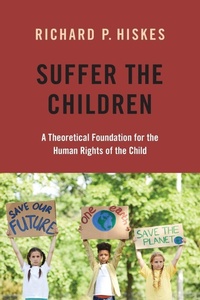
Suffer the Children
A Theoretical Foundation for the Human Rights of the Child
Published on 12. October 2021
Book
Paperback/Softback
208 pages
978-0-19-756599-5 (ISBN)
Description
In 1973, Hillary Rodham Clinton famously stated that "children's rights" is a slogan in search of a definition, used to bolster various arguments for peace and for specific rights, but without any coherent conception of children as political beings. In 1989, the United Nations established the basis for this definition in the Convention on the Rights of the Child (CRC), a document every nation in the world, save the United States, has ratified. Still, human rights theorists, scholars, and jurists continue to disagree as to the theoretical justification for children's human rights.
In Suffer the Children, Richard P. Hiskes establishes the first substantive theoretical foundation for the human rights of children. As Hiskes argues, recognizing the rights of children fundamentally alters the meaning and usefulness of human rights in a global context. Ironically, the case for children's rights, as Hiskes argues, should be seen as the evolution, distillation, or "maturing" of human rights in general. Children's human rights will end the debate about whether groups can have rights because, globally, many rights claims today are precisely group claims, including those from children. Moreover, Hiskes provides a new critical assessment of the United Nations CRC and explores child activism for human rights worldwide--in courts, on social networks, and in public demonstrations--to show how children are already claiming their rights in ways that will fundamentally change the meaning both of rights themselves and of democratic processes. Giving children rights in a way that avoids privileging any single cultural experience of children would make rights no longer a "Western," individualistic idea, but a truly global one.
In Suffer the Children, Richard P. Hiskes establishes the first substantive theoretical foundation for the human rights of children. As Hiskes argues, recognizing the rights of children fundamentally alters the meaning and usefulness of human rights in a global context. Ironically, the case for children's rights, as Hiskes argues, should be seen as the evolution, distillation, or "maturing" of human rights in general. Children's human rights will end the debate about whether groups can have rights because, globally, many rights claims today are precisely group claims, including those from children. Moreover, Hiskes provides a new critical assessment of the United Nations CRC and explores child activism for human rights worldwide--in courts, on social networks, and in public demonstrations--to show how children are already claiming their rights in ways that will fundamentally change the meaning both of rights themselves and of democratic processes. Giving children rights in a way that avoids privileging any single cultural experience of children would make rights no longer a "Western," individualistic idea, but a truly global one.
Reviews / Votes
Richard Hiskes does what has been long overdue, offers a theory of human rights that is grounded on an idea of humans as they are, not as enlightenment elites imagined themselves to be. By centering the question of the rights of children, he offers us not only a theory of the human rights of children, but also a re-grounded theory of human rights for all. * Brooke Ackerly, Vanderbilt University * This path-breaking rethinking of human rights through the lens of children's rights offers a refreshing combination of theoretical innovation and practical protection for the world's two billion children. Hiskes shows how children's rights expand our notions of the autonomy, relational identity, vulnerability, and interdependence of the human condition-at the same time as he extends the horizon of intergenerational accountability that is our best hope to confront the global environmental crisis. This is an essential reference for the next generation of human rights scholarship and planetary survival. * Alison Brysk, University of California, Santa Barbara * In this cogently argued and elegantly written book, Hiskes makes the radical and controversial claim that children are human. Following the relational and emancipatory logic of human rights to its provocative conclusions, he presents a powerful and long overdue case for full citizenship for humans of all ages. From now on, we shall have to view the disenfranchisement of children for what it is: a violation of their human rights. * Michael Goodhart, University of Pittsburgh * Richard Hiskes argues compellingly that children are rights-bearers entitled to be treated with respect for their dignity. Focusing particularly on their interests, as future generations, in environmental rights, Hiskes advocates for children to enjoy more rights to participation and to the rights of citizenship, even going so far as to advocate voting rights for children. The book is intellectually ambitious, clearly written, and persuasive. * Rhoda E. Howard-Hassmann, author of In Defense of Universal Human Rights * The human rights of children are a paradox: they are almost universally recognized, but almost never treated on par with the rights of adults. In this thought-provoking and engaging book, Richard Hiskes provides a sturdy philosophical foundation for children's rights, and then describes how taking them seriously would not only protect children, but also the future generations of which children are the first representatives-and reinvigorate the human rights of adults as well. * John H. Knox, Wake Forest University School of Law * In a unique, timely, provocative, and theoretically rich book, Richard P. Hiskes deploys the concepts of rationality and vulnerability to counter the claim that children cannot be rights bearers because they lack the requisite capacity to make rational choices. Arguing for shifting the burden onto society for the protection against actual and concrete harms, Hiskes contends that environmental human rights and the rights of children are inescapably linked on many levels. * Mahmood Monshipouir, Editor of Why Human Rights Still Matter in Contemporary Global Affairs *More details
Language
English
Place of publication
New York
United States
Target group
Professional and scholarly
Dimensions
Height: 234 mm
Width: 156 mm
Thickness: 11 mm
Weight
319 gr
ISBN-13
978-0-19-756599-5 (9780197565995)
Copyright in bibliographic data and cover images is held by Nielsen Book Services Limited or by the publishers or by their respective licensors: all rights reserved.
Schweitzer Classification
Other editions
Additional editions
Book
11/2021
Oxford University Press Inc
€130.20
Shipment within 15-20 days
E-Book
07/2021
OUP eBook
€18.49
Available for download
E-Book
07/2021
OUP eBook
€18.49
Available for download
Person
Richard P. Hiskes is Emeritus Professor of Political Science and Human Rights at the University of Connecticut. He is a political theorist who specializes in human rights theory, especially environmental human rights and the rights of children. He is former Editor of the Journal of Human Rights, Director of the Undergraduate Human Rights Program and Associate Director of the Human Rights Institute at UCONN, and twice elected President of the APSA Human Rights Section. He is the author of many books and articles on human rights and other aspects of political and democratic theory, and his 2009 book, The Human Right to a Green Future: Environmental Rights and Intergenerational Justice, won the 2010 APSA Human Rights Section award for Best Book in Human Rights.
Content
Acknowledgements
Introduction
Chapter 1: A Legacy of Child Exclusion: From Hobbes to the Present Lacuna in Human Rights Theory
Chapter 2: Vulnerable in Nature: Environmental Human Rights and the Claims of Generations
Chapter 3: Dignity and Dependency: The Honor of Children's Human Rights
Chapter 4: Beyond Victimhood: The CRC and the Human Rights of a Dignified Child
Chapter 5: From Participation to Citizenship: Every Child's Human Right to an "Open Future"
Chapter 6: Children Claiming the Future of Human Rights: "Global Kids" in Courts, on Networks, and in the Streets
Chapter 7: Toward a More Youthful Democracy and a More Mature Human Rights
References
Introduction
Chapter 1: A Legacy of Child Exclusion: From Hobbes to the Present Lacuna in Human Rights Theory
Chapter 2: Vulnerable in Nature: Environmental Human Rights and the Claims of Generations
Chapter 3: Dignity and Dependency: The Honor of Children's Human Rights
Chapter 4: Beyond Victimhood: The CRC and the Human Rights of a Dignified Child
Chapter 5: From Participation to Citizenship: Every Child's Human Right to an "Open Future"
Chapter 6: Children Claiming the Future of Human Rights: "Global Kids" in Courts, on Networks, and in the Streets
Chapter 7: Toward a More Youthful Democracy and a More Mature Human Rights
References