

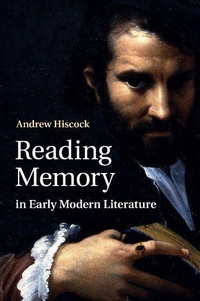
Reading Memory in Early Modern Literature
Published on 6. November 2014
Book
Paperback/Softback
334 pages
978-1-107-46340-0 (ISBN)
Description
'He who remembers or recollects, thinks' declared Francis Bacon, drawing attention to the absolute centrality of the question of memory in early modern Britain's cultural life. The vigorous debate surrounding the faculty had dated back to Plato at least. However, responding to the powerful influences of an ever-expanding print culture, humanist scholarship, the veneration for the cultural achievements of antiquity, and sweeping political upheaval and religious schism in Europe, succeeding generations of authors from the reign of Henry VIII to that of James I engaged energetically with the spiritual, political and erotic implications of remembering. Treating the works of a host of different writers from the Earl of Surrey, Katharine Parr and John Foxe, to William Shakespeare, Mary Sidney, Ben Jonson and Francis Bacon, this study explores how the question of memory was intimately linked to the politics of faith, identity and intellectual renewal in Tudor and early Stuart Britain.
Reviews / Votes
'Hiscock offers a fascinating account of the nature and uses of individual and cultural memory in the early modern period ... he elegantly demonstrates ... that remembering, committing to memory and memorialising were notions - and actions - at the very heart of identity formation through the course of the long sixteenth century.' Greg Walker, University of Edinburgh 'What a splendid book! ... a study of memory in early modern English literature which will be of real value to students interested in either or both topics ... these individual studies also present a compelling narrative of the ways in which older traditions of memory - and also poetry - gradually give way to newer ideas and idioms, so that the book as a whole provides ... clearly focussed literary-critical snapshots of an age in transition.' Mike Pincombe, Newcastle University 'Although the sweep of this book is vast, the author's findings are sensibly grounded and often quite specific. This through-thread, consistent with the masterful arrangement of the book as a whole, makes it a delight to read.' Renaissance Quarterly 'Reading Memory [in Early Modern Literature] is exhaustively researched and filled with remarkable insights.' The Review of English StudiesMore details
Language
English
Place of publication
Cambridge
United Kingdom
Target group
College/higher education
Product notice
Paperback (trade)
Illustrations
5 Halftones, unspecified
Dimensions
Height: 229 mm
Width: 152 mm
Thickness: 19 mm
Weight
485 gr
ISBN-13
978-1-107-46340-0 (9781107463400)
Copyright in bibliographic data and cover images is held by Nielsen Book Services Limited or by the publishers or by their respective licensors: all rights reserved.
Schweitzer Classification
Other editions
Additional editions
Andrew Hiscock
Reading Memory in Early Modern Literature
Book
10/2011
Cambridge University Press
€129.60
Shipment within 15-20 days
Andrew Hiscock
Reading Memory in Early Modern Literature
E-Book
10/2011
1st Edition
Cambridge University Press
€26.49
Available for download
Person
Andrew Hiscock is Professor of English at Bangor University, Wales. He teaches and publishes widely on early modern literature in British and European contexts. His earlier monographs include Authority and Desire: Crises of Interpretation in Shakespeare and Racine (1996) and The Uses of this World: Thinking Space in Shakespeare, Marlowe, Cary and Jonson (2004). He edited the 2008 Yearbook of English Studies devoted to Tudor literature and his edited critical collection Middleton: Women Beware Women appeared in 2011. He is co-editor of the academic journal English and is about to take up his role as editor (English Literature) of the Modern Language Review and as series editor for the Yearbook of English Studies.
Content
Introduction: 'the dark backward and abyss of time'; 1. 'To seke the place where I my self hadd lost': acts of memory in the poetry of Henry Howard, the Earl of Surrey; 2. 'Remembre not (lorde) myne offences': Katherine Parr and the politics of recollection; 3. 'Better a few things well pondered, than to trouble the memory with too much': troubling memory and martyr in Foxe's Acts and Monuments; 4. Text, recollection and Elizabethan fiction: Gascoigne, Nashe, Deloney; 5. The doleful Clorinda? Mary Sidney, Countess of Pembroke, and the vocation of memory; 6. 'Tell me, where all past yeares are': John Donne and the obligations of memory; 7. 'Of all the powers of the mind [...] the most delicate and fraile': the poetry of Ben Jonson and the renewal of memory; 8. 'This art of memory': Francis Bacon, memory and the discourses of power.