

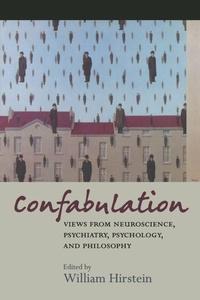
Confabulation
Views from Neuroscience, Psychiatry, Psychology and Philosophy
Published on 6. August 2009
Book
Paperback/Softback
312 pages
978-0-19-920891-3 (ISBN)
Description
When people confabulate, they make a false claim that they honestly believe is true. The book contains countless fascinating examples of confabulatory behaviour - people falsely recalling events from their childhood, the subject who was partially blind but insisted he could see, the amputee convinced that he retained all his limbs, to the patient who believed that his own parents had been replaced by imposters. Though confabulations can result from neurological damage, they can also appear in perfectly healthy people. Yet, how can confabulators so often appear to be of sound mind, yet not see their own errors?
This book brings together some of the most advanced thinking on confabulation in neuroscience, psychiatry, psychology, and philosophy, in an attempt to understand this phenomenon; what are the clinical symptoms of each type of confabulation? Which brain functions are damaged in clinical confabulators? What are the neuropsychological characteristics of each type? What causes confabulation in healthy individuals? One reason why the study of confabulation is important is that there is wide agreement that the malfunctions that produce confabulation are malfunctions in significant, high-level cognitive processes.
With contributions from a range of leading psychologists, psychiatrists, neuroscientists, and philosophers, the book develops an interdisciplinary dialogue that promises to increase our understanding of confabulatory neurological patients, and perhaps help us better understand memory, consciousness, and human nature itself.
This book brings together some of the most advanced thinking on confabulation in neuroscience, psychiatry, psychology, and philosophy, in an attempt to understand this phenomenon; what are the clinical symptoms of each type of confabulation? Which brain functions are damaged in clinical confabulators? What are the neuropsychological characteristics of each type? What causes confabulation in healthy individuals? One reason why the study of confabulation is important is that there is wide agreement that the malfunctions that produce confabulation are malfunctions in significant, high-level cognitive processes.
With contributions from a range of leading psychologists, psychiatrists, neuroscientists, and philosophers, the book develops an interdisciplinary dialogue that promises to increase our understanding of confabulatory neurological patients, and perhaps help us better understand memory, consciousness, and human nature itself.
More details
Language
English
Place of publication
Oxford
United Kingdom
Target group
College/higher education
Professional and scholarly
Illustrations
8 line figures
Dimensions
Height: 234 mm
Width: 156 mm
Thickness: 17 mm
Weight
474 gr
ISBN-13
978-0-19-920891-3 (9780199208913)
Copyright in bibliographic data and cover images is held by Nielsen Book Services Limited or by the publishers or by their respective licensors: all rights reserved.
Schweitzer Classification
Person
William Hirstein is Professor and Chair of the Philosophy Department at Elmhurst College, in Elmhurst, Illinois, USA. He received his PhD from the University of California, Davis, in 1994. His graduate and postdoctoral studies were conducted under the supervision of John Searle, V. S. Ramachandran, and Patricia Churchland. He is the author of several books, including On the Churchlands (Wadsworth, 2004), and Brain Fiction: Self-Deception and the Riddle of Confabulation (MIT, 2005). His other interests include autism, sociopathy, brain laterality, and the misidentification syndromes.
Content
1. Introduction: what is confabulation? ; 2. Confabulation in anterior communicating artery syndrome ; 3. False memories: a kind of confabulation in non-clinical subjects ; 4. The cognitive consequences of forces confabulation: evidence from studies of eyewitness suggestibility ; 5. Confabulation and ego functions; the 'ego dysequilibrium theory' ; 6. 'That's not my arm, Doctor': accounting for misidentifications with a two-phase theory ; 7. Delusional confabulations and self-deception ; 8. Confabulation as a psychiatric symptom ; 9. Confabulation and delusion ; 10. Anosognosia for hemiplegia: a confabulatory state ; 11. Everyday confabulation ; 12. Temporal consciousness and confabulation: escape from unconscious explanatory idols ; 13. Distentangling the motivational theories of confabulation