

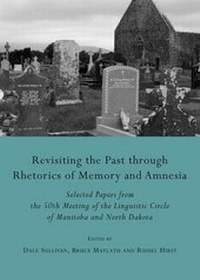
Revisiting the Past through Rhetorics of Memory and Amnesia
Selected Papers from the 50th Meeting of the Linguistic Circle of Manitoba and North Dakota
Published on 9. December 2010
Book
Hardback
240 pages
978-1-4438-2555-9 (ISBN)
Description
As the 21st century's first decade draws to a close, we are reminded of events of the past, both distant and recent. Many resulted in violent conflict. This volume investigates how our memories are shaped by rhetorics crafted by people who want audiences to remember events in specific ways. From the pivotal battle between Americans and British and their Loyalist allies during the American Revolution to North America's First Nations conflicts with the White mainstream to current memories and rhetoric about the recent war in Iraq, the authors of this book examine the ways in which rhetoric acts as a catalyst not only for cultural memory but also cultural amnesia. Both scholars and the general public will find the analyses in these chapters informative, insightful, and provocative. The authors delve into literary fiction, accounts of history, and even the vocabulary of the English language to examine what and how we remember and forget. Assembled from coast to coast across the US and Canada, the authors demonstrate how several rhetorics at once are often at play, from Wallace Stegner's fiction to the architecture of urban Toronto, the US Air Force Memorial in Arlington, Virginia, and even in rural cemeteries.
Reviews / Votes
'The essays collected in Revisiting the Past through Rhetorics of Memory and Amnesia contribute to a transformation taking place in classical rhetorical theory and criticism. Drawing upon what few would argue has been the least attended of the five parts of classical rhetoric, the canon of memory, the studies in the collection connect with emerging work in rhetoric, literary criticism, and visual communication. Studies in the rhetoric and politics of space and place have been prominent in the past decade. This collection contributes to this movement, linking such studies to the ways that inhabited spaces, historic places, and ceremonial sites are rhetorically constructed to perpetuate as well as to erase memories. The first part of the collection looks at public places and the ways they are articulated to retain, refresh, and revise memory-primarily collective memory. For example, Sally Booth investigates the rhetoric of walking tours in Toronto, describing "a narration of history that distorts the specificity of place and ignores certain aspects of history in order to mythologize a past that is more easily consumed." But memory functions rhetorically at the site of the individual as well. We see this particularly in literary works, as Sarah Himsel-Burcon explores in her analysis of Gayl Jones' novel Corregidora, the story of four generations of Brazilian slaves and their determination to keep alive the memory of what they suffered and thereby situate themselves within a history from which they might otherwise have been excluded. Visual memory is examined in Mary Fitzgerald and Elizabethada Wright's essay comparing different ways in which deceased human bodies are situated can affect whether they awaken memory, as when an unknown burial ground is discovered and those interred there are given a place they had lost in a community's history, or whether their situation erases memory, as when bodies are displayed as representations of human biology. Although we might find studies elsewhere that are similar to some in this collection, it would be difficult to find works in one place that at once encompass the scope and at the same time the unifying focus that we encounter here. The larger argument made by editors Dale Sullivan, Bruce Maylath, and Russell Hirst, which makes the collection important, is the significance of memory in the ideological processes of shaping and transforming personal and cultural identity and values.'-Gerald Savage, Professor of English, Illinois State University'In contrast to the classical interest in memory as a skill, or the psychological interest in the neurological and cognitive schema enabling individual recall, contemporary interest, as represented in this collection, examines the collective and communicative nature of memory. In this respect, The Rhetorics of Memory is consistent with a burgeoning, multi-disciplinary literature focused on the social nature of remembering, on the symbolic constitution of memory, and the political and cultural consequences of memory. Much theorizing has been done across the humanities and social sciences in this respect. Where this volume of essays stands to make a significant contribution is in its focus on the particular "sites" in which memory is accomplished. Ranging from literary works to "body works," from historical tours to battlefield monuments, The Rhetorics of Memory considers the range of sites, multiple media, and social contexts within which remembrance is accomplished. It's passionate and detailed analyses are more than simple applications of established theories, they comprise a rich effort to interrogate theoretical assumptions, to test them in the crucible of everyday encounters with memory. Rhetorics of Memory seeks collective memory where it happens in order to understand how it happens, why we remember as we do, and to what effect. The essays in this volume are accessible enough to enrich students' introduction to both theoretical and methodological questions associated with the study of collective memory from a rhetorical perspective, yet they are rich enough to bear the scrutiny of scholars interested in the study of memory.'-Gordon Coonfield, Associate Professor of Communication, Villanova University'Even though it is one of the parts of classical rhetoric, memory has been ignored in rhetoric studies for centuries. Revisiting the Past Through Rhetorics of Memory and Amnesia introduces the reader to the current reclamation of memory in rhetoric studies. The essays cover nearly every aspect of memory studies, and the book's introduction and organization serve as a primer for memory theory. Indeed, one of the book's strengths is that it contains no overt theorizing. Instead theory emerges from specific empirical case studies of memory (or amnesia). For example, Michael Halloran's study of the accounts of the battle of Saratoga illustrates the disfigurement of memory to suit ideology. Miriam Raethel's study of traumatic memory breaks new ground in studies of Holocaust literature. Mary Fitzgerald and Elizabethada Wright's "Rhetorical Situation of the Sacred: Exigences of the Human Body" confronts anthropological and religious attitudes toward the dead and sees a conflict between two value-laden definitions of memory. The essays not only present the most current thinking in memory studies but also reveal how memory studies can reconfigure approaches to problems that bedevil history and the social sciences.'-John D. Schaeffer, Professor of English, Northern Illinois UniversityMore details
Edition
Unabridged edition
Language
English
Place of publication
Newcastle upon Tyne
United Kingdom
Target group
Professional and scholarly
Edition type
Unabridged edition
Product notice
With dust jacket
Dimensions
Height: 212 mm
Width: 148 mm
ISBN-13
978-1-4438-2555-9 (9781443825559)
Copyright in bibliographic data and cover images is held by Nielsen Book Services Limited or by the publishers or by their respective licensors: all rights reserved.
Schweitzer Classification
Persons
Dale Sullivan is Professor of English at North Dakota State University, USA. He has published in several journals, among them Rhetorica, Rhetoric Society Quarterly, Rhetoric Review, Hermes, and Technical Communication Quarterly. His primary research interests include the rhetoric of religion, the rhetoric of science, and the rhetoric of agriculture and food.Bruce Maylath is Professor of English at North Dakota State University, USA. His current research takes up translation issues in technical communication. Books he has co-edited include Approaches to Teaching Non-Native English Speakers across the Curriculum and Language Awareness: A History and Implementations. His other publications appear in numerous books and journals.Russel Hirst is Associate Professor of English at the University of Tennessee, Knoxville, USA. He directs his department's program in technical communication. His research interests are in history of rhetoric as well as in style and information design for scientific and technical communication.