

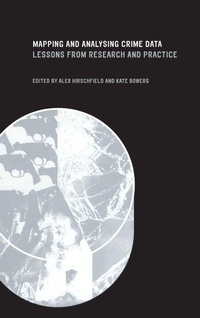
Mapping and Analysing Crime Data
Lessons from Research and Practice
1st Edition
Published on 26. April 2001
Book
Hardback
308 pages
978-0-7484-0922-8 (ISBN)
Description
One of the key methods of reducing and dealing with criminal activity is to accurately gauge and then analyse the geographical distribution of crime (from small scale to large scale areas). Once the police and government know what areas suffer most from criminal activity they can assess why this is the case and then deal with it in the most effective way.
Crime mapping and the spatial analysis of crime data have become recognised as powerful tools for the study and control of crime. Much of the emerging demand for more information and detailed crime pattern analysis have been driven by legislative changes, such as the UK's new Crime and Disorder Act which has placed a joint statutory duty on Police Forces and Local Authorities to produce crime and disorder audits for their areas.
The book sets out methods used in the fields of Geographical Information Systems and highlights areas of best practice, examines the types of problems to which spatial crime analysis can be applied, reviews the capabilities and limitations of existing techniques, and explores the future directions of spatial crime analysis and the need for training. It centres on a series of case studies highlighting the experiences of academics and practitioners in agencies centrally involved in the partnership approach to crime prevention.
Practitioners and academics not only in the UK but also worldwide should be interested in the book as an up-to-date information resource and a practical guide.
Crime mapping and the spatial analysis of crime data have become recognised as powerful tools for the study and control of crime. Much of the emerging demand for more information and detailed crime pattern analysis have been driven by legislative changes, such as the UK's new Crime and Disorder Act which has placed a joint statutory duty on Police Forces and Local Authorities to produce crime and disorder audits for their areas.
The book sets out methods used in the fields of Geographical Information Systems and highlights areas of best practice, examines the types of problems to which spatial crime analysis can be applied, reviews the capabilities and limitations of existing techniques, and explores the future directions of spatial crime analysis and the need for training. It centres on a series of case studies highlighting the experiences of academics and practitioners in agencies centrally involved in the partnership approach to crime prevention.
Practitioners and academics not only in the UK but also worldwide should be interested in the book as an up-to-date information resource and a practical guide.
More details
Language
English
Place of publication
London
United Kingdom
Target group
Professional and scholarly
Academic and Professional Practice & Development
Dimensions
Height: 235 mm
Width: 157 mm
Thickness: 21 mm
Weight
599 gr
ISBN-13
978-0-7484-0922-8 (9780748409228)
Copyright in bibliographic data and cover images is held by Nielsen Book Services Limited or by the publishers or by their respective licensors: all rights reserved.
Schweitzer Classification
Other editions
Additional editions
Book
09/2019
1st Edition
CRC Press
€124.00
Shipment within 15-20 days

Other
09/2003
CRC Press
€145.94
Article exhausted; check different version

E-Book
04/2001
1st Edition
CRC Press
€92.49
Available for download

E-Book
04/2001
1st Edition
CRC Press
€92.49
Available for download
Persons
Alex Hirschfield, Kate Bowers
Content
1. Introduction Part I: Crime Mapping and Research 2. Methods for Automating the Geographical Analysis of Crime Incident Data 3. GIS and the Journey to Crime: An Analysis of Patterns in South Yorkshire 4. Crime, Repeat Victimisation and GIS Part II: Local Authority Applications 5. Combating Crime Through Partnership: Examples of Crime and Disorder Mapping Solutions in London, UK 6. A GIS-linked Database for Monitoring Repeat Domestic Burglary Part III: GIS in the Police and Emergency Services 7. Mapping Out Hazardous Space for Police Work 8. GIS for Spatial Analysis of Fire Incidence: Identification of Social, Economic and Environmental Risk Indicators Part IV: International Perspectives 9. Tools in the Spatial Analysis of Crime 10. The Evolution of Crime Mapping in the United States: From the Descriptive to the Analytic Part V: Practical Considerations: What Can We Expect of GIS? 11. What to do About it?: Let's turn off our minds and GIS 12. Decision Support in Crime Prevention: Data Analysis, Policy Evaluation and GIS Applications; GIS in the police and Emergency Services; International Perspectives; Future Directions