

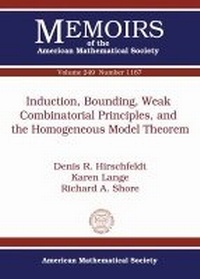
Induction, Bounding, Weak Combinatorial Principles, and the Homogeneous Model Theorem
Will be published approx. on 30. October 2017
Book
Paperback/Softback
101 pages
978-1-4704-2657-6 (ISBN)
Description
Goncharov and Peretyat'kin independently gave necessary and sufficient conditions for when a set of types of a complete theory $T$ is the type spectrum of some homogeneous model of $T$. Their result can be stated as a principle of second order arithmetic, which is called the Homogeneous Model Theorem (HMT), and analyzed from the points of view of computability theory and reverse mathematics. Previous computability theoretic results by Lange suggested a close connection between HMT and the Atomic Model Theorem (AMT), which states that every complete atomic theory has an atomic model. The authors show that HMT and AMT are indeed equivalent in the sense of reverse mathematics, as well as in a strong computability theoretic sense and do the same for an analogous result of Peretyat'kin giving necessary and sufficient conditions for when a set of types is the type spectrum of some model.
More details
Series
Language
English
Place of publication
Providence
United States
Target group
Professional and scholarly
Dimensions
Height: 254 mm
Width: 178 mm
Weight
180 gr
ISBN-13
978-1-4704-2657-6 (9781470426576)
Copyright in bibliographic data and cover images is held by Nielsen Book Services Limited or by the publishers or by their respective licensors: all rights reserved.
Schweitzer Classification
Persons
Denis R. Hirschfeldt, University of Chicago, Illinois.
Karen Lange, Wellesley College, Massachusetts.
Richard A. Shore, Cornell University, Ithaca, New York.
Karen Lange, Wellesley College, Massachusetts.
Richard A. Shore, Cornell University, Ithaca, New York.
Content
Introduction
Definitions
The atomic model theorem and related principles
Defining homogeneity
Closure conditions and model existence
Extension functions and model existence
The reverse mathematics of model existence theorems
Open questions
Appendix A. Approximating generics
Appendix B. Atomic trees
Appendix C. Saturated models
Bibliography.
Definitions
The atomic model theorem and related principles
Defining homogeneity
Closure conditions and model existence
Extension functions and model existence
The reverse mathematics of model existence theorems
Open questions
Appendix A. Approximating generics
Appendix B. Atomic trees
Appendix C. Saturated models
Bibliography.