

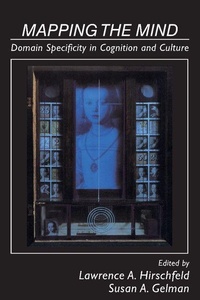
Mapping the Mind
Domain Specificity in Cognition and Culture
Published on 29. April 1994
Book
Paperback/Softback
532 pages
978-0-521-42993-1 (ISBN)
Description
What is the nature of human thought? A long dominant view holds that the mind is a general problem-solving device that approaches all questions in much the same way. Chomsky's theory of language, which revolutionised linguistics, challenged this claim, contending that children are primed to acquire some skills, like language, in a manner largely independent of their ability to solve other sorts of apparently similar mental problems. In recent years researchers in anthropology, psychology, linguistic and neuroscience have examined whether other mental skills are similarly independent. Many have concluded that much of human thought is 'domain-specific'. Thus, the mind is better viewed as a collection of cognitive abilities specialised to handle specific tasks than a general problem solver. This volume introduces a general audience to a domain-specificity perspective, by compiling a collection of essays exploring how several of these cognitive abilities are organised.
Reviews / Votes
."..thought provoking and often compelling...The introduction and many of the chapters provide grounding in the basic issues for readers who are new to the topic. At the same time, because many of the chapters push the domain specificity hypothesis to its limits, readers who are well acquainted with the issues will find this volume worthwhile reading." Contemporary PsychologyMore details
Language
English
Place of publication
Cambridge
United Kingdom
Target group
Professional and scholarly
Product notice
Paperback (trade)
Illustrations
8 Tables, unspecified; 12 Line drawings, unspecified
Dimensions
Height: 229 mm
Width: 152 mm
Thickness: 31 mm
Weight
854 gr
ISBN-13
978-0-521-42993-1 (9780521429931)
Copyright in bibliographic data and cover images is held by Nielsen Book Services Limited or by the publishers or by their respective licensors: all rights reserved.
Schweitzer Classification
Other editions
Additional editions
Lawrence A. Hirschfeld | Susan A. Gelman
Mapping the Mind
Domain Specificity in Cognition and Culture
Book
05/1994
Cambridge University Press
€61.90
Article exhausted; check for reprint
Previous edition
Lawrence A. Hirschfeld | Susan A. Gelman
Mapping the Mind
Domain Specificity in Cognition and Culture
Book
05/1994
Cambridge University Press
€61.90
Article exhausted; check for reprint
Persons
Content
Preface; Domain specificity: an introduction Lawrence Hirschfeld and Susan Gelman; Part I. General/Theoretical Approaches: 1. The modularity of thought Dan Sperber; 2. Domain specificity and cultural variation are not inconsistent: lessons from number and music Rochel Gelman and Kimberly Brenneman; Part II. Are Domains Theories?: 3. The theory theory Alison Gopkin and Henry Wellman; 4. Thinking by children and scientists: false analogies and neglected similarities Paul Harris; 5. Core domains versus scientific theories: evidence from systematics and Itzaj-Maya folkbiology Scott Atran; 6. Essences and folk theories of biology Susan Gelman, John Coley and Gail Gottfried; Part III. Origins of Domain Knowledge, Biology and Evolutionary Approaches: 7. The organization of lexical knowledge in the brain: evidence from category- and modality-specific deficits Alfonso Caramazza, Argye Hillis, Elwyn Keek and Michele Miozzo; 8. Origins of domain-specificity: the evolution of functional organization Leda Cosmides and John Tobby; 9. Tomm and Toby: core architecture and domain specificity Alan Leslie; 10. 'Moral belief' form vs. content David Premack; 11. Domain specific knowledge and conceptual change Susan Carey and Elizabeth Spelke; 12. Is the acquisition of social categories based on domain-specific competence or on knowledge transfer? Lawrence Hirschfield; 13. The birth and nurturance of concepts by domains: the origins of concepts of living things Frank Keil; Part IV. Domains Across Cultures and Languages: 14. Cognitive constraints on cultural representation: natural ontologies and religious ideas Pascal Boyer; 15. Universal and culture-specific properties of children's mental models of the earth Stella Vosniadou; 16. Cognitive domains and the structure of the lexicon Anna Wierzbicka; Part V. Implications for Education: 17. 'Teachers' models of children's minds and learning Sidney Strauss and Tamar Shilony; 18. 'Situated rationalism' biological and social preparation for learning Lauren Resnick.