

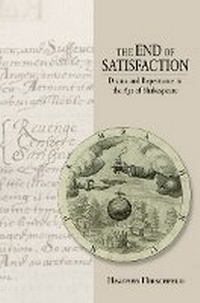
The End of Satisfaction
Drama and Repentance in the Age of Shakespeare
Published on 17. April 2014
Book
Hardback
256 pages
978-0-8014-5274-1 (ISBN)
Description
In The End of Satisfaction, Heather Hirschfeld recovers the historical specificity and the conceptual vigor of the term "satisfaction" during the sixteenth and early seventeenth centuries. Focusing on the term's significance as an organizing principle of Christian repentance, she examines the ways in which Shakespeare and his contemporaries dramatized the consequences of its re- or de-valuation in the process of Reformation doctrinal change. The Protestant theology of repentance, Hirschfeld suggests, underwrote a variety of theatrical plots "to set things right" in a world shorn of the prospect of "making enough" (satisfacere).
Hirschfeld's semantic history traces today's use of "satisfaction"-as an unexamined measure of inward gratification rather than a finely nuanced standard of relational exchange-to the pressures on legal, economic, and marital discourses wrought by the Protestant rejection of the Catholic sacrament of penance (contrition, confession, satisfaction) and represented imaginatively on the stage. In so doing, it offers fresh readings of the penitential economies of canonical plays including Dr. Faustus, The Revenger's Tragedy, The Merchant of Venice, and Othello; considers the doctrinal and generic importance of lesser-known plays including Enough Is as Good as a Feast and Love's Pilgrimage; and opens new avenues into the study of literature and repentance in early modern England.
Hirschfeld's semantic history traces today's use of "satisfaction"-as an unexamined measure of inward gratification rather than a finely nuanced standard of relational exchange-to the pressures on legal, economic, and marital discourses wrought by the Protestant rejection of the Catholic sacrament of penance (contrition, confession, satisfaction) and represented imaginatively on the stage. In so doing, it offers fresh readings of the penitential economies of canonical plays including Dr. Faustus, The Revenger's Tragedy, The Merchant of Venice, and Othello; considers the doctrinal and generic importance of lesser-known plays including Enough Is as Good as a Feast and Love's Pilgrimage; and opens new avenues into the study of literature and repentance in early modern England.
Reviews / Votes
Hirschfeld's readings are consistently imaginative and challenging. Her book is the product of wide reading and deep and sustained thinking and does enough to satisfy this reader.- Kennth J.E. Graham (Early Theatre) One mark of a good critical book is that it creates a minifield and brings together disparate scholarship into new connections. This characterizes Heather Hirschfield's new book, which coalesces around the term "satisfaction." If the subject were only the satisfaction for sin discussed by theology, the result might be predictable. But Hirschfield connects theological satisfaction with an unexpected context, the Rolling Stones' "I can't get no satisfaction," a playful connection that is, in fact, productive.
- Dennis Taylor (Renaissance Quarterly) Part of the book's achievment is that the questions it continually seems to elicit from the reader are as suprising as Hirshcfield's own argument is provocative.... The End of Satisfaction makes a real contribution to our sense of how changing theologies of penitence were registered by the culture-and especially drama-of sixteenth- and seventeenth-century England.
- William Junker (Comparative Drama)
More details
Language
English
Place of publication
Ithaca
United States
Product notice
Paper over boards
Illustrations
1 halftone - 1 Halftones, black and white
Dimensions
Height: 229 mm
Width: 152 mm
Thickness: 24 mm
Weight
907 gr
ISBN-13
978-0-8014-5274-1 (9780801452741)
Copyright in bibliographic data and cover images is held by Nielsen Book Services Limited or by the publishers or by their respective licensors: all rights reserved.
Schweitzer Classification
Other editions
Additional editions
E-Book
04/2014
Cornell University Press
€47.99
Available for download
Person
Heather Hirschfeld is Associate Professor of English at the University of Tennessee. She is the author of Joint Enterprises: Collaborative Drama and the Institutionalization of the English Renaissance Theater.
Content
Introduction: Where's Satisfaction?
1. "Adew, to all Popish satisfactions": Reforming Repentance in Early Modern England
2. The Satisfactions of Hell: Doctor Faustus and the Descensus Tradition
3. Setting Things Right: The Satisfactions of Revenge
4. As Good as a Feast?: Playing (with) Enough on the Elizabethan Stage5. "Wooing, wedding, and repenting": The Satisfactions of
Marriage in Othello and Love's Pilgrimage
Postscript: Where's the Stage at the End of Satisfaction?
1. "Adew, to all Popish satisfactions": Reforming Repentance in Early Modern England
2. The Satisfactions of Hell: Doctor Faustus and the Descensus Tradition
3. Setting Things Right: The Satisfactions of Revenge
4. As Good as a Feast?: Playing (with) Enough on the Elizabethan Stage5. "Wooing, wedding, and repenting": The Satisfactions of
Marriage in Othello and Love's Pilgrimage
Postscript: Where's the Stage at the End of Satisfaction?