

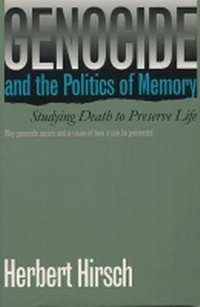
Genocide and the Politics of Memory
Studying Death to Preserve Life
Published on 17. April 1995
Book
Hardback
256 pages
978-0-8078-2198-5 (ISBN)
Description
More than sixty million people have been victims of genocide in the twentieth century alone, including recent casualties in Bosnia and Rwanda. Herbert Hirsch studies repetitions of large-scale human violence in order to ascertain why people in every historical epoch seem so willing to kill each other. He argues that the primal passions unleashed in the cause of genocide are tied to the manipulation of memory for political purposes. According to Hirsch, leaders often invoke or create memories of real or fictitious past injustices to motivate their followers to kill for political gain or other reasons. Generations pass on their particular versions of events, which then become history. If we understand how cultural memory is created, Hirsch says, we may then begin to understand how and why episodes of mass murder occur and will be able to act to prevent them. In order to revise the politics of memory, Hirsch proposes essential reforms in both the modern political state and in systems of education.
More details
Language
English
Place of publication
Chapel Hill
United States
Target group
College/higher education
Dimensions
Height: 235 mm
Width: 156 mm
ISBN-13
978-0-8078-2198-5 (9780807821985)
Copyright in bibliographic data and cover images is held by Nielsen Book Services Limited or by the publishers or by their respective licensors: all rights reserved.
Schweitzer Classification
Person
Herbert Hirsch, professor of political science at Virginia Commonwealth University, is author of many books, including Persistent Prejudice: Perspectives on Anti-Semitism and Violence as Politics: A Series of Original Essays.