

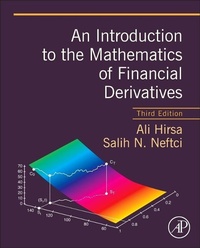
An Introduction to the Mathematics of Financial Derivatives
3rd Edition
Published on 16. December 2013
Book
Hardback
454 pages
978-0-12-384682-2 (ISBN)
Description
An Introduction to the Mathematics of Financial Derivatives is a popular, intuitive text that eases the transition between basic summaries of financial engineering to more advanced treatments using stochastic calculus. Requiring only a basic knowledge of calculus and probability, it takes readers on a tour of advanced financial engineering. This classic title has been revised by Ali Hirsa, who accentuates its well-known strengths while introducing new subjects, updating others, and bringing new continuity to the whole. Popular with readers because it emphasizes intuition and common sense, An Introduction to the Mathematics of Financial Derivatives remains the only "introductory" text that can appeal to people outside the mathematics and physics communities as it explains the hows and whys of practical finance problems.
Reviews / Votes
"This text introduces quantitative tools used in pricing financial derivatives to those with basic knowledge of calculus and probability. It reviews basic derivative instruments, the arbitrage theorem, and deterministic calculus, and describes models and notation in pricing derivatives, tools in probability theory, martingales and martingale representations, differentiation in stochastic environments, the Wiener and Levy processes and rare events in financial markets..." --ProtoView.com, February 2014"Ali Hirsa has done a superb job with this third edition of the very popular Neftci's An Introduction to the Mathematics of Financial Derivatives. New chapters and sections have been added covering in particular credit derivatives (Chapter 23) and jump processes and the associated partial integro-differential equations. The new material on numerical methods, in particular on Fourier techniques (Chapter 22) and calibration (Chapter 25), and added examples and exercises are very welcome. Overall, this new edition offers substantially more that the previous one in all of its chapters. This is a unique sophisticated introduction to financial mathematics accessible to a wide audience. Truly remarkable!" --Jean-Pierre Fouque, University of California, Santa Barbara
"The publication of this expansive and erudite text in a new edition by one of the most highly respected scholars in the field should be a welcome event for practitioners and academics alike." --Lars Tyge Nielsen, Columbia University
#"There are many books on mathematics, probability, and stochastic calculus, but relatively few focus entirely on the pricing and hedging of financial derivatives. I have used the second edition for finance and financial engineering classes for years, and will continue with the third edition; the book will no doubt remain a valuable reference for industry practitioners as well." --Robert L. Kimmel, National University of Singapore
"An excellent introduction to a wide range of topics in pricing financial derivatives with highly accessible mathematical treatment. Its heuristic style in explaining basic mathematical concepts relevant to financial markets greatly facilitates understanding the fundamentals of derivative pricing." --Seppo Pynnonen, Unversity of Vaasa
"What makes this introductory text unique for students or practitioners without a major in mathematics or physics is that it provides the most helpful heuristics while clearly stating how or why the concepts are useful for practical problems in finance. The timely additions on credit derivatives and PDEs provide considerable value-added in comparison to the second edition." --Mishael Milakovic, University of Bamberg
More details
Edition
3rd edition
Language
English
Place of publication
San Diego
United States
Publishing group
Elsevier Science Publishing Co Inc
Target group
Professional and scholarly
Upper-division undergraduates and graduate students seeking an introduction to the mathematics and concepts underlying financial derivatives in specific and investment vehicles (options, futures, and other financial engineering products) in general.
Dimensions
Height: 241 mm
Width: 189 mm
Thickness: 27 mm
Weight
1074 gr
ISBN-13
978-0-12-384682-2 (9780123846822)
Copyright in bibliographic data and cover images is held by Nielsen Book Services Limited or by the publishers or by their respective licensors: all rights reserved.
Schweitzer Classification
Other editions
Additional editions
E-Book
12/2013
3rd Edition
Academic Press
€62.99
Available for download
Previous edition
Salih N. Neftci
An Introduction to the Mathematics of Financial Derivatives
Book
06/2000
2nd Edition
Academic Press
€80.46
Article exhausted; check for reprint
Person
Ali Hirsa is a professor and co-director of financial engineering at the Industrial Engineering & Operations Research at Columbia University. He is also Managing Partner at Sauma Capital, LLC and Senior Advisor at DV Trading, LLC where he was Managing Director and Global Head of Quantitative Strategy from June 2016 to August 2017. Ali was a Fellow at Courant Institute of New York University in the Mathematics of Finance Program from 2004 to 2014. He is co-inventor of "Methods for Post Trade Allocation? (US Patent 8,799,146). The method focuses on allocation of filled orders (post-trade) on any security to multiple managed accounts which has to be fair and unbiased. Current existing methods lead to biases and the invention provides a solution to this problem.
Content
1: Financial Derivatives: A Brief Introduction
2: A Primer on Arbitrage Theorem
3: Review of Deterministic Calculus
4: Pricing Derivatives: Models and Notations
5: Tools in Probability Theory
6: Martingales and Martingale Representations
7: Wiener Process, Levy Processes, and Rare Events
8: Differentiation in Stochastic Environments
9: Integration in Stochastic Environments
10: Ito's Lemma
11: The dynamics of Derivatives Prices: Stochastic Differential
12: Pricing Derivatives Products via Partial Differential Equations
13: Equivalent Martingale Measures
14: Equivalent Martingale Measures: Applications
15: Arbitrage Theorem in a New Setting
16: Term Structure Modeling and Related Concepts
17: Approaches to Modeling Term Structure
18: Conditional Expectations and PDEs
19: Derivative Pricing via Transform Techniques
20: Credit Spread and Credit Derivatives
21: Stopping Times and American-Style Derivatives
22: A Primer on Calibration and Estimation Techniques
2: A Primer on Arbitrage Theorem
3: Review of Deterministic Calculus
4: Pricing Derivatives: Models and Notations
5: Tools in Probability Theory
6: Martingales and Martingale Representations
7: Wiener Process, Levy Processes, and Rare Events
8: Differentiation in Stochastic Environments
9: Integration in Stochastic Environments
10: Ito's Lemma
11: The dynamics of Derivatives Prices: Stochastic Differential
12: Pricing Derivatives Products via Partial Differential Equations
13: Equivalent Martingale Measures
14: Equivalent Martingale Measures: Applications
15: Arbitrage Theorem in a New Setting
16: Term Structure Modeling and Related Concepts
17: Approaches to Modeling Term Structure
18: Conditional Expectations and PDEs
19: Derivative Pricing via Transform Techniques
20: Credit Spread and Credit Derivatives
21: Stopping Times and American-Style Derivatives
22: A Primer on Calibration and Estimation Techniques