

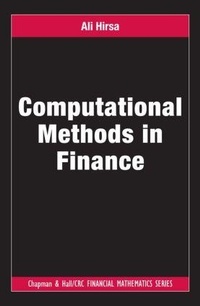
Computational Methods in Finance
1st Edition
Published on 5. September 2012
Book
Hardback
444 pages
978-1-4398-2957-8 (ISBN)
Description
As today's financial products have become more complex, quantitative analysts, financial engineers, and others in the financial industry now require robust techniques for numerical analysis. Covering advanced quantitative techniques, Computational Methods in Finance explains how to solve complex functional equations through numerical methods.
The first part of the book describes pricing methods for numerous derivatives under a variety of models. The book reviews common processes for modeling assets in different markets. It then examines many computational approaches for pricing derivatives. These include transform techniques, such as the fast Fourier transform, the fractional fast Fourier transform, the Fourier-cosine method, and saddlepoint method; the finite difference method for solving PDEs in the diffusion framework and PIDEs in the pure jump framework; and Monte Carlo simulation.
The next part focuses on essential steps in real-world derivative pricing. The author discusses how to calibrate model parameters so that model prices are compatible with market prices. He also covers various filtering techniques and their implementations and gives examples of filtering and parameter estimation.
Developed from the author's courses at Columbia University and the Courant Institute of New York University, this self-contained text is designed for graduate students in financial engineering and mathematical finance as well as practitioners in the financial industry. It will help readers accurately price a vast array of derivatives.
The first part of the book describes pricing methods for numerous derivatives under a variety of models. The book reviews common processes for modeling assets in different markets. It then examines many computational approaches for pricing derivatives. These include transform techniques, such as the fast Fourier transform, the fractional fast Fourier transform, the Fourier-cosine method, and saddlepoint method; the finite difference method for solving PDEs in the diffusion framework and PIDEs in the pure jump framework; and Monte Carlo simulation.
The next part focuses on essential steps in real-world derivative pricing. The author discusses how to calibrate model parameters so that model prices are compatible with market prices. He also covers various filtering techniques and their implementations and gives examples of filtering and parameter estimation.
Developed from the author's courses at Columbia University and the Courant Institute of New York University, this self-contained text is designed for graduate students in financial engineering and mathematical finance as well as practitioners in the financial industry. It will help readers accurately price a vast array of derivatives.
Reviews / Votes
"The depth and breadth of this stand-alone textbook on computational methods in finance is astonishing. It brings together a full-spectrum of methods with many practical examples. ... the purpose of the book is to aid the understanding and solving of current problems in computational finance. ... an excellent synthesis of numerical methods needed for solving practical problems in finance. This book provides plenty of exercises and realistic case studies. Those who work through them will gain a deep understanding of the modern computational methods in finance. This uniquely comprehensive and well-written book will undoubtedly prove invaluable to many researchers and practitioners. In addition, it seems to be an excellent teaching book."-Lasse Koskinen, International Statistical Review (2013), 81
"... there are several sections on topics that are rarely treated in textbooks: saddle point approximations, numerical solution of PIDEs, and others. There is also extensive material on model calibration, including interest rate models and filtering approaches. The book is a very comprehensive and useful reference for anyone, even with limited mathematical background, who wishes to quickly understand techniques from computational finance."
-Stefan Gerhold, Zentralblatt MATH 1260
"A natural polymath, the author is at once a teacher, a trader, a quant, and now an author of a book for the ages. The content reflects the author's vast experience teaching master's level courses at Columbia and NYU, while simultaneously researching and trading on quantitative finance in leading banks and hedge funds."
-Dr. Peter Carr, Global Head of Market Modeling, Morgan Stanley, and Executive Director of Masters in Math Finance, NYU Courant Institute of Mathematical Sciences
"A long-time expert in computational finance, Ali Hirsa brings his excellent expository skills to bear on not just one technique but the whole panoply, from finite difference solutions to PDEs/PIDEs through simulation to calibration and parameter estimation."
-Emanuel Derman, professor at Columbia University and author of Models Behaving Badly
More details
Series
Language
English
Place of publication
Bosa Roca
United States
Publishing group
Taylor & Francis Inc
Target group
College/higher education
Graduate students in computational finance; researchers and practitioners in finance.
Product notice
sewn/stitched
Cloth over boards
Illustrations
73 s/w Abbildungen, 59 s/w Tabellen
59 Tables, black and white; 73 Illustrations, black and white
Dimensions
Height: 261 mm
Width: 182 mm
Thickness: 30 mm
Weight
944 gr
ISBN-13
978-1-4398-2957-8 (9781439829578)
Copyright in bibliographic data and cover images is held by Nielsen Book Services Limited or by the publishers or by their respective licensors: all rights reserved.
Schweitzer Classification
Other editions
New editions
Ali Hirsa
Computational Methods in Finance
Book
08/2024
2nd Edition
Chapman & Hall/CRC
€146.80
Shipment within 15-20 days
Person
Ali Hirsa is head of Analytical Trading Strategy at Caspian Capital Management. Dr. Hirsa is also an adjunct professor at Columbia University and NYU's Courant Institute of Mathematical Sciences.
Content
I Pricing and Valuation: Stochastic Processes and Risk-Neutral Pricing. Derivatives Pricing via Transform Techniques. Introduction to Finite Differences. Derivative Pricing via Numerical Solutions of PDEs. Derivative Pricing via Numerical Solutions of PIDEs. Simulation Methods for Derivatives Pricing. II Calibration and Estimation: Model Calibration. Filtering and Parameter Estimation. References. Index.