

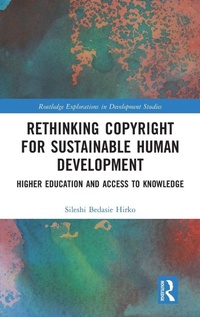
Rethinking Copyright for Sustainable Human Development
Higher Education and Access to Knowledge
1st Edition
Published on 26. November 2021
Book
Hardback
220 pages
978-1-032-10222-1 (ISBN)
Description
This book explores the interface between copyright and higher education, and their complementarities for the advancement of sustainable human development. In its broader sense, the concept of human development is noted as a set of freedoms and human capabilities that are essential for human flourishing.
Adopting a rights-based human development and capability approach (HDCA), this book primarily examines the relevant policy and legal ?exibilities under the existing international copyright system, and their implications for access to knowledge required for creative innovation and higher education. Exploring the interfaces between copyright and higher education, this book argues that an unbalanced and restrictive copyright system impedes reasonable access to knowledge, and stifles creative and learning freedoms or capabilities. In effect, a restrictive copyright system results in serious ramifications for sustainable human development. In view of its findings, this book underscores the need for rethinking copyright and reframing its relevant ?exibilities as users' rights that are vital for promoting creative and learning capabilities towards sustainable human development. Further, the book emphasizes the complementarities between copyright and higher education, and their joint roles for sustainable human development.
Given its application of the HDCA to explore ranges of interlinked topics, this book will be of a great interest to researchers across the fields of intellectual property law, innovation, global development, human rights, and higher education.
Adopting a rights-based human development and capability approach (HDCA), this book primarily examines the relevant policy and legal ?exibilities under the existing international copyright system, and their implications for access to knowledge required for creative innovation and higher education. Exploring the interfaces between copyright and higher education, this book argues that an unbalanced and restrictive copyright system impedes reasonable access to knowledge, and stifles creative and learning freedoms or capabilities. In effect, a restrictive copyright system results in serious ramifications for sustainable human development. In view of its findings, this book underscores the need for rethinking copyright and reframing its relevant ?exibilities as users' rights that are vital for promoting creative and learning capabilities towards sustainable human development. Further, the book emphasizes the complementarities between copyright and higher education, and their joint roles for sustainable human development.
Given its application of the HDCA to explore ranges of interlinked topics, this book will be of a great interest to researchers across the fields of intellectual property law, innovation, global development, human rights, and higher education.
More details
Series
Language
English
Place of publication
London
United Kingdom
Publishing group
Taylor & Francis Ltd
Target group
College/higher education
Dimensions
Height: 240 mm
Width: 161 mm
Thickness: 17 mm
Weight
520 gr
ISBN-13
978-1-032-10222-1 (9781032102221)
Copyright in bibliographic data and cover images is held by Nielsen Book Services Limited or by the publishers or by their respective licensors: all rights reserved.
Schweitzer Classification
Other editions
Additional editions
Sileshi Bedasie Hirko
Rethinking Copyright for Sustainable Human Development
Higher Education and Access to Knowledge
Book
05/2023
1st Edition
Routledge
€65.00
Shipment within 10-20 days
Sileshi Bedasie Hirko
Rethinking Copyright for Sustainable Human Development
Higher Education and Access to Knowledge
E-Book
11/2021
1st Edition
Routledge
€59.49
Available for download
Sileshi Bedasie Hirko
Rethinking Copyright for Sustainable Human Development
Higher Education and Access to Knowledge
E-Book
11/2021
1st Edition
Routledge
€59.49
Available for download
Person
Dr. Sileshi Bedasie Hirko is a Queen Elizabeth II Diamond Jubilee Advanced Scholar and a Postdoctoral Fellow affiliated with University of Ottawa and Open African Innovation Research Organization (Open AIR). From 2015-2020, he was a PhD Fellow at Open AIR and a Doctoral Student Scholar at the Centre for International Governance Innovation. Prior to 2015, he worked as an Assistant Professor at Haramaya University in Ethiopia. In addition to the PhD in Law he holds from University of Ottawa in Canada, the author has earned his LL.B from Haramaya University in Ethiopia and LL.M from Munich Intellectual Property Law Center in Germany. Having specialized in laws with a special focus on international IP, Competition Law and human development, among others, Dr. Sileshi has made several publications in the fields. His major areas of research interests include international IP, innovation, competition law, human development, human rights and civil laws.
Content
Foreword by Chidi Oguamanam
Chapter I: The Conceptual Framework of the Book
Chapter II: Copyright, Education and Human Development: Theeoretical Frameworks
Chapter III: International Copyright and Human Rights Systems: Development Context
Chapter IV: Higher Education and Creative Innovation: Exploring Copyright Flexibilities
Chapter V: Copyright and Higher Education for Human Development: HDCA for Rethinking of Flexibilities
Chapter VI: Re-integrating Licensing Regimes into the Framework of Flexibilities
Chapter VII: Concluding Remarks
Chapter I: The Conceptual Framework of the Book
Chapter II: Copyright, Education and Human Development: Theeoretical Frameworks
Chapter III: International Copyright and Human Rights Systems: Development Context
Chapter IV: Higher Education and Creative Innovation: Exploring Copyright Flexibilities
Chapter V: Copyright and Higher Education for Human Development: HDCA for Rethinking of Flexibilities
Chapter VI: Re-integrating Licensing Regimes into the Framework of Flexibilities
Chapter VII: Concluding Remarks