

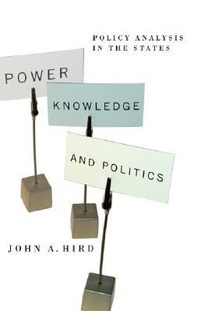
Power, Knowledge, and Politics
Policy Analysis in the States
Published on 29. March 2005
Book
Paperback/Softback
256 pages
978-1-58901-049-9 (ISBN)
Description
If knowledge is power, then John Hird has opened the doors for anyone interested in public policymaking and policy analysis on the state level. A beginning question might be: does politics put gasoline or sugar in the tank? More specifically, in a highly partisan political environment, is nonpartisan expertise useful to policymaking? Do policy analysts play a meaningful role in decision making? Does policy expertise promote democratic decision making? Does it vest power in an unelected and unaccountable elite, or does it become co-opted by political actors and circumstances? Is it used to make substantive changes or just for window-dressing? In a unique comparative focus on state policy, Power, Knowledge, and Politics dissects the nature of the policy institutions that policymakers establish and analyzes the connection between policy research and how it is actually used in decision making. Hird probes the effects of politics and political institutions - parties, state political culture and dynamics, legislative and gubernatorial staffing, partisan think tanks, interest groups - on the nature and conduct of nonpartisan policy analysis.
Through a comparative examination of institutions and testing theories of the use of policy analysis, Hird draws conclusions that are more useful than those derived from single cases. Hird examines nonpartisan policy research organizations established by and operating in U.S. state legislatures - one of the most intense of political environments - to determine whether and how nonpartisan policy research can survive in that harsh climate. By first detailing how nonpartisan policy analysis organizations came to be and what they do, and then determining what state legislators want from them, he presents a rigorous statistical analysis of those agencies in all 50 states and from a survey of 800 state legislators. This thoroughly comprehensive look at policymaking at the state level concludes that nonpartisan policy analysis institutions can play an important role - as long as they remain scrupulously nonpartisan.
Through a comparative examination of institutions and testing theories of the use of policy analysis, Hird draws conclusions that are more useful than those derived from single cases. Hird examines nonpartisan policy research organizations established by and operating in U.S. state legislatures - one of the most intense of political environments - to determine whether and how nonpartisan policy research can survive in that harsh climate. By first detailing how nonpartisan policy analysis organizations came to be and what they do, and then determining what state legislators want from them, he presents a rigorous statistical analysis of those agencies in all 50 states and from a survey of 800 state legislators. This thoroughly comprehensive look at policymaking at the state level concludes that nonpartisan policy analysis institutions can play an important role - as long as they remain scrupulously nonpartisan.
Reviews / Votes
Hird has produced a book of great merit and insight. Political Science Quarterly Hird has made a major contribution to the fields of public policy and public administration that enhances knowledge about the significance of nonpartisan policy research organizations at the state level. This book is a valuable resource for scholars and practitioners seeking to better understand the complex policy process in American politics. Public Integrity This book is a valuable resource for both students and scholars interested in the complex process of policy making in the United States. It is written in a manner that makes it accessible to readers without a background in research methodology and could be utilized in both a graduate or undergraduate classroom. Power, Knowledge, and Politics is a major contribution to the field of public policy, and a good read for anyone interested in policy making in the United States. Equal Opportunities InternationalMore details
Series
Language
English
Place of publication
Washington, DC
United States
Target group
Professional and scholarly
US School Grade: College Graduate Student and over
Product notice
Paperback (trade)
Illustrations
Not illustrated
Dimensions
Height: 216 mm
Width: 142 mm
Thickness: 17 mm
Weight
312 gr
ISBN-13
978-1-58901-049-9 (9781589010499)
Copyright in bibliographic data and cover images is held by Nielsen Book Services Limited or by the publishers or by their respective licensors: all rights reserved.
Schweitzer Classification
Person
John A. Hird is associate professor of political science and director of the Center for Public Policy and Administration at the University of Massachusetts, Amherst; author of The Political Economy of Environmental Risk; and coauthor with Michael Reese and Matthew Shilvock of Controversies in American Public Policy (3rd edition).
Content
Preface 1. The Development and Limitations of Policy Analysis 2. Expertise and the Use of Policy Analysis 3. Policy Analysis in the State 4. Explaining Variation in Policy Research Organizations 5. Legislators and Policy Analysis 6. The Effectiveness of Nonpartisan Policy Research Organizations 7. Conclusions and Implications: The Politics of Policy Analysis Appendix: Summary of Survey Responses References Index