

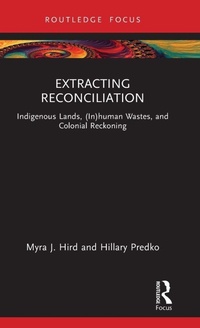
Extracting Reconciliation
Indigenous Lands, (In)human Wastes, and Colonial Reckoning
1st Edition
Published on 25. September 2023
Book
Hardback
84 pages
978-1-032-37908-1 (ISBN)
Description
Extracting Reconciliation argues that reconciliation constitutes a critical contemporary mechanism through which colonialism is seeking to ensure continuing access to Indigenous lands and resources.
Making use of two historical case studies concerned with the intersection of resource extraction, Crown/Inuit relations, and waste legacies in Nunavut, Canada, the authors illuminate the mechanisms of colonial and neoliberal governance globally that promise reconciliation while delivering the status quo. Through Indigenous and non-Indigenous anticolonial and posthuman concepts and theories, the book engages with the inhuman politics of settler colonial extractivism and explores the socio-ethical social justice dimensions, political possibilities, and environmental implications of a much more challenging and accountable reckoning between (settler) colonialism and Indigenous land rights.
This book is of interest to students and scholars in gender studies, postcolonial studies, environmental studies, Indigenous studies, and politics.
Making use of two historical case studies concerned with the intersection of resource extraction, Crown/Inuit relations, and waste legacies in Nunavut, Canada, the authors illuminate the mechanisms of colonial and neoliberal governance globally that promise reconciliation while delivering the status quo. Through Indigenous and non-Indigenous anticolonial and posthuman concepts and theories, the book engages with the inhuman politics of settler colonial extractivism and explores the socio-ethical social justice dimensions, political possibilities, and environmental implications of a much more challenging and accountable reckoning between (settler) colonialism and Indigenous land rights.
This book is of interest to students and scholars in gender studies, postcolonial studies, environmental studies, Indigenous studies, and politics.
More details
Series
Language
English
Place of publication
London
United Kingdom
Publishing group
Taylor & Francis Ltd
Target group
College/higher education
Postgraduate and Undergraduate Advanced
Illustrations
1 s/w Abbildung, 1 s/w Photographie bzw. Rasterbild
1 Halftones, black and white; 1 Illustrations, black and white
Dimensions
Height: 222 mm
Width: 145 mm
Thickness: 9 mm
Weight
263 gr
ISBN-13
978-1-032-37908-1 (9781032379081)
Copyright in bibliographic data and cover images is held by Nielsen Book Services Limited or by the publishers or by their respective licensors: all rights reserved.
Schweitzer Classification
Other editions
Additional editions
Myra J. Hird | Hillary Predko
Extracting Reconciliation
Indigenous Lands, (In)human Wastes, and Colonial Reckoning
Book
12/2024
1st Edition
Routledge
€32.50
Shipment within 10-20 days
Myra J. Hird | Hillary Predko
Extracting Reconciliation
Indigenous Lands, (In)human Wastes, and Colonial Reckoning
E-Book
09/2023
1st Edition
Taylor & Francis
€27.49
Available for download
Myra J. Hird | Hillary Predko
Extracting Reconciliation
Indigenous Lands, (In)human Wastes, and Colonial Reckoning
E-Book
09/2023
1st Edition
Taylor & Francis
€27.49
Available for download
Persons
Hillary Predko (MES Queen's) is a researcher, writer, and artist based in Ontario. Her research explores issues around the materiality of waste, climate change, and social justice. Her Masters of Environmental Studies research explored the waste politics of resource extraction in Nunavut and earned Social Sciences and Humanities Research Council of Canada funding.
Myra J. Hird (DPhil Oxford) is Professor, elected Fellow of the Royal Society of Canada, and Queen's National Scholar in the School of Environmental Studies, Queen's University, Canada. Professor Hird is Director of the research project Waste Flow and has published 12 books and over 80 articles and book chapters on a diversity of topics relating to waste and science studies.
Myra J. Hird (DPhil Oxford) is Professor, elected Fellow of the Royal Society of Canada, and Queen's National Scholar in the School of Environmental Studies, Queen's University, Canada. Professor Hird is Director of the research project Waste Flow and has published 12 books and over 80 articles and book chapters on a diversity of topics relating to waste and science studies.
Content
Introduction; 1. Reconciling Reconciliation; 2. Reconciling Geology; 3. Reconciling Resource Extraction; 4. Reconciling Waste; Conclusions: Reckoning