

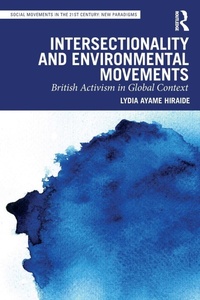
Intersectionality and Environmental Movements
British Activism in Global Context
1st Edition
Published on 19. May 2026
Book
Paperback/Softback
206 pages
978-1-041-06447-3 (ISBN)
Description
In view of recent criticisms of the environmentalist movement for centring middle-class whiteness, this book examines the discourses, strategies, and theories of environmentalism in modern Britain through the Black feminist lens of intersectionality.
The author proposes a framework of 'intersectional absences and presences' to argue that how environmentalists understand-or ignore-intersectionality shapes their social movements in important ways. It affects how they build and communicate their political demands as environmentalists, as well as the literal spaces in which they organise. Drawing on interviews, ethnography, and archival research, it demonstrates the usefulness of intersectionality for analysing the structural relationships between discrete structures of oppression such as racism, sexism, and classism, and how political demands are built and communicated.
This book will appeal to scholars, postgraduate students, and researchers of gender studies, social movements, political sociology, environmental sociology, and race and ethnicity.
The author proposes a framework of 'intersectional absences and presences' to argue that how environmentalists understand-or ignore-intersectionality shapes their social movements in important ways. It affects how they build and communicate their political demands as environmentalists, as well as the literal spaces in which they organise. Drawing on interviews, ethnography, and archival research, it demonstrates the usefulness of intersectionality for analysing the structural relationships between discrete structures of oppression such as racism, sexism, and classism, and how political demands are built and communicated.
This book will appeal to scholars, postgraduate students, and researchers of gender studies, social movements, political sociology, environmental sociology, and race and ethnicity.
More details
Series
Language
English
Place of publication
London
United Kingdom
Publishing group
Taylor & Francis Ltd
Target group
College/higher education
Professional and scholarly
Academic and Postgraduate
Illustrations
1 s/w Zeichnung, 1 s/w Abbildung
1 Line drawings, black and white; 1 Illustrations, black and white
Dimensions
Height: 233 mm
Width: 156 mm
Thickness: 14 mm
Weight
336 gr
ISBN-13
978-1-041-06447-3 (9781041064473)
Copyright in bibliographic data and cover images is held by Nielsen Book Services Limited or by the publishers or by their respective licensors: all rights reserved.
Schweitzer Classification
Other editions
Additional editions
Book
05/2026
1st Edition
Routledge
€192.50
Shipment within 15-20 days
E-Book
05/2026
Routledge
€55.49
Available for download
E-Book
05/2026
Routledge
€55.49
Available for download
Person
Lydia Ayame Hiraide is a Lecturer at Soka University in the Graduate School of International Peace Studies (SIPS). Previously, Lydia Ayame was a Postdoctoral Research Fellow at SOAS, University of London, and Associate Lecturer at Goldsmiths, University of London. She holds a PhD in Politics from Goldsmiths, which was funded by the UK Arts and Humanities Research Council. She also holds an MA in Postcolonial Studies from the University of Kent and a BA (Hons) in Politics and International Relations from SOAS. Her research interests include social movements, climate change and ecology, social inequities, migration, and reproductive politics.
Content
1 Introduction: Taking a Black feminist approach to environmentalism 2 Intersectionality: Claims and contestations 3 Questions for a billion green Black feminisms 4 Environmentalism and intersectionality: Histories and
trajectories 5 Intersectional absences and presences in environmentalism 6 'Until the politically impossible becomes politically inevitable'
trajectories 5 Intersectional absences and presences in environmentalism 6 'Until the politically impossible becomes politically inevitable'