

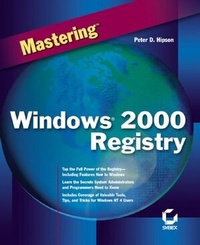
Mastering Windows 2000 Registry
1st Edition
Published on 23. February 2000
Book
Paperback/Softback
726 pages
978-0-7821-2615-0 (ISBN)
Description
Expert Advice for Windows 2000 Administrators, Programmers, and Power Users
Mastering Windows 2000 Registry takes you to guruhood fast. Created for experienced system administrators, programmers, and consultants, this reference provides focused coverage of Windows' most important--and most challenging--element: the Registry. Inside, you'll learn to customize Windows 2000, optimize the network, and avoid scores of potential disasters, all by working with Registry settings. If you have to be prepared to troubleshoot the latest version of Windows, this guide is absolutely essential. Coverage includes:
* Understanding registry keys and data types
* Applying the secrets of the most important registry keys
* Adjusting the Windows UI through registry settings
* Using the registry in networking
* Optimizing performance by editing registry settings
* Working with registry tools
* Recovering from disasters
* Eliminating unwanted keys, entries, applications, and files
* Taking advantage of the registry in your own programs
* Tracking registry changes made by applications
* Navigating registry entries
Mastering Windows 2000 Registry takes you to guruhood fast. Created for experienced system administrators, programmers, and consultants, this reference provides focused coverage of Windows' most important--and most challenging--element: the Registry. Inside, you'll learn to customize Windows 2000, optimize the network, and avoid scores of potential disasters, all by working with Registry settings. If you have to be prepared to troubleshoot the latest version of Windows, this guide is absolutely essential. Coverage includes:
* Understanding registry keys and data types
* Applying the secrets of the most important registry keys
* Adjusting the Windows UI through registry settings
* Using the registry in networking
* Optimizing performance by editing registry settings
* Working with registry tools
* Recovering from disasters
* Eliminating unwanted keys, entries, applications, and files
* Taking advantage of the registry in your own programs
* Tracking registry changes made by applications
* Navigating registry entries
More details
Edition
1., Auflage
Language
English
Place of publication
New York
United States
Publishing group
John Wiley & Sons Inc
Target group
Professional and scholarly
Edition type
Revised edition
Illustrations
illustrations
Dimensions
Height: 22.9 cm
Width: 19 cm
Thickness: 48 mm
Weight
1240 gr
ISBN-13
978-0-7821-2615-0 (9780782126150)
Schweitzer Classification
Other editions
Previous edition

Peter Hipson
Expert Guide to Windows NT 4 Registry
Book
10/1998
Sybex Inc.,U.S.
€70.75
Article exhausted; check for reprint
Person
Peter D. Hipson is an author, consultant, and teacher. When not writing computer books, he can often be found teaching computer science at the local college, where he says he "ruins the lives of hundreds of unsuspecting college students every year." An avid Microsoft beta tester, he finds time to test and use virtually every product Microsoft produces.
Content
Introduction.
Part I: REGISTRY BASICS.
Chapter 1: What Is a Registry-and Why?
Chapter 2: Readme.1st: Preventing Disaster!
Chapter 3: Anatomy of the Registry: The Blood, Gore, and Guts.
Chapter 4: Registry Tools and Tips: Getting the Work Done.
Chapter 5: Policies, Good for One, Good for All.
Part II: ADVANCED REGISTRY STUFF.
Chapter 6: Associations, Linkages, and OLE: How Confusing Can This Get?
Chapter 7: Why, Oh Why, Are There System.ini and Win.ini Files?
Chapter 8: Getting Rid of the Unwanted.
Chapter 9: Recovering from Disaster, or Making the Best of a Bad Situation.
Chapter 10: Programming and the Registry: A Developer's Paradise?
Chapter 11: The Performance Monitor Meets the Registry.
Part III: WINDOWS AND OFFICE REGISTRY ENTRIES.
Chapter 12: The Windows 2000 User Interface: Changing How It Looks.
Chapter 13: Networking and Registry System Entries.
Chapter 14: Microsoft Office Entries.
Part IV: THE REGISTRY REFERENCE.
Chapter 15: Introduction to HKEY_CLASSES_ROOT.
Chapter 16: Introduction to HKEY_CURRENT_USER and HKEY_USERS.
Chapter 17: Introduction to HKEY_LOCAL_MACHINE.
Chapter 18: Introduction to HKEY_LOCAL_MACHINE\Software.
Chapter 19: Introduction to HKEY_LOCAL_MACHINE\System and HKEY_CURRENT_CONFIG.
Appendices.
Appendix A: Common Hives and Keys.
Appendix B: Registry Data Types.
Appendix C: Where Can I Get More Help?
Appendix D: Performance Counters.
Appendix E: Plug-and-Play Identifiers.
Appendix F: Office 2000 CLSIDs.
Index.
Part I: REGISTRY BASICS.
Chapter 1: What Is a Registry-and Why?
Chapter 2: Readme.1st: Preventing Disaster!
Chapter 3: Anatomy of the Registry: The Blood, Gore, and Guts.
Chapter 4: Registry Tools and Tips: Getting the Work Done.
Chapter 5: Policies, Good for One, Good for All.
Part II: ADVANCED REGISTRY STUFF.
Chapter 6: Associations, Linkages, and OLE: How Confusing Can This Get?
Chapter 7: Why, Oh Why, Are There System.ini and Win.ini Files?
Chapter 8: Getting Rid of the Unwanted.
Chapter 9: Recovering from Disaster, or Making the Best of a Bad Situation.
Chapter 10: Programming and the Registry: A Developer's Paradise?
Chapter 11: The Performance Monitor Meets the Registry.
Part III: WINDOWS AND OFFICE REGISTRY ENTRIES.
Chapter 12: The Windows 2000 User Interface: Changing How It Looks.
Chapter 13: Networking and Registry System Entries.
Chapter 14: Microsoft Office Entries.
Part IV: THE REGISTRY REFERENCE.
Chapter 15: Introduction to HKEY_CLASSES_ROOT.
Chapter 16: Introduction to HKEY_CURRENT_USER and HKEY_USERS.
Chapter 17: Introduction to HKEY_LOCAL_MACHINE.
Chapter 18: Introduction to HKEY_LOCAL_MACHINE\Software.
Chapter 19: Introduction to HKEY_LOCAL_MACHINE\System and HKEY_CURRENT_CONFIG.
Appendices.
Appendix A: Common Hives and Keys.
Appendix B: Registry Data Types.
Appendix C: Where Can I Get More Help?
Appendix D: Performance Counters.
Appendix E: Plug-and-Play Identifiers.
Appendix F: Office 2000 CLSIDs.
Index.