

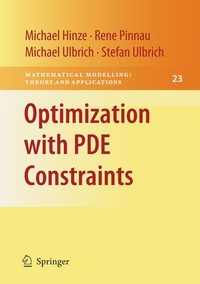
Optimization with PDE Constraints
1st Edition
Published on 14. November 2008
Book
Hardback
XII, 270 pages
978-1-4020-8838-4 (ISBN)
Description
Solving optimization problems subject to constraints given in terms of partial d- ferential equations (PDEs) with additional constraints on the controls and/or states is one of the most challenging problems in the context of industrial, medical and economical applications, where the transition from model-based numerical si- lations to model-based design and optimal control is crucial. For the treatment of such optimization problems the interaction of optimization techniques and num- ical simulation plays a central role. After proper discretization, the number of op- 3 10 timization variables varies between 10 and 10. It is only very recently that the enormous advances in computing power have made it possible to attack problems of this size. However, in order to accomplish this task it is crucial to utilize and f- ther explore the speci?c mathematical structure of optimization problems with PDE constraints, and to develop new mathematical approaches concerning mathematical analysis, structure exploiting algorithms, and discretization, with a special focus on prototype applications. The present book provides a modern introduction to the rapidly developing ma- ematical ?eld of optimization with PDE constraints. The ?rst chapter introduces to the analytical background and optimality theory for optimization problems with PDEs. Optimization problems with PDE-constraints are posed in in?nite dim- sional spaces. Therefore, functional analytic techniques, function space theory, as well as existence- and uniqueness results for the underlying PDE are essential to study the existence of optimal solutions and to derive optimality conditions.
Reviews / Votes
From the reviews: "The book presents a state-of-the-art of optimization problems described by partial differential equations (PDEs) and algorithms for obtaining their solutions. Solving optimization problems with constraints given in terms of PDEs is one of the most challenging problems appearing, e.g., in industry, medical and economical applications. The book consists of four chapters. ... This well-written book can be recommended to scientists and graduate students working in the fields of optimal control theory, optimization algorithms and numerical solving of optimization problems described by PDEs." (Wieslaw Kotarski, Zentralblatt MATH, Vol. 1167, 2009)More details
Product info
HC runder Rücken kaschiert
Series
Language
English
Place of publication
Dordrecht
Netherlands
Target group
Research
Illustrations
18 s/w Tabellen
18 black & white tables, biography
Dimensions
Height: 235 mm
Width: 155 mm
Thickness: 23 mm
Weight
642 gr
ISBN-13
978-1-4020-8838-4 (9781402088384)
DOI
10.1007/978-1-4020-8839-1
Schweitzer Classification
Other editions
Additional editions
Michael Hinze | Rene Pinnau | Michael Ulbrich
Optimization with PDE Constraints
Book
10/2010
1st Edition
Springer
€149.79
Shipment within 15-20 days
Michael Hinze | Rene Pinnau | Michael Ulbrich
Optimization with PDE Constraints
E-Book
10/2008
1st Edition
Springer
€139.90
Available for download
Content
1 Analytical Background and Optimality Theory. 7 1.1 Introduction and examples. 7 1.1.1 Introduction. 7 1.1.2 Examples for optimization problems with PDEs. 10 1.1.3 Optimization of a stationary heating process. 10 1.1.4 Optimization of an unsteady heating processes. 13 1.1.5 Optimal design. 13 1.2 Linear functional analysis and Sobolev spaces. 14 1.2.1 Banach and Hilbert spaces. 15 1.2.2 Sobolev spaces. 18 1.2.3 Weak convergence. 27 1.3 Weak solutions of elliptic and parabolic PDEs. 29 1.3.1 Weak solutions of elliptic PDEs. 29 1.3.2 Weak solutions of parabolic PDEs. 37 1.4 G^ateaux- and Fr´echet Differentiability. 48 1.4.1 Basic definitions. 48 1.4.2 Implicit function theorem. 50 1.5 Existence of optimalcontrols. 50 1.5.1 Existence result for a general linear-quadratic problem. 50 1.5.2 Existence results for nonlinear problems. 52 1.5.3 Applications. 53 1.6 Reduced problem, sensitivities and adjoints. 55 1.6.1 Sensitivity approach. 55 1.6.2 Adjoint approach. 56 1.6.3 Application to a linear-quadratic optimal control problem. 57 1.6.4 A Lagrangian-based view of the adjoint approach. 59 3 4 Contents 1.6.5 Second derivatives. 60 1.7 Optimality conditions. 61 1.7.1 Optimality conditions for simply constrained problems. 61 1.7.2 Optimality conditions for control-constrained problems. 66 1.7.3 Optimality conditions for problems with general constraints. 74 1.8 Optimal control of instationary incompressible Navier-Stokes flow. 80 1.8.1 Functional analytic setting. 81 1.8.2 Analysis of the flow control problem. 83 1.8.3 Reduced Optimal Control Problem. 85 2 Optimization