

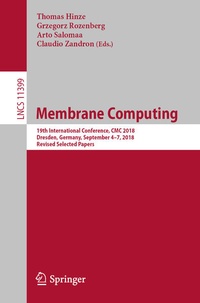
Membrane Computing
19th International Conference, CMC 2018, Dresden, Germany, September 4-7, 2018, Revised Selected Papers
Published on 2. February 2019
Book
Paperback/Softback
XVI, 275 pages
978-3-030-12796-1 (ISBN)
Description
This book constitutes revised selected papers from the 19th International Conference on Membrane Computing (CMC19), CMC 2018, which was held in Dresden, Germany, in September 2018. The 15 papers presented in this volume were carefully reviewed and selected from 20 submissions. The contributions aim to abstract computing ideas and models from the structure and the functioning of living cells, as well as from the way the cells are organized in tissues or higher order structures.
More details
Series
Edition
2019 ed.
Language
English
Place of publication
Cham
Switzerland
Publishing group
Springer International Publishing
Target group
Professional and scholarly
Illustrations
146 s/w Abbildungen, 21 farbige Abbildungen
XVI, 275 p. 167 illus., 21 illus. in color.
Dimensions
Height: 235 mm
Width: 155 mm
Thickness: 16 mm
Weight
446 gr
ISBN-13
978-3-030-12796-1 (9783030127961)
DOI
10.1007/978-3-030-12797-8
Schweitzer Classification
Other editions
Additional editions
Thomas Hinze | Grzegorz Rozenberg | Arto Salomaa
Membrane Computing
19th International Conference, CMC 2018, Dresden, Germany, September 4-7, 2018, Revised Selected Papers
E-Book
01/2019
Springer
€53.49
Available for download
Content
Invited Papers.- Impacts of Membrane Computing on Theoretical Computer Science.- Time and Space Complexity of P Systems - And Why They Matter.- A Brute-Force Solution to the 27-Queens Puzzle Using a Distributed Computation.- Regular Papers. -Tissue P Systems with Point Mutation Rules.- Adaptive P Systems.- Chain Code P System Generating a Variant of the Peano Space-filling Curve.- APCol Systems with Agent Creation.- APCol Systems with Verifier Agents.- A Semantic Investigation of Spiking Neural P Systems.- Towards Automated Analysis of Belousov-Zhabotinsky Reactions in a Petri Dish by Membrane Computing using Optic Flow.- Testing Identifiable Kernel P Systems using an X-machine Approach.- Actor-like cP Systems.- Solving QSAT in Sublinear Depth.- Design of specific P systems simulators on GPUs.- Construction of Stable and Lightweight Technical Structures Inspired by Ossification of Bones using Osteogenetic P Systems.- On Small Universality of Spiking Neural P Systems with Multiple Channels.- Modeling Plant Development with M Systems.- An Improved Quicksort Algorithm Based on Tissue-Like P Systems with Promoters.