

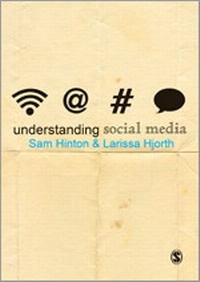
Understanding Social Media
1st Edition
Published on 18. June 2013
Book
Hardback
168 pages
978-1-4462-0120-6 (ISBN)
Description
Understanding Social Media provides a critical and timely conceptual toolbox for navigating the evolution and practices of social media. Taking an interdisciplinary and intercultural approach, this book provides a clear and concise explanation of the key concepts but also goes beyond specific brands, sites and practices to show readers how to place social media more critically within the changing media and cultural landscape.
As an aid to understanding, key concepts in each chapter are illustrated by case studies to give real-world examples of theory in action. Cutting across the many dimensions of social media, from the political, economic and visual, this book explores the industries, ideologies and cultural practices that are increasingly becoming part of global popular culture.
As an aid to understanding, key concepts in each chapter are illustrated by case studies to give real-world examples of theory in action. Cutting across the many dimensions of social media, from the political, economic and visual, this book explores the industries, ideologies and cultural practices that are increasingly becoming part of global popular culture.
Reviews / Votes
[O]f the three books under review here, this is the one I would ask my undergraduate students to read (indeed, I already have). It's clear and straightforward, and is organized around thematic categories of social media practice, rather than around specific firms and platforms or around familiar tropes from media and cultural studies. -- Graham Meikle, University of Westminster Hinton and Hjorth have written an excellent introduction to the emergent field of social media studies. They examine a wide variety of pressing issues, including user-generated content, citizen journalism, location-based services (such as Google Maps and Foursquare) and the commercial applications of social data... Understanding Social Media has a broad focus and treats diverse social matter from deviantART to Kony 2012. It would be particularly useful for anyone needing a detailed overview of the field. In this sense, the book is very successful. -- A. Moore, St. Thomas University Understanding Social Media potentially has a wide appeal for both non-academic and academic audiences in a range of disciplines. For political scientists, this book would be a valuable introduction to thinking about how social media shapes issues such as political activism, global divides, journalism and 'the politics of everyday life' (p. 136). -- Naomi Racz, Independent Scholar A solid overview of current research and debates in the analysis of social networks, Understanding Social Media is a useful text for all students of digital media. -- Rebecca Bishop, Independent Scholar, SydneyMore details
Series
Language
English
Place of publication
London
United Kingdom
Target group
College/higher education
Professional and scholarly
Dimensions
Height: 234 mm
Width: 156 mm
Weight
390 gr
ISBN-13
978-1-4462-0120-6 (9781446201206)
Copyright in bibliographic data and cover images is held by Nielsen Book Services Limited or by the publishers or by their respective licensors: all rights reserved.
Schweitzer Classification
Other editions
New editions
Larissa Hjorth | Sam Hinton
Understanding Social Media
Book
10/2019
2nd Edition
SAGE Publications Ltd
€142.50
Shipment within 15-20 days
Persons
Sam Hinton is Senior Lecturer in Media, Arts and Design Faculty at the University of Canberra, Australia. Larissa Hjorth is Professor in the Games Program at the School of Media & Communication, at RMIT University, Australia.
Content
Introduction to Social Media
What Is Web 2.0?
Social Network Sites
Participation and User Created Content
Art and Cultural Production
Social Media Games
Social, Locative and Mobile Media
Conclusion
What Is Web 2.0?
Social Network Sites
Participation and User Created Content
Art and Cultural Production
Social Media Games
Social, Locative and Mobile Media
Conclusion