

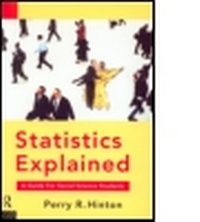
Statistics Explained
A Guide for Social Science Students, 2nd Edition
Published on 15. June 1995
Book
Paperback/Softback
344 pages
978-0-415-10286-5 (ISBN)
Description
This text outlines the major statistical tests used by undergraduates in the social sciences. It provides easy-to-understand explanations of how and why they are used and aims to make statistics much less mysterious. The book provides a simple introduction to the jargon and guides the reader in using computers in statistical analysis. In addition, it can be dipped into so that readers can see why a specific analytical procedure was developed and what it is best used for. Readers can also analyse their own data by following the worked examples provided. The text aims to show that statistics can be a helpful tool to all of us in deciding answers to our research questions.
Reviews / Votes
This is a superb introduction to statistics. It is very well written and easy to read. It represents excellent value and will prove to be a big success with students. - P. Morrison, Wales University College of MedicineMore details
Language
English
Place of publication
London
United Kingdom
Publishing group
Taylor & Francis Ltd
Target group
College/higher education
Dimensions
Height: 248 mm
Width: 171 mm
Weight
567 gr
ISBN-13
978-0-415-10286-5 (9780415102865)
Copyright in bibliographic data and cover images is held by Nielsen Book Services Limited or by the publishers or by their respective licensors: all rights reserved.
Schweitzer Classification
Other editions
New editions
Perry R. Hinton
Statistics Explained
Book
03/2014
3rd Edition
Routledge
€56.00
Article exhausted; check for reprint
Book
07/2004
2nd Edition
Routledge
€57.13
Article exhausted; check for reprint
Additional editions

Book
06/1995
Routledge
€75.71
Article exhausted; check for reprint
Person
Content
Introduction. Descriptive Statistics. Measures of 'Central Tendency'. Measures of 'Spread'. Describing a Set of Data: In Conclusion. Comparing Two Sets of Data with Descriptive Statistics. Some Important Information About Numbers. Standard Scores. Comparing Scores from Different Distributions. The Normal Distribution. The Standard Normal Distribution. Introduction to Hypothesis Testing. Testing a Hypothesis. The Logic of Hypothesis Testing. One- and Two-tailed Predictions. Sampling. Populations and Samples. Selecting a Sample. Sample Statistics and Population Parameters. Summary. Hypothesis Testing with a Sample. An Example. When We Do Not Have the Known Population Standard Deviation. Hypothesis Testing with a Sample: In Conclusion. Selecting Samples for Comparison. Designing Experiments to Compare Samples. The Interpretation of Sample Differences. Hypothesis Testing with Two Samples. The Assumptions of the Two Sample t-test. Related Samples or Independent Samples. The Related t-test. The Independent t-test. Significance, Error and Power. Type I and Type II Errors. The Power of a Test. Increasing the Power of a Test. Conclusion. Introduction to the Analysis of Variance. Factors and Conditions. The Problem of Many Conditions and the t-test. Why Do Scores Vary in an Experiment? The Process of Analysing Variability. The F Distribution. Conclusion. One Factor Independent Measures ANOVA. Analysing Variability in the Independent Measures ANOVA. Rejecting the Null Hypothesis. Unequal Sample Sizes. The Relationship of F to t. Multiple Comparisons. The Turkey Test (for all Pairwise Comparisons). The Scheffe Test (for Complex Comparisons). One Factor Repeated Measures ANOVA. Deriving the F Value. Multiple Comparisons. The Interaction of Factors in the Analysis of Variance. Interactions. Dividing Up the Between Conditions Sums of Squares. Simple Main Effects. Conclusion. Calculating the Two Factor ANOVA. The Two Factor Independent Measures ANOVA. The Two Factor Mixed Design ANOVA. The Two Factor Repeated Measures ANOVA. A Non-significant Interaction. An Introduction to Nonparametric Analysis. Calculating Ranks. Two Sample Nonparametric Analysis. The Mann-Whitney U Test (for Independent Samples). The Wilcoxon Signed-ranks Test (for Related Samples). One Factor ANOVA for Ranked Data. Kruskal-Wallis Test (for Independent Samples). The Friedman Test (for Related Samples). Analysing Frequency Data: Chi-square. Nominal Data, Categories and Frequency Counts. Introduction to Chi-square. Chi-square as a 'Goodness of Fit' Test. Chi-square as a Test of Independence. The Chi-square Distribution. The Assumptions of the Chi-square Test. Linear Correlation and Regression. Introduction. Pearson r Correlation Coefficient. Linear Regression. The Interpretation of Correl