

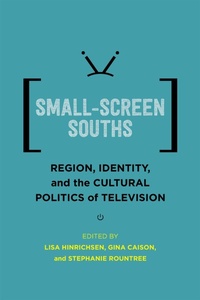
Small-Screen Souths
Region, Identity, and the Cultural Politics of Television
Will be published approx. on 13. October 2026
Book
Paperback/Softback
344 pages
978-0-8071-8741-8 (ISBN)
Description
As the first collection dedicated to the relationship between television and the U.S. South, Small-Screen Souths addresses the growing interest in how mass culture represents the region and influences popular perceptions of it. In sixteen essays divided into three thematic sections, scholars of southern culture analyze representations of the South in a variety of television shows spanning the history of the medium, from classic network programs such as The Andy Griffith Show and Designing Women to some of today's popular franchises like Duck Dynasty and The Walking Dead.
The first section, "Politics and Identity in the Televisual South," focuses on how television constructs understandings of race, gender, sexuality, and class, often adapting to changing configurations of community and identity. The next section, "Caricatures, Commodities, and Catharsis in the Rural South," examines the tension between depictions of southern rural communities and assumptions about abject whiteness, particularly conceptions of poverty and profitized culture. The concluding section, "(Dis)Locating the South," considers the influence of postcolonialism, globalization, and cosmopolitanism in understanding television featuring the region. Throughout, the essays investigate the profuse, often contradictory ways that the U.S. South has been represented on television, seeking to expand and pluralize myopic perspectives of the region.
By analyzing depictions of the South from the classical network era to the contemporary post-broadcast age, Small-Screen Souths offers a broad historical scope and a multiplicity of theoretical and interdisciplinary perspectives on what it means to see the South from the television screen.
The first section, "Politics and Identity in the Televisual South," focuses on how television constructs understandings of race, gender, sexuality, and class, often adapting to changing configurations of community and identity. The next section, "Caricatures, Commodities, and Catharsis in the Rural South," examines the tension between depictions of southern rural communities and assumptions about abject whiteness, particularly conceptions of poverty and profitized culture. The concluding section, "(Dis)Locating the South," considers the influence of postcolonialism, globalization, and cosmopolitanism in understanding television featuring the region. Throughout, the essays investigate the profuse, often contradictory ways that the U.S. South has been represented on television, seeking to expand and pluralize myopic perspectives of the region.
By analyzing depictions of the South from the classical network era to the contemporary post-broadcast age, Small-Screen Souths offers a broad historical scope and a multiplicity of theoretical and interdisciplinary perspectives on what it means to see the South from the television screen.
Reviews / Votes
"Small-Screen Souths is indispensable reading for anyone in the fields of media, southern studies, and popular culture. The collection fills a significant gap in the scholarship and demonstrates the importance of region in analyzing the dynamic impact of television. The introduction skillfully situates the collection in the intersections of popular culture, television, and southern studies, giving the reader the necessary theoretical background and an excellent overview of the classic and current trends in the televisual South. The variety and scope of the essays and the strength of the introduction make this collection perfect for the classroom. Small-Screen Souths establishes the televisual South as a significant area of study that has been waiting for just such a collection." -Deborah E. Barker, author of Reconstructing Violence: The Southern Rape Complex in Film and Literature"Offering region as corrective lens, Small-Screen Souths expands our understanding of television as an ideological and a material medium, one whose physical and symbolic networks have from the start intertwined with 'the South' to stabilize and to challenge notions of identity, place, and nation. By turns illuminating, innovative, and provocative, these essays ask not (only) what TV has done with 'the South,' but what the South has done with, and for, TV. Wide-ranging in historical scope and always engaging, this collection lays a foundation that will support a generation of fascinating scholarship to come." - Katherine Henninger, author of Ordering the Facade: Photography and Contemporary Southern Women's Writing
More details
Series
Language
English
Place of publication
Baton Rouge
United States
Target group
Professional and scholarly
Product notice
Paperback (trade)
Dimensions
Height: 229 mm
Width: 152 mm
Thickness: 20 mm
Weight
463 gr
ISBN-13
978-0-8071-8741-8 (9780807187418)
Copyright in bibliographic data and cover images is held by Nielsen Book Services Limited or by the publishers or by their respective licensors: all rights reserved.
Schweitzer Classification
Persons
Lisa Hinrichsen is associate professor of English at the University of Arkansas and the author of Possessing the Past: Trauma, Imagination, and Memory in Post-Plantation Southern Literature.
Gina Caison, the Kenneth M. England Professor of Southern Literature at Georgia State University, is the author of Erosion: American Environments and the Anxiety of Disappearance and Red States: Indigeneity, Settler Colonialism, and Southern Studies.
Stephanie Rountree is associate professor of English at the University of North Georgia and the coeditor, with Lisa Hinrichsen and Gina Caison, of Remediating Region: New Media and the U.S. South and Record, Document, Archive: Constructing the South out of Region.
Gina Caison, the Kenneth M. England Professor of Southern Literature at Georgia State University, is the author of Erosion: American Environments and the Anxiety of Disappearance and Red States: Indigeneity, Settler Colonialism, and Southern Studies.
Stephanie Rountree is associate professor of English at the University of North Georgia and the coeditor, with Lisa Hinrichsen and Gina Caison, of Remediating Region: New Media and the U.S. South and Record, Document, Archive: Constructing the South out of Region.