

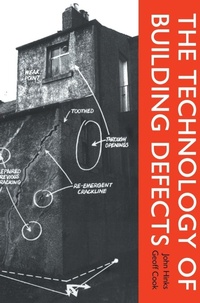
The Technology of Building Defects
1st Edition
Published on 1. August 2016
Book
Hardback
376 pages
978-1-138-17739-0 (ISBN)
Description
The Technology of Building Defects has been developed to provide a unique review of the subject. Defects are considered as part of the whole building rather than in isolation.
General educational objectives are set out which offer the reader the opportunity of self-assessment. Each section is generously illustrated with photographs and diagrams, forming an accessible self contained review covering the following: objectives; core information; exercises; revision notes; further reading.
Taken together these sections build up to offer the reader an understanding of a range of technical topics concerned with building defects.
This core text can be used for direct lecture material, seminar and tutorial information, assignment work and revision notes. It is a convenient one stop resource which dispenses with the need to consult a mass of different information sources.
General educational objectives are set out which offer the reader the opportunity of self-assessment. Each section is generously illustrated with photographs and diagrams, forming an accessible self contained review covering the following: objectives; core information; exercises; revision notes; further reading.
Taken together these sections build up to offer the reader an understanding of a range of technical topics concerned with building defects.
This core text can be used for direct lecture material, seminar and tutorial information, assignment work and revision notes. It is a convenient one stop resource which dispenses with the need to consult a mass of different information sources.
Reviews / Votes
The book is suitable for students, academics and practitioners. Chartered building, quantity and general practice surveyors would find it of particular interest. A general knowledge of the technology of building defects is essential, and this book is a worthwhile guide.' - Chartered Surveyor Monthly'...Will be of value to students and novice practitioners alike. ...the book is to be welcomed as a useful addition to the available literature...' - Journal of Architectural Conservation
More details
Language
English
Place of publication
London
United Kingdom
Publishing group
Taylor & Francis Ltd
Target group
College/higher education
Illustrations
80 s/w Abbildungen, 85 s/w Photographien bzw. Rasterbilder, 12 s/w Tabellen
12 Tables, black and white; 85 Halftones, black and white; 80 Illustrations, black and white
Dimensions
Height: 250 mm
Width: 175 mm
Thickness: 25 mm
Weight
827 gr
ISBN-13
978-1-138-17739-0 (9781138177390)
Copyright in bibliographic data and cover images is held by Nielsen Book Services Limited or by the publishers or by their respective licensors: all rights reserved.
Schweitzer Classification
Other editions
Additional editions
John Hinks | Geoff Cook
The Technology of Building Defects
E-Book
09/2002
1st Edition
Routledge
€72.49
Available for download
John Hinks | Geoff Cook
The Technology of Building Defects
E-Book
09/2002
1st Edition
Routledge
€72.49
Available for download
John Hinks | Geoff Cook
The Technology of Building Defects
Book
10/1997
1st Edition
CRC Press
€79.40
Shipment within 10-20 days
Persons
John Hinks is Reader in Facilities Management in the Department of Building Engineering and Surveying at Heriot-Watt University, Edinburgh, UK
Geoff Cook is Senior Lecturer in the Department of Construction Management and Engineering at the University of Reading, UK
Geoff Cook is Senior Lecturer in the Department of Construction Management and Engineering at the University of Reading, UK
Content
Materials. Defects with materials. Failure mechanisms in cementitious materials. Failure mechanisms in ceramic materials. Failure mechanisms in timber. Failure mechanisms in metals. Components. Defects in components: general mechanisms. Defects in external joinery. Elements.Defects in elements: soil and foundation related problems. Walls. Movement and distortion problems in walls generally. Defects in floors. Problems with internal finishes. Defects in roofs. Radon in buildings. Distortion in buildings. Wind around buildings. Measuring movement. Index.