

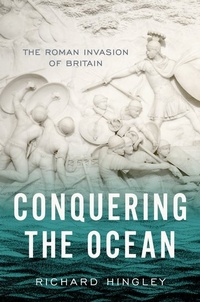
Conquering the Ocean
The Roman Invasion of Britain
Published on 28. June 2022
Book
Hardback
336 pages
978-0-19-093741-6 (ISBN)
Description
An authoritative new history of the Roman conquest of Britain
Why did Julius Caesar come to Britain? His own account suggests that he invaded to quell a resistance of Gallic sympathizers in the region of modern-day Kent -- but there must have been personal and divine aspirations behind the expeditions in 55 and 54 BCE. To the ancients, the Ocean was a body of water that circumscribed the known world, separating places like Britain from terra cognita, and no one, not even Alexander the Great, had crossed it. While Caesar came and saw, he did not conquer. In the words of the historian Tacitus, "he revealed, rather than bequeathed, Britain to Rome." For the next five hundred years, Caesar's revelation was Rome's remotest imperial bequest.
Conquering the Ocean provides a new narrative of the Roman conquest of Britain, from the two campaigns of Caesar up until the construction of Hadrian's Wall across the Tyne-Solway isthmus during the 120s CE. Much of the ancient literary record portrays this period as a long march of Roman progress but recent archaeological discoveries reveal that there existed a strong resistance in Britain, Boudica's short lived revolt being the most celebrated of them, and that Roman success was by no means inevitable. Richard Hingley here draws upon an impressive array of new information from archaeological research and recent scholarship on the classical sources to provide a balanced picture of the military activities and strategies that led to the conquest and subjugation of Britain. Conquering the Ocean is the fullest picture to date of a chapter in Roman military history that continues to captivate the public.
Why did Julius Caesar come to Britain? His own account suggests that he invaded to quell a resistance of Gallic sympathizers in the region of modern-day Kent -- but there must have been personal and divine aspirations behind the expeditions in 55 and 54 BCE. To the ancients, the Ocean was a body of water that circumscribed the known world, separating places like Britain from terra cognita, and no one, not even Alexander the Great, had crossed it. While Caesar came and saw, he did not conquer. In the words of the historian Tacitus, "he revealed, rather than bequeathed, Britain to Rome." For the next five hundred years, Caesar's revelation was Rome's remotest imperial bequest.
Conquering the Ocean provides a new narrative of the Roman conquest of Britain, from the two campaigns of Caesar up until the construction of Hadrian's Wall across the Tyne-Solway isthmus during the 120s CE. Much of the ancient literary record portrays this period as a long march of Roman progress but recent archaeological discoveries reveal that there existed a strong resistance in Britain, Boudica's short lived revolt being the most celebrated of them, and that Roman success was by no means inevitable. Richard Hingley here draws upon an impressive array of new information from archaeological research and recent scholarship on the classical sources to provide a balanced picture of the military activities and strategies that led to the conquest and subjugation of Britain. Conquering the Ocean is the fullest picture to date of a chapter in Roman military history that continues to captivate the public.
Reviews / Votes
The target audience is presumably undergraduates with little knowledge of Roman Britain. The book may offer them a marker of the current anti colonial approach with an up-to-date bibliography, but it is to be hoped that challenging it will encourage readers to seek a more balanced engagement with the original texts. * David Bird, Classical Review * Richly illustrated and offering an extensive bibliography, Conquering the Ocean is a pleasing and well-crafted examination of the Roman occupation of Britain that students of the period, as well as professional historians, will find to be of considerable value. * Brett F. Woods, Brett F. Woods, Ph.D., is a professor of history for the American Public University System, Worldhistory.org * This is a fascinating and well-illustrated look at this neglected aspect of Roman and ancient war history, describing the long-term successes and failures of a succession of emperors to conquer this land at the northern limits of the Roman empire. * New York Journal of Books * ... an incisive, up-to-date commentary on Roman campaigning... The text is an engaging and enjoyable read, with Hingley taking care to discuss both Romans and Britons, while scrupulously setting the warfare within its wider context to produce a rounded picture of events... Hingley's account of the Boudican revolt is a particular triumph... a highly successful volume that makes for essential reading. * Matthew Symonds, Current Archaeology * The text is an engaging and enjoyable read, with Hingley taking care to discuss both Romans and Britons, while scrupulously setting the warfare within its wider context to produce a rounded picture of events. A wealth of illustrations, especially those prepared by Christina Unwin, are a major asset.... For the Romans, Ocean was a divine force that encircled the inhabited world and was the father of all water deities. As Britain lay within this realm, conquering the island amounted to subjugating Ocean himself. In this spirit, the power of the sea was evoked at key moments, including Tacitus' account of Agricola's campaigning in Scotland. The emphasis on Hadrian's Wall running between 'the two shores of Ocean' can be seen in a similar light. Teasing out this dimension adds real freshness to the subject, delivering a highly successful volume that makes for essential reading. * Current Archaeology * Overall... an excellent investment for readers looking for an accessible and engaging overview of the Roman conquest of Britain. * Captain Richard Dick, Naval Historical Foundation * a fascinating and well-illustrated look at this neglected aspect of Roman and ancient war history, describing the long-term successes and failures of a succession of emperors to conquer this land at the northern limits of the Roman empire. * Jerry Lenaburg * This highly readable account of the Roman conquest and occupation of Britain seeks to synthesise recent work on classical literary references to the island with the much larger body of archaeological and epigraphic research on Roman Britain. * Britannia * In this captivating and compact book, Hingley reconstructs the various ideological and historical moments of the Roman conquest and securing of Britain between Caesar's invasion and 410 CE. * Donato Sitaro, Bryn Mawr Classical Review * Hingley's narrative of this process is a masterful blend of the archaeological and textual records (find spots, epigraphy, historiographical narratives)... There is always a lot of archaeological interest in Roman Britain; Hingley's great service is to bring that often scattered work together here, as a benchmark for future research. * Classical Journal-Online *More details
Series
Language
English
Place of publication
New York
United States
Illustrations
40 illustrations
Dimensions
Height: 243 mm
Width: 165 mm
Thickness: 32 mm
Weight
653 gr
ISBN-13
978-0-19-093741-6 (9780190937416)
Copyright in bibliographic data and cover images is held by Nielsen Book Services Limited or by the publishers or by their respective licensors: all rights reserved.
Schweitzer Classification
Other editions
New editions
Book
08/2024
Oxford University Press Inc
€16.50
Article in reprint
Additional editions
E-Book
02/2022
OUP eBook
€9.99
Available for download
E-Book
01/2022
OUP eBook
€9.99
Available for download
Person
Richard Hingley is Professor of Roman Archaeology at Durham University and the author of several books, including Londinium: A Biography; Boudica: Iron Age Warrior Queen (with Christina Unwin); and Hadrian's Wall: A Life.
Content
Preface
1. Taking Sides: On Britain and Rome
2. Julius Caesar and Ocean, 55 and 54 BCE
3. Experiments in Kingship, 54 BCE-43 CE
4. Subduing Ocean: Claudius and Britain, 43-52 CE
5. A Setback and a Recovery: Nero and Boudica, 54-68 CE
6. Total Conquest? Agricola and Caledonia, 68-86 CE
7. Establishing a Northern Frontier, 87 to 117 CE
8. The Spirit of Water: Hadrian and His Wall, 117-130 CE
9. 'Britons Never Will Be Slaves': The Legacy of the Roman Conquest
1. Taking Sides: On Britain and Rome
2. Julius Caesar and Ocean, 55 and 54 BCE
3. Experiments in Kingship, 54 BCE-43 CE
4. Subduing Ocean: Claudius and Britain, 43-52 CE
5. A Setback and a Recovery: Nero and Boudica, 54-68 CE
6. Total Conquest? Agricola and Caledonia, 68-86 CE
7. Establishing a Northern Frontier, 87 to 117 CE
8. The Spirit of Water: Hadrian and His Wall, 117-130 CE
9. 'Britons Never Will Be Slaves': The Legacy of the Roman Conquest