

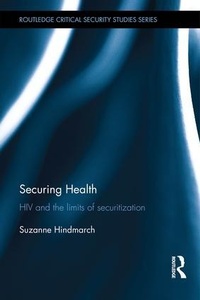
Securing Health
HIV and the Limits of Securitization
1st Edition
Published on 29. April 2016
Book
Hardback
186 pages
978-1-138-86038-4 (ISBN)
Description
This book offers a critical inquiry into the framing of health and disease as a security issue.
In particular, the book examines what happens in the United Nations when the ostensibly 'low' politics of global health meet the 'high' politics of security, and when the logic of security comes to shape global health initiatives. It offers a critical re-assessment of efforts in the United Nations system to position HIV as a security threat with the hope that this would attract greater attention and resources for the global HIV response. The book advances securitization theory by presenting a new framework for studying HIV as a policy process, uniting several theoretical strands into a single, powerful model for empirical application. It uses this model to draw attention to important, understudied aspects of HIV securitization, including the role played by discourses about Africa, and the evolution of ideas about HIV and security as actors learned over time. On the basis of this empirically grounded assessment of how securitization works as a theory and a political strategy, the book suggests that securitization is inherently limited, and perhaps dangerous, as a strategy for 'securing' social change.
This book will be of much interest to students of critical security studies, global health, development studies, and IR in general.
In particular, the book examines what happens in the United Nations when the ostensibly 'low' politics of global health meet the 'high' politics of security, and when the logic of security comes to shape global health initiatives. It offers a critical re-assessment of efforts in the United Nations system to position HIV as a security threat with the hope that this would attract greater attention and resources for the global HIV response. The book advances securitization theory by presenting a new framework for studying HIV as a policy process, uniting several theoretical strands into a single, powerful model for empirical application. It uses this model to draw attention to important, understudied aspects of HIV securitization, including the role played by discourses about Africa, and the evolution of ideas about HIV and security as actors learned over time. On the basis of this empirically grounded assessment of how securitization works as a theory and a political strategy, the book suggests that securitization is inherently limited, and perhaps dangerous, as a strategy for 'securing' social change.
This book will be of much interest to students of critical security studies, global health, development studies, and IR in general.
More details
Series
Language
English
Place of publication
London
United Kingdom
Publishing group
Taylor & Francis Ltd
Target group
College/higher education
Professional and scholarly
Product notice
sewn/stitched
Cloth over boards
Illustrations
2 s/w Zeichnungen, 4 s/w Tabellen
4 Tables, black and white; 2 Line drawings, black and white
Dimensions
Height: 234 mm
Width: 157 mm
Thickness: 20 mm
Weight
476 gr
ISBN-13
978-1-138-86038-4 (9781138860384)
Copyright in bibliographic data and cover images is held by Nielsen Book Services Limited or by the publishers or by their respective licensors: all rights reserved.
Schweitzer Classification
Other editions
Additional editions

Book
06/2020
1st Edition
Routledge
€52.03
Shipment within 15-20 days
E-Book
04/2016
Routledge
€59.49
Available for download
E-Book
04/2016
Routledge
€59.49
Available for download
Person
Suzanne Hindmarch is Assistant Professor of political science at the University of New Brunswick, Canada.
Content
1. Introduction: HIV and securitization as a transformative strategy in global health
2. Securitization as a policy process
3. Africa, HIV and security: the discursive context of threat construction in securitization
4. Speech acts, framing contests, and strategic action in HIV securitization
5 When urgency meets bureaucracy: boundary work in HIV and security policy implementation
6. Through the looking glass: the production of HIV and security knowledge
7. The limits of 'securing' health through securitization
8. Conclusion
2. Securitization as a policy process
3. Africa, HIV and security: the discursive context of threat construction in securitization
4. Speech acts, framing contests, and strategic action in HIV securitization
5 When urgency meets bureaucracy: boundary work in HIV and security policy implementation
6. Through the looking glass: the production of HIV and security knowledge
7. The limits of 'securing' health through securitization
8. Conclusion