

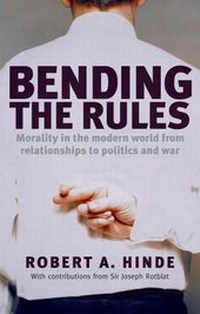
Bending the Rules
Morality in the Modern World - From Relationships to Politics and War
Published on 1. December 2007
Book
Hardback
288 pages
978-0-19-921897-4 (ISBN)
Description
Everywhere people share certain moral principles - it is bad to steal, to kill, to lie. We see our morality as absolute, yet we live by rules that differ with the context: it is ok to kill the enemy in war; for a businessman to do the best for himself; for a lawyer to argue professionally for a position he would personally reject. We are constantly 'bending the rules', while considering our moral principles as absolute. Robert Hinde, the eminent Cambridge biologist and psychologist, presents a new approach to morality based on combining an evolutionary approach with observations on how people actually behave to show that morality is more subtle than it appears. The complexity of modern societies requires the rules to be somewhat flexible according to the context - personal relationships, science, law, business, politics and war. Some bending of rules is necessary for social cohesion; but too much is destructive. Hinde argues from a humanistic standpoint for a deeper appreciation of the nature of morality, so that we may avoid global catastrophe, and strive for a more ethical, just, and peaceful world.
More details
Language
English
Place of publication
Oxford
United Kingdom
Target group
College/higher education
Dimensions
Height: 223 mm
Width: 144 mm
Thickness: 27 mm
Weight
480 gr
ISBN-13
978-0-19-921897-4 (9780199218974)
Copyright in bibliographic data and cover images is held by Nielsen Book Services Limited or by the publishers or by their respective licensors: all rights reserved.
Schweitzer Classification
Other editions
Additional editions
Book
12/2008
Oxford University Press
€11.13
Article exhausted; check different version
Content
Introduction; 1. Ethical principles and precepts; 2. The evolution of morality; 3. Ethics and law; 4. Exchange and Reciprocity: conflict in Personal Relationships; 5. Ethics and the physical sciences; 6. Ethics and medicine; 7. Ethics and politics; 8. Ethics and business; 9. Ethics and war; 10. What does it mean for the future?