

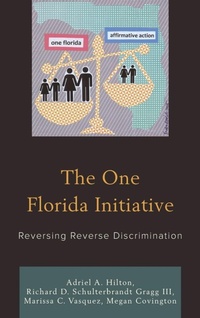
The One Florida Initiative
Reversing Reverse Discrimination
Published on 7. July 2021
Book
Hardback
130 pages
978-0-7618-7276-4 (ISBN)
Description
In this sixty-seventh anniversary year of the groundbreaking Supreme Court decision in the Brown v. Board of Education case that outlawed segregation in the nation's public schools, research reveals that schools have undergone significant re-segregation. The anguish that many of us feel about this incredible failure of public policy underscores the layered aspect of achieving racial equality in America. In Florida, and across the nation, the steps that have been taken to implement affirmative action in higher education have been under constant attack by conservatives, and a series of actions by various state and federal courts have resulted in reduced access and enrollment of students of color in several states. In 1999, Governor Jeb Bush used his authority to redefine affirmative action in his state by issuing an executive order that established the One Florida Initiative (OFI). Bush's claim that the OFI was intended to increase diversity and opportunities for people of color in Florida's state university system appears to be contradicted by findings that minority representation actually decreased in most of the state universities after the policy was implemented.
Hilton and colleagues provide a cogent analysis of the effects of the OFI on enrollment patterns in the state's public law schools to help us understand how changes in public policy can have detrimental effects on particular communities. The research is both enriched and complicated by the inclusion of the two law schools: Florida A&M and Florida International Universities, both of which are minority-serving institutions (MSIs). These schools were developed independently of the OFI but had a potential effect on the level of diversity that can be calculated across the system. The use of critical race theory offers an approach that will prove unnerving to some readers, but is one that provided insights that may not have been revealed through a different framework.
Hilton and colleagues provide a cogent analysis of the effects of the OFI on enrollment patterns in the state's public law schools to help us understand how changes in public policy can have detrimental effects on particular communities. The research is both enriched and complicated by the inclusion of the two law schools: Florida A&M and Florida International Universities, both of which are minority-serving institutions (MSIs). These schools were developed independently of the OFI but had a potential effect on the level of diversity that can be calculated across the system. The use of critical race theory offers an approach that will prove unnerving to some readers, but is one that provided insights that may not have been revealed through a different framework.
Reviews / Votes
Hilton and colleagues have chosen to enter the discourse on diversity in American academe by engaging two seemingly unusual suspects; namely, law schools and the state of Florida. The authors painstakingly integrate both qualitative and quantitative methods to explore the impact of the One Florida Initiative (OFI) on enhancing racial diversity in the State University System of Florida. Critical Race Theory (CRT) serves as the theoretical structure to frame this important work. The One Florida Initiative: Reversing Reverse Discrimination is sure to become an important contribution to the burgeoning body of work that attempts to tackle the issues that arise related to the tripartite concomitance of diversity, race, and American academe. -- Fred A. Bonner, Prairie View A&M University Dr. Hilton and colleagues' research advances the overarching values in higher education by examining a policy that purports to advance one of the more complex and important issues of our time as it relates to institutions of higher learning. The study sought to discover the impact of the One Florida Initiative (OFI) and the addition of two minority serving institution (MSI) law schools on diversity in Florida's legal profession. The authors challenge the SUS of Florida to be prepared for a more diverse society to adequately prepare students for the challenges of the social, political, and economic changes that seem to be inevitable. This work is both scholarly and of profound quality. -- Patricia Green-Powell, Florida A&M University In part, the quest to allow equitable opportunity to higher education rests on society's ability to understand the importance of diversity at the highest levels of education. The complexities of achieving this quest in today's society are real. This book provides an opportunity for readers to understand how this issue was addressed in one state. This volume moves our society towards the proper direction to achieve educational opportunities for all. -- Chance W. Lewis, University of North Carolina at CharlotteMore details
Language
English
Place of publication
Lanham, MD
United States
Publishing group
University Press of America
Target group
Professional and scholarly
Illustrations
2 b/w photos; 24 tables;
Dimensions
Height: 235 mm
Width: 157 mm
Thickness: 12 mm
Weight
353 gr
ISBN-13
978-0-7618-7276-4 (9780761872764)
Copyright in bibliographic data and cover images is held by Nielsen Book Services Limited or by the publishers or by their respective licensors: all rights reserved.
Schweitzer Classification
Other editions
Additional editions
Adriel A. Hilton | Richard D. Schulterbrandt Gragg III | Marissa C. Vasquez
The One Florida Initiative
Reversing Reverse Discrimination
E-Book
07/2021
1st Edition
Hamilton Books
€62.49
Available for download
Adriel A. Hilton | Richard D. Schulterbrandt Gragg III | Marissa C. Vasquez
The One Florida Initiative
Reversing Reverse Discrimination
E-Book
07/2021
1st Edition
Bloomsbury eBooks US
€62.49
Available for download
Persons
Adriel A. Hilton is vice chancellor for student affairs and enrollment management at Southern University at New Orleans.
Richard D. Schulterbrandt Gragg III is professor of environmental science and policy in the School of the Environment at Florida A&M University in Tallahassee, Florida.
Marissa C. Vasquez is assistant professor of postsecondary educational leadership in the Department of Administration, Rehabilitation, and Postsecondary Education (ARPE) at San Diego State University.
Megan Covingtonis a research associate at Frederick D. Patterson Research Institute at the United Negro College Fund.
Richard D. Schulterbrandt Gragg III is professor of environmental science and policy in the School of the Environment at Florida A&M University in Tallahassee, Florida.
Marissa C. Vasquez is assistant professor of postsecondary educational leadership in the Department of Administration, Rehabilitation, and Postsecondary Education (ARPE) at San Diego State University.
Megan Covingtonis a research associate at Frederick D. Patterson Research Institute at the United Negro College Fund.
Content
List of Tables
Foreword
Acknowledgments
Introduction
Chapter 1: Emergence of Affirmative Action
Chapter 2: Theoretical Framework and Context
Chapter 3: One Florida Initiative: The Race Neutral Policy in Florida
Chapter 4: Methodology
Chapter 5: Findings
Chapter 6: Discussion
Epilogue
References
About the Authors
Foreword
Acknowledgments
Introduction
Chapter 1: Emergence of Affirmative Action
Chapter 2: Theoretical Framework and Context
Chapter 3: One Florida Initiative: The Race Neutral Policy in Florida
Chapter 4: Methodology
Chapter 5: Findings
Chapter 6: Discussion
Epilogue
References
About the Authors