

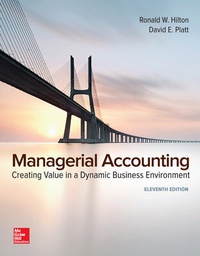
Managerial Accounting: Creating Value in a Dynamic Business Environment
11th Edition
Published on 16. October 2016
Book
Hardback
848 pages
978-1-259-56956-2 (ISBN)
Description
The emphasis of Managerial Accounting, 11th edition is on teaching students to use accounting information to best manage an organization. In a practice Hilton pioneered in the first edition, each chapter is written around a realistic business or focus company that guides the reader through the topics of that chapter. Known for balanced examples of Service, Retail, Nonprofit and Manufacturing companies, Hilton/Platt offers a clear, engaging writing style that has been praised by instructors and students alike. As in previous editions, there is significant coverage of contemporary topics such as activity-based costing, target costing, the value chain, customer profitability analysis, and throughput costing while also including traditional topics such as job-order costing, budgeting and performance evaluation.
More details
Edition
11th edition
Language
English
Place of publication
OH
United States
Target group
College/higher education
US School Grade: From College Freshman to College Graduate Student
Illustrations
196 Illustrations
Dimensions
Height: 285 mm
Width: 224 mm
Thickness: 31 mm
Weight
1827 gr
ISBN-13
978-1-259-56956-2 (9781259569562)
Schweitzer Classification
Other editions
Previous edition
Ronald Hilton | David Platt
Managerial Accounting: Creating Value in a Dynamic Business Environment
Book
10/2013
10th Edition
McGraw-Hill Professional
€323.10
Article exhausted; check for reprint
Persons
Ronald W. Hilton is a Professor of Accounting at Cornell University. With bachelor's and master's degrees in accounting from The Pennsylvania State University, he received his Ph.D. from The Ohio State University.
Content
1 The Changing Role of Managerial Accounting in a Dynamic Business Environment
2 Basic Cost Management Concepts
3 Product Costing and Cost Accumulation in a Batch Production Environment
4 Process Costing and Hybrid Product-Costing Systems
5 Activity-Based Costing and Management
6 Activity Analysis, Cost Behavior, and Cost Estimation
7 Cost-Volume-Profit Analysis
8 Variable Costing and the Costs of Quality and Sustainability
9 Financial Planning and Analysis: The Master Budget
10 Standard Costing and Analysis of Direct Costs
11 Flexible Budgeting and Analysis of Overhead Costs
12 Responsibility Accounting, Operational Performance Measures, and the Balanced Scorecard
13 Investment Centers and Transfer Pricing
14 Decision Making: Relevant Costs and Benefits
15 Target Costing and Cost Analysis for Pricing Decisions
16 Capital Expenditure Decisions
17 Allocation of Support Activity Costs and Joint Costs
Appendix I: The Sarbanes-Oxley Act, Internal Controls, and Management Accounting
Appendix II: Compound Interest and the Concept of Present Value
Appendix III: Inventory Management
2 Basic Cost Management Concepts
3 Product Costing and Cost Accumulation in a Batch Production Environment
4 Process Costing and Hybrid Product-Costing Systems
5 Activity-Based Costing and Management
6 Activity Analysis, Cost Behavior, and Cost Estimation
7 Cost-Volume-Profit Analysis
8 Variable Costing and the Costs of Quality and Sustainability
9 Financial Planning and Analysis: The Master Budget
10 Standard Costing and Analysis of Direct Costs
11 Flexible Budgeting and Analysis of Overhead Costs
12 Responsibility Accounting, Operational Performance Measures, and the Balanced Scorecard
13 Investment Centers and Transfer Pricing
14 Decision Making: Relevant Costs and Benefits
15 Target Costing and Cost Analysis for Pricing Decisions
16 Capital Expenditure Decisions
17 Allocation of Support Activity Costs and Joint Costs
Appendix I: The Sarbanes-Oxley Act, Internal Controls, and Management Accounting
Appendix II: Compound Interest and the Concept of Present Value
Appendix III: Inventory Management