

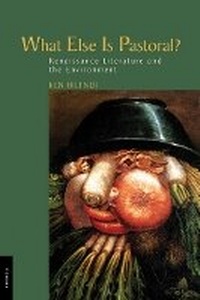
What Else Is Pastoral?
Renaissance Literature and the Environment
Published on 18. March 2011
Book
Hardback
200 pages
978-0-8014-4940-6 (ISBN)
Description
Pastoral was one of the most popular literary forms of early modern England. Inspired by classical and Italian Renaissance antecedents, writers from Ben Jonson to John Beaumont and Abraham Cowley wrote in idealized terms about the English countryside. It is often argued that the Renaissance pastoral was a highly figurative mode of writing that had more to do with culture and politics than with the actual countryside of England. For decades now literary criticism has had it that in pastoral verse, hills and crags and moors were extolled for their metaphoric worth, rather than for their own qualities. In What Else Is Pastoral? Ken Hiltner takes a fresh look at pastoral, offering an environmentally minded reading that reconnects the poems with literal landscapes, not just figurative ones.
Considering the pastoral in literature from Virgil and Petrarch to Jonson and Milton, Hiltner proposes a new ecocritical approach to these texts. We only become truly aware of our environment, he explains, when its survival is threatened. As London expanded rapidly during the sixteenth and seventeenth centuries, the city and surrounding rural landscapes began to look markedly different. Hiltner finds that Renaissance writers were acutely aware that the countryside they had known was being lost to air pollution, deforestation, and changing patterns of land use; their works suggest this new absence of nature through their appreciation for the scraps that remained in memory or in fact. A much-needed corrective to the prevailing interpretation of pastoral poetry, What Else Is Pastoral? shows the value of reading literature with an ecological eye.
Considering the pastoral in literature from Virgil and Petrarch to Jonson and Milton, Hiltner proposes a new ecocritical approach to these texts. We only become truly aware of our environment, he explains, when its survival is threatened. As London expanded rapidly during the sixteenth and seventeenth centuries, the city and surrounding rural landscapes began to look markedly different. Hiltner finds that Renaissance writers were acutely aware that the countryside they had known was being lost to air pollution, deforestation, and changing patterns of land use; their works suggest this new absence of nature through their appreciation for the scraps that remained in memory or in fact. A much-needed corrective to the prevailing interpretation of pastoral poetry, What Else Is Pastoral? shows the value of reading literature with an ecological eye.
Reviews / Votes
For Hiltner a preoccupation with mimesis as the defining element of nature writing has blinded ecocritics to 'what else is pastoral in the Renaissance.' Chapters on 'Air Pollution in Early Modern London' and 'Environmental Protest Literature of the Renaissance' lead to 'Empire, the Environment, and the Growth of the Georgic'. The latter, in particular, is typical of the radical rethinking demanded by... [this] challenging extension of ecocritical achievement.- Terry Gifford (Green Letters: Studies in Ecocriticism) This book is a fresh departure from the long critical tradition that reads the pastoral figuratively or as a stock convention. For Hiltner, the pastoral in Renaissance England is... a form of nature writing... [and] reflects real environmental crises in and around London, fraught issues that sparked debates and influenced literature across different forms and genres.... Hiltner has made a valuable contribution to both early modern studies and ecocriticism.
- Lowell Duckert (Sixteenth Century Journal) What is fascinating about What Else is Pastoral? is the way it tracks the gestation of one of the most pressing issues: how do we represent those processes and activities that our society can live neither with nor without? Hiltner challenges environmentally minded critics who focus on 'wilderness and nature' without accounting for the 'dynamic whereby we become conscious of the countryside and the earth.'... Hiltner's book does not overplay the relevance to contemporary ecological issues. Even so, the analogues are compelling, especially when he takes us over to Ireland to investigate the centrality of land to a postcolonial perspective.
(Times Literary Supplement)
More details
Language
English
Place of publication
Ithaca
United States
Target group
College/higher education
Product notice
Paper over boards
Dimensions
Height: 229 mm
Width: 152 mm
Thickness: 22 mm
Weight
454 gr
ISBN-13
978-0-8014-4940-6 (9780801449406)
Copyright in bibliographic data and cover images is held by Nielsen Book Services Limited or by the publishers or by their respective licensors: all rights reserved.
Schweitzer Classification
Other editions
Additional editions

E-Book
03/2011
Cornell University Press
€43.99
Available for download
Person
Ken Hiltner is Associate Professor of English at the University of California, Santa Barbara. He is the author of Milton and Ecology and the editor of Renaissance Ecology: Imagining Eden in Milton's England.
Content
IntroductionPart I. Literary Issues
1. The Nature of Art
2. What Else Is Pastoral
3. What Else Was Pastoral in the Renaissance?
4. Pastoral and Ideology, and the EnvironmentPart II. Environmental Problems
5. Representing Air Pollution in Early Modern London
6. Environmental Protest Literature of the Renaissance
7. Empire, the Environment, and the Growth of GeorgicSelect Bibliography
Index
1. The Nature of Art
2. What Else Is Pastoral
3. What Else Was Pastoral in the Renaissance?
4. Pastoral and Ideology, and the EnvironmentPart II. Environmental Problems
5. Representing Air Pollution in Early Modern London
6. Environmental Protest Literature of the Renaissance
7. Empire, the Environment, and the Growth of GeorgicSelect Bibliography
Index