

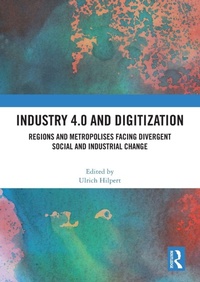
Industry 4.0 and Digitization
Regions and Metropolises Facing Divergent Social and Industrial Change
1st Edition
Published on 29. January 2024
Book
Paperback/Softback
166 pages
978-1-032-27305-1 (ISBN)
Description
This book includes studies on regions, industries and tendencies of industrial change and spatial concentration of competences and industrial potentials. The chapters in this volume provide for discussions concerning a wider understanding of situations related to Industry 4.0 and digitization. It also reaches out further than towards technology and economy because it includes regional and metropolitan societies, workforces and the divergencies of effects and opportunities.
Industry 4.0 and digitization are new transformations for regions and metropolises where technologies are applied but regionally can appear as a continuation of innovative processes where it is developed. The divergent presence of competences creates a selectivity process among regions. There are individual industry-location-nexuses formed out of competences of industries, labour force and research which are complemented by public policies providing support towards such adaptation of innovation and change. Regional societies formed from skilled and educated labour become an important basis for participation in innovation and supply chains. Since smart factories widely can be managed remotely, this also shows a concentration of decision making. Simultaneously, it forms a polycentric de-concentration, indicating some more important locations as central within the networks. These systematic changes continue to deepen over time. While public policies may match innovative opportunities at the appropriate moment, they also contribute to a continuation of uneven development and divergent societal tendencies. Industry 4.0 and digitization indicate a wide and selective change of organization associated with new technologies and innovation. While some regions and metropolises can continue to build both innovative competences and innovative societies based on innovative labour force, others will participate because of their position in supply chains.
The chapters in this book were originally published as a special issue of the journal, European Planning Studies.
Industry 4.0 and digitization are new transformations for regions and metropolises where technologies are applied but regionally can appear as a continuation of innovative processes where it is developed. The divergent presence of competences creates a selectivity process among regions. There are individual industry-location-nexuses formed out of competences of industries, labour force and research which are complemented by public policies providing support towards such adaptation of innovation and change. Regional societies formed from skilled and educated labour become an important basis for participation in innovation and supply chains. Since smart factories widely can be managed remotely, this also shows a concentration of decision making. Simultaneously, it forms a polycentric de-concentration, indicating some more important locations as central within the networks. These systematic changes continue to deepen over time. While public policies may match innovative opportunities at the appropriate moment, they also contribute to a continuation of uneven development and divergent societal tendencies. Industry 4.0 and digitization indicate a wide and selective change of organization associated with new technologies and innovation. While some regions and metropolises can continue to build both innovative competences and innovative societies based on innovative labour force, others will participate because of their position in supply chains.
The chapters in this book were originally published as a special issue of the journal, European Planning Studies.
More details
Language
English
Place of publication
London
United Kingdom
Publishing group
Taylor & Francis Ltd
Target group
College/higher education
Postgraduate and Undergraduate
Dimensions
Height: 246 mm
Width: 174 mm
Thickness: 10 mm
Weight
329 gr
ISBN-13
978-1-032-27305-1 (9781032273051)
Copyright in bibliographic data and cover images is held by Nielsen Book Services Limited or by the publishers or by their respective licensors: all rights reserved.
Schweitzer Classification
Other editions
Additional editions
Ulrich Hilpert
Industry 4.0 and Digitization
Regions and Metropolises Facing Divergent Social and Industrial Change
Book
06/2022
1st Edition
Routledge
€205.90
Shipment within 10-20 days
Ulrich Hilpert
Industry 4.0 and Digitization
Regions and Metropolises Facing Divergent Social and Industrial Change
E-Book
06/2022
1st Edition
Routledge
€59.49
Available for download
Ulrich Hilpert
Industry 4.0 and Digitization
Regions and Metropolises Facing Divergent Social and Industrial Change
E-Book
06/2022
1st Edition
Routledge
€59.49
Available for download
Person
Ulrich Hilpert is Professor of Comparative Government at the University of Jena, Germany; Fellow of the Academy of Social Sciences, London; Senior Fellow of the Hans-Boeckler-Foundation, Duesseldorf, and has been visiting professor at a dozen universities in Europe and the United States. His main areas of research are comparative studies in technology, innovation, regional development, global networking, and skilled and university trained labour.
Content
Introduction - spatial evolution in the light of innovative transformation: the impact of policies and institutions in divergent situations 1. Regional selectivity of innovative progress: Industry 4.0 and digitization ahead 2. The impact of Industry 4.0 on supply chains and regions: innovation in the aerospace and automotive industries 3. The transition of regional innovation systems to Industry 4.0: the case of Basque Country and Catalonia 4. The growing inequalities in Italy - North/South - and the increasing dependency of the successful North upon German and French industries 5. How does Industry 4.0 affect the relationship between centre and periphery? The case of manufacturing industry in Germany 6. Glowing cities and the future of manufacturing in the US and Europe: How digitalization will impact metropolitan areas depending on sectoral dominances and regional skill distribution 7. The Korean approach to Industry 4.0: the 4th Industrial Revolution from regional perspectives 8. Industry 4.0/Digitalization and networks of innovation in the North American regional context 9. Industry 4.0 as a 'sudden change': the relevance of long waves of economic development for the regional level Conclusion - the complexity of reorganizing industries and value chains: challenges and selectivity of Industry 4.0 and digitization