

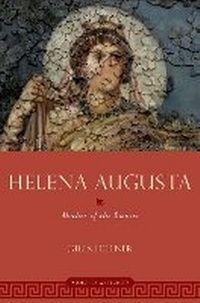
Helena Augusta
Mother of the Empire
Published on 10. November 2022
Book
Hardback
432 pages
978-0-19-087529-9 (ISBN)
Description
In the middle of the third century, a girl was born on the north-eastern frontier of the Roman empire. Eighty years later, she died as Flavia Iulia Helena, Augusta of the Roman world and mother of the first Christian emperor Constantine, without ever having been married to an emperor herself. In Helena Augusta: Mother of the Empire, Julia Hillner traces Helena's story through her life's peaks, which generated beautiful imperial artwork, entertaining legends as well as literary outrage. But Helena Augusta also pays careful attention to the disruptions in Helena's life course and in her commemoration--disruptions that were created by her nearest male relatives.
Hillner shows that Helena's story was not just determined by the love of a son or the rise of Christianity. It was also--like that of many other late Roman women--defined by male violence and by the web of changing female relationships around her, to which Helena was sometimes marginal, sometimes central and sometimes ancillary. Helena Augusta offers unique insight into the roles of imperial women in Constantinian self-display and in dynastic politics from the Tetrarchy to the Theodosian Age, and it also reminds us that the late Roman female life course, even that of an empress, was fragile and non-linear.
Hillner shows that Helena's story was not just determined by the love of a son or the rise of Christianity. It was also--like that of many other late Roman women--defined by male violence and by the web of changing female relationships around her, to which Helena was sometimes marginal, sometimes central and sometimes ancillary. Helena Augusta offers unique insight into the roles of imperial women in Constantinian self-display and in dynastic politics from the Tetrarchy to the Theodosian Age, and it also reminds us that the late Roman female life course, even that of an empress, was fragile and non-linear.
Reviews / Votes
Hillner reveals the life of a Roman empress, in all its splendor and danger, conjuring a flesh-and-blood woman where others might only see hints and fragments. Helena Augusta is both a dazzling piece of detective work and a powerful act of the historical imagination. * Kate Cooper, Royal Holloway, University of London * Using tools developed for feminist historiography, Hillner has retrieved the historical mother of Constantine the Great from the realm of legend. Her reconstruction is engaging, filled with shrewd insight, and well-grounded in ancient sources. She is especially good at using material culture to lead into deeper discussions. Instead of the saintly Helena who discovered the True Cross, we now have a living, breathing person who can teach us a great deal about the history of women in the fourth century. * H. A. Drake, University of California, Santa Barbara * In many respects this is a great book and a fascinating read...It will rapidly become the standard monograph on Helena. The book's greatest value, however, lies in how Hillner explains the role of Tetrarchic and Constantinian women in dynastic politics. * Jan Willem Drijvers, University of Groningen, Plekos * In many respects this is a great book and a fascinating read. It does a much better job than previous studies of outlining Helena's life against the background and in the context of political and dynastic entanglements during the Tetrarchy and the reign of Constantine. It will rapidly become the standard monograph on Helena. * Stefan Vranka, Plekos * This is a very rich and rewarding...book...Offer[s] much to those interested in Roman women and Roman history, those interested in female power, its contingencies and limits. * Journal of Roman Studies * The study represents a significant advancement in understanding the history of the fourth century AD. Additionally, the study stands out for its meticulous examination of all available literary sources and previous research, as well as for its careful and clear statements on the historical issues of the Constantinian era. Furthermore, the study excels in its precise examination of the archaeological evidence, which is often used as the starting point for individual chapters. Another strength of the work is Hillner's keen focus on the regional contexts of the presentation of imperial female roles and functions... With this research approach, the author consolidates her detailed network and communication analysis, which, as mentioned, proves to be highly productive for the Constantinian era. * Bryn Mawr Classical Review * A fine study of one of the most famous Christian women... This book is fantastic. Hillner hardly puts a historical foot wrong, combining rigorous command of technical material in a range of sub-disciplines with an understanding of the value and limits of the imagination in historical narrative.... [Hillner] has produced a work that, in both methodology and content, is not just a triumph of gender history, but a model for writing ancient biography in general. * Greece & Rome * This skillfully researched work has given the full story of the women and men who guided the late empire. * Joyce E. Salisbury, Church History *More details
Series
Language
English
Place of publication
New York
United States
Target group
Professional and scholarly
Illustrations
68, B/W
Dimensions
Height: 156 mm
Width: 235 mm
Thickness: 29 mm
Weight
735 gr
ISBN-13
978-0-19-087529-9 (9780190875299)
Copyright in bibliographic data and cover images is held by Nielsen Book Services Limited or by the publishers or by their respective licensors: all rights reserved.
Schweitzer Classification
Other editions
Additional editions
Book
12/2022
Oxford University Press Inc
€42.70
Shipment within 15-20 days
E-Book
11/2022
OUP eBook
€17.49
Available for download
E-Book
11/2022
OUP eBook
€17.49
Available for download
Person
Julia Hillner is Professor of Dependency Studies (Imperial Rome, Late Antiquity) at the Bonn Center for Dependency and Slavery Studies, Rheinische Friedrich-Wilhelms-Universitaet Bonn. She is the author of Prison, Punishment and Penance in Late Antiquity.
Content
Acknowledgements
Abbreviations
Timeline of the Constantinian, Valentinian and Theodosian Dynasties
Dramatis Personae
Family Tree
Maps
Introduction: Writing Helena
The Case for (Chronological) Biography
Writing Helena's Life Forwards: Of Places, Gaps and Relationships
Helena, Dynasty, and Power
Part I: Extra (c. 248-c.289)
Chapter 1: On the Frontiers
Demographics
Helena and the 'Crisis of the Third Century'
Meeting Constantius
Chapter 2: Weather Eye on the Horizon
Legalities
Helena at Naissus and Salona
Helena's Tetrarchy
Part II: Off-Stage (c. 289-c. 317)
Chapter 3: Sister Act
Lost Girl: Theodora
Fausta's Nose
Pruning the Tree
Waiting in the Wings, Becoming Christian?
Chapter 4: The Necklace Affair
The Tomb at %Sarkamen
Divine Mothers
The Augusta in the East
Fair Game: Empresses as Prey
Part III: Centre-Stage (c.317-c.329)
Chapter 5: Keeping Up Appearances
The Road to Thessalonica: A Wedding, a Conspiracy, and a War
The Augusta-Double
Fausta, Super Star
Chapter 6: Roman Holiday
Palace Life
Helena and Constantine's Churches in Rome
New Look
Chapter 7: Four Deaths and an Anniversary
Murders in the Family
Becoming Genetrix
Chapter 8: From Here to Eternity
The Travelling Empress: Conflicting Portraits
Helena, the Pilgrim?
On the Road
A New Jezebel
Empresses in the Holy Land
Part IV: Curtain and Encores (c.329-c. 600)
Chapter 9: Burying an Empress
Final Honours
Rebranching the Tree
Coming Through Slaughter
Chapter 10: Silence of the Empress
Extending Helena: Constantina
Burying Empresses, One More Time
Countering Helena: Justina
Chapter 11: New Model Empress
Ambrose's Helena
Reviving Helena's Look: Flaccilla and Thermantia
Reviving Helena in Action
Emulating Helena: Galla Placidia and Eudocia
A 'New Helena' in Name: Pulcheria
Being Helena: Radegund
Epilogue
Ancient Sources
Modern Studies
Index
Abbreviations
Timeline of the Constantinian, Valentinian and Theodosian Dynasties
Dramatis Personae
Family Tree
Maps
Introduction: Writing Helena
The Case for (Chronological) Biography
Writing Helena's Life Forwards: Of Places, Gaps and Relationships
Helena, Dynasty, and Power
Part I: Extra (c. 248-c.289)
Chapter 1: On the Frontiers
Demographics
Helena and the 'Crisis of the Third Century'
Meeting Constantius
Chapter 2: Weather Eye on the Horizon
Legalities
Helena at Naissus and Salona
Helena's Tetrarchy
Part II: Off-Stage (c. 289-c. 317)
Chapter 3: Sister Act
Lost Girl: Theodora
Fausta's Nose
Pruning the Tree
Waiting in the Wings, Becoming Christian?
Chapter 4: The Necklace Affair
The Tomb at %Sarkamen
Divine Mothers
The Augusta in the East
Fair Game: Empresses as Prey
Part III: Centre-Stage (c.317-c.329)
Chapter 5: Keeping Up Appearances
The Road to Thessalonica: A Wedding, a Conspiracy, and a War
The Augusta-Double
Fausta, Super Star
Chapter 6: Roman Holiday
Palace Life
Helena and Constantine's Churches in Rome
New Look
Chapter 7: Four Deaths and an Anniversary
Murders in the Family
Becoming Genetrix
Chapter 8: From Here to Eternity
The Travelling Empress: Conflicting Portraits
Helena, the Pilgrim?
On the Road
A New Jezebel
Empresses in the Holy Land
Part IV: Curtain and Encores (c.329-c. 600)
Chapter 9: Burying an Empress
Final Honours
Rebranching the Tree
Coming Through Slaughter
Chapter 10: Silence of the Empress
Extending Helena: Constantina
Burying Empresses, One More Time
Countering Helena: Justina
Chapter 11: New Model Empress
Ambrose's Helena
Reviving Helena's Look: Flaccilla and Thermantia
Reviving Helena in Action
Emulating Helena: Galla Placidia and Eudocia
A 'New Helena' in Name: Pulcheria
Being Helena: Radegund
Epilogue
Ancient Sources
Modern Studies
Index