

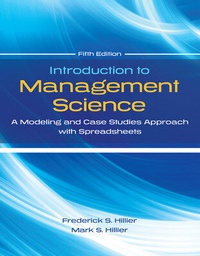
Introduction to Management Science with Student CD and Risk Solver Platform Access Card
A Modeling and Cases Studies Approach with Spreadsheets
5th Edition
Published on 16. April 2013
Book
978-0-07-782556-0 (ISBN)
Description
The fifth edition text focuses on business situations, including prominent non-mathematical issues, the use spreadsheets, and involves model formulation and assessment more than model structuring. The text has three key elements: modeling, case studies, and spreadsheets. In addition to examples, nearly every chapter includes one or two case studies patterned after actual applications to convey the whole process of applying management science.
More details
Edition
5th edition
Language
English
Place of publication
London
United States
Publishing group
McGraw-Hill Education - Europe
Target group
College/higher education
US School Grade: College Freshman
Dimensions
Height: 279 mm
Width: 221 mm
Thickness: 31 mm
Weight
1560 gr
ISBN-13
978-0-07-782556-0 (9780077825560)
Schweitzer Classification
Other editions
New editions
Frederick Hillier | Mark Hillier
ISE Introduction to Management Science: A Modeling and Case Studies Approach with Spreadsheets
A Modeling and Case Studies Approach with Spreadsheets
Book
01/2018
6th Edition
McGraw-Hill Education
€61.41
Article is exhausted; no reprint
Persons
Professor emeritus of operations research at Stanford University. Dr. Hillier is especially known for his classic, award-winning text, Introduction to Operations Research, co-authored with the late Gerald J. Lieberman, which has been translated into well over a dozen languages and is currently in its 8th edition. The 6th edition won honorable mention for the 1995 Lanchester Prize (best English-language publication of any kind in the field) and Dr. Hillier also was awarded the 2004 INFORMS Expository Writing Award for the 8th edition. His other books include The Evaluation of Risky Interrelated Investments, Queueing Tables and Graphs, Introduction to Stochastic Models in Operations Research, and Introduction to Mathematical Programming. He received his BS in industrial engineering and doctorate specializing in operations research and management science from Stanford University. The winner of many awards in high school and college for writing, mathematics, debate, and music, he ranked first in his undergraduate engineering class and was awarded three national fellowships (National Science Foundation, Tau Beta Pi, and Danforth) for graduate study. Dr. Hilliers research has extended into a variety of areas, including integer programming, queueing theory and its application, statistical quality control, and production and operations management. He also has won a major prize for research in capital budgeting.
Associate professor of quantitative methods at the School of Business at the University of Washington. Dr. Hillier received his BS in engineering (plus a concentration in computer science) from Swarthmore College, and he received his MS with distinction in operations research and PhD in industrial engineering and engineering management from Stanford University. As an undergraduate, he won the McCabe Award for ranking first in his engineering class, won election to Phi Beta Kappa based on his work in mathematics, set school records on the mens swim team, and was awarded two national fellowships (National Science Foundation and Tau Beta Pi) for graduate study. During that time, he also developed a comprehensive software tutorial package, OR Courseware, for the Hillier-Lieberman textbook, Introduction to Operations Research. As a graduate student, he taught a PhD-level seminar in operations management at Stanford and won a national prize for work based on his PhD dissertation. At the University of Washington, he currently teaches courses in management science and spreadsheet modeling.
Associate professor of quantitative methods at the School of Business at the University of Washington. Dr. Hillier received his BS in engineering (plus a concentration in computer science) from Swarthmore College, and he received his MS with distinction in operations research and PhD in industrial engineering and engineering management from Stanford University. As an undergraduate, he won the McCabe Award for ranking first in his engineering class, won election to Phi Beta Kappa based on his work in mathematics, set school records on the mens swim team, and was awarded two national fellowships (National Science Foundation and Tau Beta Pi) for graduate study. During that time, he also developed a comprehensive software tutorial package, OR Courseware, for the Hillier-Lieberman textbook, Introduction to Operations Research. As a graduate student, he taught a PhD-level seminar in operations management at Stanford and won a national prize for work based on his PhD dissertation. At the University of Washington, he currently teaches courses in management science and spreadsheet modeling.
Content
Chapter 1: IntroductionChapter 2: Linear Programming: Basic ConceptsChapter 3: Linear Programming: Formulation and ApplicationsChapter 4: The Art of Modeling with SpreadsheetsChapter 5: What-If Analysis for Linear ProgrammingChapter 6: Network Optimization ProblemsChapter 7: Using Binary Integer Programming to Deal with Yes-or-No DecisionsChapter 8: Nonlinear ProgrammingChapter 9: Decision AnalysisChapter 10: ForecastingChapter 11: Queuing ModelsChapter 12: Computer Simulation: Basic ConceptsChapter 13: Computer Simulation with Risk Solver PlatformAPPENDIXESAppendix A: Tips for Using Microsoft Excel for ModelingAppendix B: Partial Answers to Selected ProblemsINDEX