

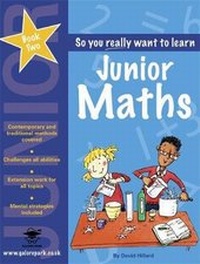
Junior Maths: Book 2
Published on 18. September 2008
Book
Paperback/Softback
320 pages
978-1-905735-23-5 (ISBN)
Description
Junior Maths Book 2 continues to stretch and challenge pupils with revision of basic numerical skills and the introduction of new material on topics such as negative numbers, decimals, inequalities and perimeter and area. - Covers the new numeracy framework to ensure pupils are learning the most up to date material - Combines the traditional standard method with the mental approach to challenge all abilities and satisfy all needs - Features end of chapter activities and summary exercises to engage pupils and consolidate information learned throughout each chapter - Includes a huge bank of practice material including problem solving exercises to ensure pupils have plenty of practice material Answer book available separately. See Junior Maths Book 2 Answer Book. Also available from Galore Park www.galorepark.co.uk: - Junior Maths Book 1 - Junior Maths Book 3 - 11+ Maths Practice Exercises - 11+ Maths Practice Exercises Answer Book - 11+ Maths Revision Guide
Reviews / Votes
"I think this book is simply wonderful! The publishers are to be congratulated on producing another book which will appeal to both pupil and teacher." David Hanson "Packed full of material to enthuse and stretch every pupil." Carolyn Hatt, Wellesley House SchoolMore details
Language
English
Place of publication
United Kingdom
Publishing group
Hachette Learning
Target group
Primary & secondary/elementary & high school
Dimensions
Height: 246 mm
Width: 191 mm
Thickness: 13 mm
Weight
702 gr
ISBN-13
978-1-905735-23-5 (9781905735235)
Copyright in bibliographic data and cover images is held by Nielsen Book Services Limited or by the publishers or by their respective licensors: all rights reserved.
Schweitzer Classification
Other editions
New editions
David Hillard | Serena Alexander
Mathematics Year 4
Book
11/2015
Galore Park Publishing Ltd
€46.00
Shipment within 10-20 days
Person
David Hillard has spent more than 45 years teaching mathematics in two preparatory schools. Since 1980 he has been associated with the Common Entrance examination at 11+, 12+ and 13+ levels in the role of either advisor, assessor or setter. He played a significant part in the revision of the syllabus in 2003 when the present format of the Common Entrance examination was introduced.
Content
Chapter 1: Place value Place value and larger numbers Ordering numbers End of chapter activity: Binary arithmetic Chapter 2: Counting Counting in tens Counting in hundreds Counting in thousands End of chapter activity: More binary arithmetic Chapter 3: Addition Formal addition Problem solving End of chapter activity: Magic squares Chapter 4: Subtraction Complementary addition Compensation subtraction Decomposition Formal subtraction Problem solving End of chapter activity: Magic squares revisited Chapter 5: Addition and subtraction Inverses Problem solving End of chapter activity: A magic number Chapter 6: Multiplication Multiples and tables Multiplying by 1000 Square numbers. Multiplying a 2-digit number by a 1-digit number. Multiplying a 3-digit number by a 1-digit number. Problem solving End of chapter activity: Another way to multiply Chapter 7: Division Dividing by 1000 Informal division The formal method of division Checking your answers Problem solving End of chapter activity: Yet another way to multiply Chapter 8: Functions Finding outputs Finding the input End of chapter activity: Missing digits (addition) Chapter 9: Inequalities End of chapter activity: Missing digits (subtraction) Chapter 10: Negative numbers Negative numbers in real-life contexts End of chapter activity: Missing digits (multiplication) Chapter 11: Sequences Writing a sequence given a rule End of chapter activity: Pascal's triangle Chapter 12: Money Problem solving End of chapter activity: Money round the world Chapter 13: Fractions Writing improper fractions as whole numbers or mixed numbers Fractions and division Writing mixed numbers as improper fractions Ordering fractions (1) Lowest common multiple Ordering fractions (2) End of chapter activity: Four and twenty Chapter 14: Introduction to decimals Place value and decimals Ordering decimals Writing decimals as fractions End of chapter activity: Dominoes Chapter 15: Decimal addition and subtraction Adding decimals Subtracting decimals End of chapter activity: Missing digits (division) Chapter 16: Scales, estimation and rounding Reading scales. Marking numbers on a scale. Rounding numbers End of chapter activity: Palindromes Chapter 17: Multiplication and division by 10, 100 and 1000 Multiplication by 10, 100 and 1000 Division by 10, 100 and 1000 End of chapter activity: Pigeon post Chapter 18: Metric measurement Length Mass Capacity End of chapter activity: Traffic control Chapter 19: Lines End of chapter activity: More lines Chapter 20: Position - Co-ordinates The grid Co-ordinates Plotting points Drawing shapes Drawing shapes with letters End of chapter activity: Making squares Chapter 21: Angles and direction Types of angle The protractor Measuring angles Drawing angles Angles and the hands of a clock Direction - the compass End of chapter activity: Clock shapes Chapter 22: 2D Shapes Circles and semicircles Triangles Quadrilaterals Polygons Regular figures Diagonals End of chapter activity: Diagonals Chapter 23: Symmetry and reflection Reflection End of chapter activity: Reflection by design Chapter 24: 3D shapes End of chapter activity: Monkey business Chapter 25: Perimeter and area Perimeter Area End of chapter activity: Same perimeter, different area Chapter 26: Mental strategies Teacher's introduction Addition Subtraction Addition and subtraction Multiplication Multiplication strategies Division