

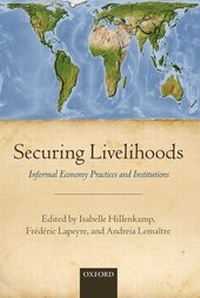
Securing Livelihoods
Informal Economy Practices and Institutions
Published on 7. November 2013
Book
Hardback
320 pages
978-0-19-968701-5 (ISBN)
Description
Far from the vision of popular actors in the popular economy as reactionary and archaic, stubbornly resisting any move towards change, this book's overall aim is to contribute to a broadening and deepening of our understanding of the logic and socio-economic practices of those operating in the informal economy. It focuses on the vulnerabilities of these participants, resulting from high exposure to different risks combined with low social protection, and on the interactions between vulnerability and poverty. It considers security of livelihoods as the guiding principle for multiple practices in the informal economy. Thirteen studies, based on careful analyses of empirical data in different contexts in Africa, Latin America, and Asia, contribute to this multidisciplinary discussion.
This book describes how people develop their own strategies to solve their problems through the use of interpersonal networks, associations, and other community-based arrangements. Moreover, it shows that informal economy actors systematically reposition themselves vis-a-vis the State, markets, international, and national policies with the aim of enhancing their economic and social security, and they may do this either individually or collectively. The book emphasizes how adaptability of the informal economy can be influenced by such factors as the macroeconomic context, access to financial, technological, and information resources, infrastructure, social protection schemes, and the institutional environment within which adaptations occur. Case studies stress the need to reformulate questions relating to policy intervention based on a more thorough understanding of the perspective of informal economy actors.
This book describes how people develop their own strategies to solve their problems through the use of interpersonal networks, associations, and other community-based arrangements. Moreover, it shows that informal economy actors systematically reposition themselves vis-a-vis the State, markets, international, and national policies with the aim of enhancing their economic and social security, and they may do this either individually or collectively. The book emphasizes how adaptability of the informal economy can be influenced by such factors as the macroeconomic context, access to financial, technological, and information resources, infrastructure, social protection schemes, and the institutional environment within which adaptations occur. Case studies stress the need to reformulate questions relating to policy intervention based on a more thorough understanding of the perspective of informal economy actors.
Reviews / Votes
The informal and popular economy has often been analysed as a form of barefoot capitalism. The analysis in this book is completely different. Using mainly a Polanyian framework, which recognizes a plurality of principles of economic integration, it presents a new picture of the popular economy and of the role of solidarity within that economy. This different perspective gives a new impulse to conceive of public policy not only in terms of social protection organized by the State, but also in terms of efforts to coordinate formal and informal institutions and practices aimed at enhancing security of livelihoods. * Jean-Louis Laville, the Karl Polanyi Institute of Political Economy * Global economic crisis is adding to the numbers and vulnerabilities of the billion or more people in all parts of the world finding employment and survival in the informal sector. This important collection of 13 case studies from Latin America, Africa, and Asia brings out the human positives as well as the negatives of this process. The book broadens and deepens our understanding of how the informal sector contributes to income, security, and survival, providing some new sources of hope but also new warnings for th se who would simply view these trends with complacency. * Richard Jolly, University of Sussex * The informal economy lies at the heart of the question of social security today. This is because the welfare state is being dismantled in the world's former leading economies and is being built by the BRICS. The issue of how to combine formal and informal institutions in more effective social protection programmes is urgent. This volume, bringing together an impressive range of new scholarship from several regions, breaks new ground in the on-going attempt to coordinate public provision with what people already do for themselves. * Keith Hart, University of Pretoria, South Africa * This book provides an intelligent and well-structured critical contribution to the knowledge of the popular economy. Inspired by Karl Polanyis hypothesis of the substantive economy, it demonstrates the heuristic value of Polanyis work. The studies, which have a strong empirical basis, focus on the informality, vulnerabilities, and finances of various forms of economic organization and their interaction with their socio-economic environments. The book also advances proposals for public intervention to support local development of the popular economy. This work marks a before and after methodology to investigate a key sector of the economy of peripheral countries.More details
Language
English
Place of publication
Oxford
United Kingdom
Target group
College/higher education
Illustrations
15 Figures, 35 Tables, 4 Boxes
Dimensions
Height: 240 mm
Width: 161 mm
Thickness: 23 mm
Weight
638 gr
ISBN-13
978-0-19-968701-5 (9780199687015)
Copyright in bibliographic data and cover images is held by Nielsen Book Services Limited or by the publishers or by their respective licensors: all rights reserved.
Schweitzer Classification
Other editions
Additional editions
Isabelle Hillenkamp | Frédéric Lapeyre | Andreia Lemaître
Securing Livelihoods
Informal Economy Practices and Institutions
E-Book
11/2013
1st Edition
OUP eBook
€105.99
Available for download
Persons
Isabelle Hillenkamp is Research Associate at the Institute of Socio-Economics, University of Geneva, attached to the Swiss National Centre of Competence in Research - LIVES. Her research focuses on the informal and popular economy in Latin America, with particular interest in community and solidarity projects. Before joining the University of Geneva, she was a post-doctoral researcher at the University San Andres of La Paz (Bolivia) and the National Conservatory of Arts and Crafts (CNAM) in Paris. She holds a PhD in Development Studies from the Graduate Institute of International and Development Studies, Geneva.
Frederic Lapeyre is senior employment and informal economy specialist and Manager of the ILO-Technical Cooperation Project for Youth Employment in Katanga (PAEJK), International Labour Organization. He holds a PhD in Development Studies. Previously he was Professor at the Catholic University of Louvain, Belgium, Chairman of the Belgium Post-Graduate School for Development Studies, and Fulbright Post-doctoral Fellow at Brown University (Watson Institute for International Studies). His recent publications include 'The Contributions of the United Nations to Development Theory and Practices' (with R. Jolly, L. Emmerij and D. Ghai) and 'Poverty and Exclusion in a Global World' (with A. Bhalla).
Andreia Lemaitre is socio-economist and Lecturer in Development Studies at the Catholic University of Louvain, Belgium. She is a member of the Centre for Development Studies (DVLP) and of the Interdisciplinary Research Centre on Work, State and Society (CIRTES). She holds a PhD in political and social sciences from the Catholic University of Louvain and the Conservatoire National des Arts et Metiers, France. She was also a post-doctoral Fellow at the International Institute of Social Studies (ISS) of Erasmus University Rotterdam in The Hague. Her research focuses on popular and solidarity-based economy in the South, mainly in Latin America, and on substantive approaches to the economy.
Frederic Lapeyre is senior employment and informal economy specialist and Manager of the ILO-Technical Cooperation Project for Youth Employment in Katanga (PAEJK), International Labour Organization. He holds a PhD in Development Studies. Previously he was Professor at the Catholic University of Louvain, Belgium, Chairman of the Belgium Post-Graduate School for Development Studies, and Fulbright Post-doctoral Fellow at Brown University (Watson Institute for International Studies). His recent publications include 'The Contributions of the United Nations to Development Theory and Practices' (with R. Jolly, L. Emmerij and D. Ghai) and 'Poverty and Exclusion in a Global World' (with A. Bhalla).
Andreia Lemaitre is socio-economist and Lecturer in Development Studies at the Catholic University of Louvain, Belgium. She is a member of the Centre for Development Studies (DVLP) and of the Interdisciplinary Research Centre on Work, State and Society (CIRTES). She holds a PhD in political and social sciences from the Catholic University of Louvain and the Conservatoire National des Arts et Metiers, France. She was also a post-doctoral Fellow at the International Institute of Social Studies (ISS) of Erasmus University Rotterdam in The Hague. Her research focuses on popular and solidarity-based economy in the South, mainly in Latin America, and on substantive approaches to the economy.
Editor
Research AssociateResearch Associate, Institute of Socio-Economics, University of Geneva
Senior Employment and Informal Economy SpecialistSenior Employment and Informal Economy Specialist, International Labour Organization
Lecturer in Development StudiesLecturer in Development Studies, Universite catholique de Louvain
Content
PART I. A PLURALITY OF SOCIO-ECONOMIC LOGICS: NEW POLANYIAN APPROACHES TO INFORMALITY AND VULNERABILITY; PART II. THE ROLE OF FINANCIAL PRACTICES AND INSTITUTIONS IN SECURING LIVELIHOODS; PART III. FORMALIZING THE INFORMAL? A CRITICAL ASSESSMENT