

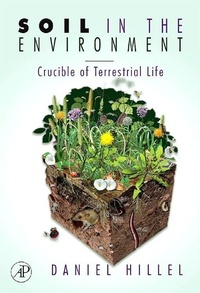
Soil in the Environment
Crucible of Terrestrial Life
Published on 20. December 2007
Book
Hardback
320 pages
978-0-12-348536-6 (ISBN)
Description
Soil in the Environment is key for every course in soil science, earth science, and environmental disciplines. This textbook engages students to critically look at soil as the central link in the function and creation of the terrestrial environment.
For the first time, Dr. Hillel brilliantly discusses soils as a natural body that is engaged in dynamic interaction with the atmosphere above and the strata below that influences the planet's climate and hydrological cycle, and serves as the primary habitat for a versatile community of living organisms.
The book offers a larger perspective of soil's impact on the environment by organizing chapters among three main processes: Physical, Chemical, and Biology. It is organized in a student-friendly format with examples, discussion boxes, and key definitions in every chapter.
The book provides students of geology, physical science, and environmental studies with fundamental information and tools for meeting the natural resource challenges of the 21st century, while providing students of soil science and ecology with the understanding of physical and biological interactions necessary for sustainability.
For the first time, Dr. Hillel brilliantly discusses soils as a natural body that is engaged in dynamic interaction with the atmosphere above and the strata below that influences the planet's climate and hydrological cycle, and serves as the primary habitat for a versatile community of living organisms.
The book offers a larger perspective of soil's impact on the environment by organizing chapters among three main processes: Physical, Chemical, and Biology. It is organized in a student-friendly format with examples, discussion boxes, and key definitions in every chapter.
The book provides students of geology, physical science, and environmental studies with fundamental information and tools for meeting the natural resource challenges of the 21st century, while providing students of soil science and ecology with the understanding of physical and biological interactions necessary for sustainability.
Reviews / Votes
"What a great textbook for students of the environmental sciences and a reference book for scientists seeking cutting-edge practical applications of theories. The author produced a very well written and organized book with historical and modern perspectives, matched with excellent graphics. WOW!" --Dr. Leticia S. Sonon, Soil, Plant, and Water Laboratory, University of Georgia, Athens, USA"As current university soil courses more and more blend agriculture and environmental issues this text will become a standard. The topics provide insightful coverage of soil in sustaining two basic human needs, a quality food supply and a livable environment, both needs on which future global dependency will rise, not diminish. This text is the right resource for the right time, it's perfect for the new type of introductory soil course appearing on college campuses." --Steve Thien, Kansas State University, USA
"Soil in the Environment is an excellent introductory text addressing the importance of soils in ecosystems and the environment. It would be an outstanding choice as the text for a university core science course introducing students to soil science. Core science courses are required for all non-science students at almost all major universities and colleges as part of a well-rounded university education.
The textbook could also serve as a very good textbook for an introductory soil science course for ecologists, landscape architects, and other students who need a good exposure to the fundamentals of soil science for their future careers, but who might be overwhelmed by a comprehensive soil science text. Students taking soils related courses at community colleges could also find this textbook potentially useful.
The textbook is written in Dr. Hillel's easy to understand style and he has made liberal use of high quality figures and tables. The ample use of color figures and diagrams is partcularly striking. The author has also included blue boxed text areas throughout the book that illustrate real world practical examples of the material being discussed in that chapter. The examples included in these blue boxed areas are critically important in making the subject being discussed pertinent to students and help retain their interest when reading. There is also a well conceived and thoughtful glossary included at the end of the textbook." --Dr. Robert L. Hill, Professor of Soil Physics, Soil & Water Management, Dep. of Environmental Science & Technology, University of Maryland College Park, USA
"I find this book full of fascination and passion for soil knowledge. Dr. Hillel vividly depicts the importance of soil and why we should care about it while he walks us through both a general and broad understanding of soil science. I consider it the perfect tool for captivating new generations of soil scientists whom, for sure, will readily become Homo sapiens curans after this reading. This book could be used as a core text in introductory courses for non soil science students and as an additional reading for soil science students." --Nadia Martinez-Villegas, Pennsylvania State University, University Park, USA
More details
Language
English
Place of publication
San Diego
United States
Publishing group
Elsevier Science Publishing Co Inc
Target group
College/higher education
Advanced undergraduate professors who teach courses in Soil Physics, Soil Geography, Soil Ecology, Soil Chemistry, Geophysics, Environmental Geography, Environmental Science, Earth Science,
Physical Geography
Product notice
sewn/stitched
Paper over boards
Illustrations
Illustrated
Dimensions
Height: 272 mm
Width: 193 mm
Thickness: 19 mm
Weight
920 gr
ISBN-13
978-0-12-348536-6 (9780123485366)
Copyright in bibliographic data and cover images is held by Nielsen Book Services Limited or by the publishers or by their respective licensors: all rights reserved.
Schweitzer Classification
Other editions
Additional editions
E-Book
12/2007
Academic Press
€47.99
Available for download
Person
Born in California and raised in Israel, Dr. Daniel Hillel acquired an early and lifelong love of the land and a commitment to understanding and protecting the natural environment. Through decades of work in some thirty countries, he has become an international authority on sustainable management of land and water resources. Dr. Hillel has served as professor of soil physics, hydrology and the environmental sciences at leading universities in the U.S. and abroad, and has been a consultant to the World Bank and the United Nations. Among the honors he has received are the Chancellor's Medal for Exemplary Service at the University of Massachusetts , a Guggenheim award, and Doctorates of Science honoris causa by Guelph University of Canada and Ohio State University . Dr. Hillel is an elected Fellow of the American Association for Advancement of Science, the American Geophysical Union, the Soil Science Society of America, and the American Society of Agronomy and was granted the Distinguished Service Award by the latter societies. He has published well over 300 scientific papers and research reports, and authored or edited twenty two books. His definitive textbooks on environmental physics have been use by universities and research institutions throughout the world and have been translated into twelve languages.
Content
1. Soil as a Living Body: Its Dynamic Role in the Environment
2. Soil Formation
Weathering, Soil-Forming Factors, Soil Profile, Pedogenesis
3. Soil Classification
Attributes and Criteria, Orders and Global Distribution
4. Soil Physical Attributes
Texture, Specific Surface, Clay, Ion Exchange, Soil Structure, Soil Air
5. Soil-Water Statics
Water Content, Energy Potential, Matric and Osmotic Effects
6. Soil-Water Dynamics
Water Flow in Saturated and Unsaturated Soils, Solute Transport
7. Soil-Water Cycle
Infiltration, Runoff, Redistribution, Drainage, Evapotranspiration, SPAC
8. Soil-Water and Soil-Energy Balances in the Field
Water and Energy Budgets, Atmospheric Greenhouse Effect
9. Soil Chemical Attributes and Processes
Organic Matter, Acidity, Oxidation-Reduction, Salinity, Sodicity
10. Soil Fertility and Plant Nutrition
Essential Macro and Micro Nutrients, Fertilizers, Soil Amendments
11. Soil Biodiversity
Forms and Functions of the Soil Community, Sustaining Biodiversity
12. Soil and Water Management
Origin of Agriculture, Tillage, Irrigation, Water-Use Efficiency
13. Soil Erosion and Conservation
Water Erosion, Wind Erosion, Desertification, Soil Conservation
14. Soil Pollution and Remediation
Waste Disposal on Land, Inorganic and Organic Pollutants, Soil Remediation
15. Current Perspectives, Future Prospects
The Population-Food Dilemma, Water Resources, Climate Change
2. Soil Formation
Weathering, Soil-Forming Factors, Soil Profile, Pedogenesis
3. Soil Classification
Attributes and Criteria, Orders and Global Distribution
4. Soil Physical Attributes
Texture, Specific Surface, Clay, Ion Exchange, Soil Structure, Soil Air
5. Soil-Water Statics
Water Content, Energy Potential, Matric and Osmotic Effects
6. Soil-Water Dynamics
Water Flow in Saturated and Unsaturated Soils, Solute Transport
7. Soil-Water Cycle
Infiltration, Runoff, Redistribution, Drainage, Evapotranspiration, SPAC
8. Soil-Water and Soil-Energy Balances in the Field
Water and Energy Budgets, Atmospheric Greenhouse Effect
9. Soil Chemical Attributes and Processes
Organic Matter, Acidity, Oxidation-Reduction, Salinity, Sodicity
10. Soil Fertility and Plant Nutrition
Essential Macro and Micro Nutrients, Fertilizers, Soil Amendments
11. Soil Biodiversity
Forms and Functions of the Soil Community, Sustaining Biodiversity
12. Soil and Water Management
Origin of Agriculture, Tillage, Irrigation, Water-Use Efficiency
13. Soil Erosion and Conservation
Water Erosion, Wind Erosion, Desertification, Soil Conservation
14. Soil Pollution and Remediation
Waste Disposal on Land, Inorganic and Organic Pollutants, Soil Remediation
15. Current Perspectives, Future Prospects
The Population-Food Dilemma, Water Resources, Climate Change