

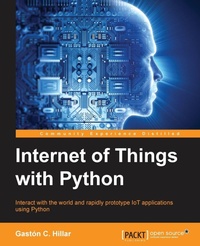
Internet of Things with Python
Create exciting IoT solutions
Published on 20. May 2016
Book
Paperback/Softback
388 pages
978-1-78588-138-1 (ISBN)
Description
Interact with the world and rapidly prototype IoT applications using Python
Key Features
[*] Rapidly prototype even complex IoT applications with Python and put them to practical use
[*] Enhance your IoT skills with the most up-to-date applicability in the field of wearable tech, smart environments, and home automation
[*] Interact with hardware, sensors, and actuators and control your DIY IoT projects through Python
Book DescriptionInternet of Things (IoT) is revolutionizing the way devices/things interact with each other. And when you have IoT with Python on your side, you'll be able to build interactive objects and design them.
This book lets you stay at the forefront of cutting-edge research on IoT. We'll open up the possibilities using tools that enable you to interact with the world, such as Intel Galileo Gen 2, sensors, and other hardware. You will learn how to read, write, and convert digital values to generate analog output by programming Pulse Width Modulation (PWM) in Python. You will get familiar with the complex communication system included in the board, so you can interact with any shield, actuator, or sensor.
Later on, you will not only see how to work with data received from the sensors, but also perform actions by sending them to a specific shield. You'll be able to connect your IoT device to the entire world, by integrating WiFi, Bluetooth, and Internet settings. With everything ready, you will see how to work in real time on your IoT device using the MQTT protocol in python.
By the end of the book, you will be able to develop IoT prototypes with Python, libraries, and tools.
What you will learn
[*] Prototype and develop IoT solutions from scratch with Python as the programming language
[*] Develop IoT projects with Intel Galileo Gen 2 board along with Python
[*] Work with the different components included in the boards using Python and the MRAA library
[*] Interact with sensors, actuators, and shields
[*] Work with UART and local storage
[*] Interact with any electronic device that supports the I2C bus
[*] Allow mobile devices to interact with the board
[*] Work with real-time IoT and cloud services
[*] Understand Big Data and IoT analytics
Who this book is forThe book is ideal for Python developers who want to explore the tools in the Python ecosystem in order to build their own IoT applications and work on IoT-related projects. It is also a very useful resource for developers with experience in other programming languages that want to easily prototype IoT applications with the Intel Galileo Gen 2 board.
Key Features
[*] Rapidly prototype even complex IoT applications with Python and put them to practical use
[*] Enhance your IoT skills with the most up-to-date applicability in the field of wearable tech, smart environments, and home automation
[*] Interact with hardware, sensors, and actuators and control your DIY IoT projects through Python
Book DescriptionInternet of Things (IoT) is revolutionizing the way devices/things interact with each other. And when you have IoT with Python on your side, you'll be able to build interactive objects and design them.
This book lets you stay at the forefront of cutting-edge research on IoT. We'll open up the possibilities using tools that enable you to interact with the world, such as Intel Galileo Gen 2, sensors, and other hardware. You will learn how to read, write, and convert digital values to generate analog output by programming Pulse Width Modulation (PWM) in Python. You will get familiar with the complex communication system included in the board, so you can interact with any shield, actuator, or sensor.
Later on, you will not only see how to work with data received from the sensors, but also perform actions by sending them to a specific shield. You'll be able to connect your IoT device to the entire world, by integrating WiFi, Bluetooth, and Internet settings. With everything ready, you will see how to work in real time on your IoT device using the MQTT protocol in python.
By the end of the book, you will be able to develop IoT prototypes with Python, libraries, and tools.
What you will learn
[*] Prototype and develop IoT solutions from scratch with Python as the programming language
[*] Develop IoT projects with Intel Galileo Gen 2 board along with Python
[*] Work with the different components included in the boards using Python and the MRAA library
[*] Interact with sensors, actuators, and shields
[*] Work with UART and local storage
[*] Interact with any electronic device that supports the I2C bus
[*] Allow mobile devices to interact with the board
[*] Work with real-time IoT and cloud services
[*] Understand Big Data and IoT analytics
Who this book is forThe book is ideal for Python developers who want to explore the tools in the Python ecosystem in order to build their own IoT applications and work on IoT-related projects. It is also a very useful resource for developers with experience in other programming languages that want to easily prototype IoT applications with the Intel Galileo Gen 2 board.
More details
Language
English
Place of publication
Birmingham
United Kingdom
Target group
Professional and scholarly
US School Grade: College Graduate Student
Dimensions
Height: 235 mm
Width: 191 mm
Thickness: 21 mm
Weight
723 gr
ISBN-13
978-1-78588-138-1 (9781785881381)
Copyright in bibliographic data and cover images is held by Nielsen Book Services Limited or by the publishers or by their respective licensors: all rights reserved.
Schweitzer Classification
Other editions
Additional editions
E-Book
07/2025
Packt Publishing
from
€43.19
Available for download
Person
Gaston C. Hillar is Italian and has been working with computers since he was 8 years old. Gaston has a Bachelor's degree in computer science (graduated with honors) and an MBA. Currently, Gaston is an independent IT consultant and a freelance author who is always looking for new adventures anywhere in the world. He was a senior contributing editor at Dr. Dobb's, and has written more than a hundred articles on software development topics. He has received the prestigious Intel Black Belt Software Developer award eight times. He has written many articles about Java for Oracle Java Magazine. Gaston was also a former Microsoft MVP in technical computing. He lives with his wife, Vanesa, and his two sons, Kevin and Brandon.
Content
Table of Contents
Understanding and setting up the base IoT hardware
Working with Python on Intel Galileo Gen 2
Interacting with digital outputs with Python
Working with local storage and databases
Working with Digital Inputs, Polling and Interrupts
Retrieving data from the real world with sensors
Performing actions with actuators and shields
Connecting the IoT device to the entire world
Working with real-time actions and cloud services
Analyzing huge amounts of data
Understanding and setting up the base IoT hardware
Working with Python on Intel Galileo Gen 2
Interacting with digital outputs with Python
Working with local storage and databases
Working with Digital Inputs, Polling and Interrupts
Retrieving data from the real world with sensors
Performing actions with actuators and shields
Connecting the IoT device to the entire world
Working with real-time actions and cloud services
Analyzing huge amounts of data