

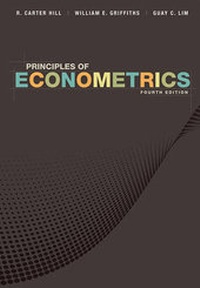
Principles of Econometrics
4th Edition
Published on 4. January 2011
Book
Hardback
784 pages
978-0-470-62673-3 (ISBN)
Description
Principles of Econometrics is an introductory book for undergraduate students in economics and finance, and can be used for MBA and first-year graduate students in many fields. The 4th Edition provides students with an understanding of why econometrics is necessary and a working knowledge of basic econometric tools. This text emphasizes motivation, understanding and implementation by introducing very simple economic models and asking economic questions that students can answer.
More details
Edition
4th edition
Language
English
Place of publication
New York
United States
Target group
College/higher education
Dimensions
Height: 252 mm
Width: 187 mm
Thickness: 32 mm
Weight
1300 gr
ISBN-13
978-0-470-62673-3 (9780470626733)
Copyright in bibliographic data and cover images is held by Nielsen Book Services Limited or by the publishers or by their respective licensors: all rights reserved.
Schweitzer Classification
Other editions
New editions
R. Carter Hill | William E. Griffiths | Guay C. Lim
Principles of Econometrics
Book
09/2024
5th Edition
Wiley
€199.00
Article not available at the moment
Previous edition
R. Carter Hill | William E. Griffiths | Mark Andrew Lim
Principles of Econometrics
Book
11/2007
3rd Edition
Wiley
€65.90
Article exhausted; check for reprint
Person
R. Carter Hill is the author of Principles of Econometrics, 4th Edition, published by Wiley.
Content
Preface. Chapter 1 An Introduction to Econometrics.
1.1 Why Study Econometrics?
1.2 What Is Econometrics About?
1.3 The Econometric Model.
1.4 How Are Data Generated?
1.5 Economic Data Types.
1.6 The Research Process.
1.7 Writing An Empirical Research Paper.
1.8 Sources of Economic Data.
Probability Primer.
P.1 Random Variables.
P.2 Probability Distributions.
P.3 Joint, Marginal, and Conditional Probabilities.
P.4 A Digression: Summation Notation.
P.5 Properties of Probability Distributions.
P.6 The Normal Distribution.
P.7 Exercises.
Chapter 2 The Simple Linear Regression Model.
2.1 An Economic Model.
2.2 An Econometric Model.
2.3 Estimating the Regression Parameters.
2.4 Assessing the Least Squares Estimators.
2.5 The Gauss-Markov Theorem.
2.6 The Probability Distributions of the Least Squares Estimators.
2.7 Estimating the Variance of the Error Term.
2.8 Estimating Nonlinear Relationships.
2.9 Regression with Indicator Variables.
2.10 Exercises.
Chapter 3 Interval Estimation and Hypothesis Testing.
3.1 Interval Estimation.
3.2 Hypothesis Tests.
3.3 Rejection Regions for Specific Alternatives.
3.4 Examples of Hypothesis Tests.
3.5 The p-Value.
3.6 Linear Combinations of Parameters.
3.7 Exercises.
Chapter 4 Prediction, Goodness-of-Fit, and Modeling Issues.
4.1 Least Squares Prediction.
4.2 Measuring Goodness-of-Fit.
4.3 Modeling Issues.
4.4 Modeling Issues.
4.4 Polynomial Models.
4.5 Log-Linear Models.
4.6 Log-Log Models.
4.7 Exercises.
Chapter 5 The Multiple Regression Model.
5.1 Introduction.
5.2 Estimating the Parameters of the Multiple Regression Model.
5.3 Sampling Properties of the Least Squares Estimator.
5.4 Interval Estimation.
5.5 Hypothesis Testing.
5.6 Polynomial Equations.
5.7 Interaction Variables.
5.8 Measuring Goodness-of-Fit.
5.9 Exercises.
Chapter 6 Further Inference in the Multiple Regression Model.
6.1 Testing Joint Hypotheses.
6.2 The Use of Nonsample Information.
6.3 Model Specification.
6.4 Poor Data, Collinearity, and Insignificance.
6.5 Prediction.
6.6 Exercises.
Chapter 7 Using Indicator Variables.
7.1 Indicator Variables.
7.2 Applying Indicator Variables.
7.3 Log-Linear Models.
7.4 The Linear Probability Model.
7.5 Treatment Effects.
7.6 Exercises.
Chapter 8 Heteroskedasticity.
8.1 The Nature of Heteroskedasticity.
8.2 Detecting Heteroskedasticity.
8.3 Heteroskedasticity-Consistent Standard Errors.
8.4 Generalized Least Squares: Known Form of Variance.
8.5 Generalized Least Squares: Unknown Form of Variance.
8.6 Heteroskedasticity in the Linear Probability Model.
8.7 Exercises.
Chapter 9 Regression with Time-Series Data: Stationary Variables.
9.1 Introduction.
9.2 Finite Distributed Lags.
9.3 Serial Correlation.
9.4 Other Tests for Serially Correlated Errors.
9.5 Estimation with Serially Correlated Errors.
9.6 Autoregressive Distributed Lag Models.
9.7 Forecasting.
9.8 Multiplier Analysis.
9.9 Exercises.
Chapter 10 Random Regressors and Moment-Based Estimation.
10.1 Linear Regression with Random x's.
10.2 Cases in which x and e Are Correlated.
10.3 Estimators Based on the Method of Moments.
10.4 Specification Tests.
10.5 Exercises.
Chapter 11 Simultaneous Equations Models.
11.1 A Supply and Demand Model.
11.2 The Reduced-Form Equations.
11.3 The Failure of Least Squares Estimation,
11.4 The Identification Problem.
11.5 Two-Stage Least Squares Estimation.
11.6 An Example of Two-Stage Least Squares Estimation.
11.7 Supply and Demand at the Fulton Fish Demand.
11.8 Exercises.
Chapter 12 Regression with Time-Series Data: Nonstationary Variables.
12.1 Stationary and Nonstationary Variables.
12.2 Spurious Regressions.
12.3 Unit Root Tests for Stationarity.
12.4 Cointegration.
12.5 Regression When There Is No Cointegration.
12.6 Exercises.
Chapter 13 Vector Error Correction and Vector Autoregressive Models.
13.1 VEC and VAR Models.
13.2 Estimating a Vector Error Correction Model.
13.3 Estimating a VAR Model.
13.4 Impulse Responses and Variance Decompositions.
13.5 Exercises.
Chapter 14 Time-Varying Volatility and ARCH Models.
14.1 The ARCH Model.
14.2 Time-Varying Volatility.
14.3 Testing. Estimating, and Forecasting.
14.4 Extensions.
14.5 Exercises.
Chapter 15 Panel Data Models.
15.1 A Microeconomic Panel.
15.2 Pooled Model.
15.3 The Fixed Effects Model.
15.4 The Random Effects Model.
15.5 Comparing Fixed and Random Effects Estimators.
15.6 The Hausman-Taylor Estimator.
15.7 Sets of Regression Equations.
15.8 Exercises.
Chapter 16 Qualitative and Limited Dependent Variable Models.
16.1 Models with Binary Dependent Variables.
16.2 The Logit Model for Binary Choice.
16.3 Multinomial Logit.
16.4 Conditional Logit.
16.5 Ordered Choice Models.
16.6 Models for Count Data.
16.7 Limited Dependent Variable Models.
16.8 Exercises.
Appendix A Mathematical Tools.
Appendix B Probability Concepts.
Appendix C Review of Statistical Inference.
Appendix D.
Index.
1.1 Why Study Econometrics?
1.2 What Is Econometrics About?
1.3 The Econometric Model.
1.4 How Are Data Generated?
1.5 Economic Data Types.
1.6 The Research Process.
1.7 Writing An Empirical Research Paper.
1.8 Sources of Economic Data.
Probability Primer.
P.1 Random Variables.
P.2 Probability Distributions.
P.3 Joint, Marginal, and Conditional Probabilities.
P.4 A Digression: Summation Notation.
P.5 Properties of Probability Distributions.
P.6 The Normal Distribution.
P.7 Exercises.
Chapter 2 The Simple Linear Regression Model.
2.1 An Economic Model.
2.2 An Econometric Model.
2.3 Estimating the Regression Parameters.
2.4 Assessing the Least Squares Estimators.
2.5 The Gauss-Markov Theorem.
2.6 The Probability Distributions of the Least Squares Estimators.
2.7 Estimating the Variance of the Error Term.
2.8 Estimating Nonlinear Relationships.
2.9 Regression with Indicator Variables.
2.10 Exercises.
Chapter 3 Interval Estimation and Hypothesis Testing.
3.1 Interval Estimation.
3.2 Hypothesis Tests.
3.3 Rejection Regions for Specific Alternatives.
3.4 Examples of Hypothesis Tests.
3.5 The p-Value.
3.6 Linear Combinations of Parameters.
3.7 Exercises.
Chapter 4 Prediction, Goodness-of-Fit, and Modeling Issues.
4.1 Least Squares Prediction.
4.2 Measuring Goodness-of-Fit.
4.3 Modeling Issues.
4.4 Modeling Issues.
4.4 Polynomial Models.
4.5 Log-Linear Models.
4.6 Log-Log Models.
4.7 Exercises.
Chapter 5 The Multiple Regression Model.
5.1 Introduction.
5.2 Estimating the Parameters of the Multiple Regression Model.
5.3 Sampling Properties of the Least Squares Estimator.
5.4 Interval Estimation.
5.5 Hypothesis Testing.
5.6 Polynomial Equations.
5.7 Interaction Variables.
5.8 Measuring Goodness-of-Fit.
5.9 Exercises.
Chapter 6 Further Inference in the Multiple Regression Model.
6.1 Testing Joint Hypotheses.
6.2 The Use of Nonsample Information.
6.3 Model Specification.
6.4 Poor Data, Collinearity, and Insignificance.
6.5 Prediction.
6.6 Exercises.
Chapter 7 Using Indicator Variables.
7.1 Indicator Variables.
7.2 Applying Indicator Variables.
7.3 Log-Linear Models.
7.4 The Linear Probability Model.
7.5 Treatment Effects.
7.6 Exercises.
Chapter 8 Heteroskedasticity.
8.1 The Nature of Heteroskedasticity.
8.2 Detecting Heteroskedasticity.
8.3 Heteroskedasticity-Consistent Standard Errors.
8.4 Generalized Least Squares: Known Form of Variance.
8.5 Generalized Least Squares: Unknown Form of Variance.
8.6 Heteroskedasticity in the Linear Probability Model.
8.7 Exercises.
Chapter 9 Regression with Time-Series Data: Stationary Variables.
9.1 Introduction.
9.2 Finite Distributed Lags.
9.3 Serial Correlation.
9.4 Other Tests for Serially Correlated Errors.
9.5 Estimation with Serially Correlated Errors.
9.6 Autoregressive Distributed Lag Models.
9.7 Forecasting.
9.8 Multiplier Analysis.
9.9 Exercises.
Chapter 10 Random Regressors and Moment-Based Estimation.
10.1 Linear Regression with Random x's.
10.2 Cases in which x and e Are Correlated.
10.3 Estimators Based on the Method of Moments.
10.4 Specification Tests.
10.5 Exercises.
Chapter 11 Simultaneous Equations Models.
11.1 A Supply and Demand Model.
11.2 The Reduced-Form Equations.
11.3 The Failure of Least Squares Estimation,
11.4 The Identification Problem.
11.5 Two-Stage Least Squares Estimation.
11.6 An Example of Two-Stage Least Squares Estimation.
11.7 Supply and Demand at the Fulton Fish Demand.
11.8 Exercises.
Chapter 12 Regression with Time-Series Data: Nonstationary Variables.
12.1 Stationary and Nonstationary Variables.
12.2 Spurious Regressions.
12.3 Unit Root Tests for Stationarity.
12.4 Cointegration.
12.5 Regression When There Is No Cointegration.
12.6 Exercises.
Chapter 13 Vector Error Correction and Vector Autoregressive Models.
13.1 VEC and VAR Models.
13.2 Estimating a Vector Error Correction Model.
13.3 Estimating a VAR Model.
13.4 Impulse Responses and Variance Decompositions.
13.5 Exercises.
Chapter 14 Time-Varying Volatility and ARCH Models.
14.1 The ARCH Model.
14.2 Time-Varying Volatility.
14.3 Testing. Estimating, and Forecasting.
14.4 Extensions.
14.5 Exercises.
Chapter 15 Panel Data Models.
15.1 A Microeconomic Panel.
15.2 Pooled Model.
15.3 The Fixed Effects Model.
15.4 The Random Effects Model.
15.5 Comparing Fixed and Random Effects Estimators.
15.6 The Hausman-Taylor Estimator.
15.7 Sets of Regression Equations.
15.8 Exercises.
Chapter 16 Qualitative and Limited Dependent Variable Models.
16.1 Models with Binary Dependent Variables.
16.2 The Logit Model for Binary Choice.
16.3 Multinomial Logit.
16.4 Conditional Logit.
16.5 Ordered Choice Models.
16.6 Models for Count Data.
16.7 Limited Dependent Variable Models.
16.8 Exercises.
Appendix A Mathematical Tools.
Appendix B Probability Concepts.
Appendix C Review of Statistical Inference.
Appendix D.
Index.